

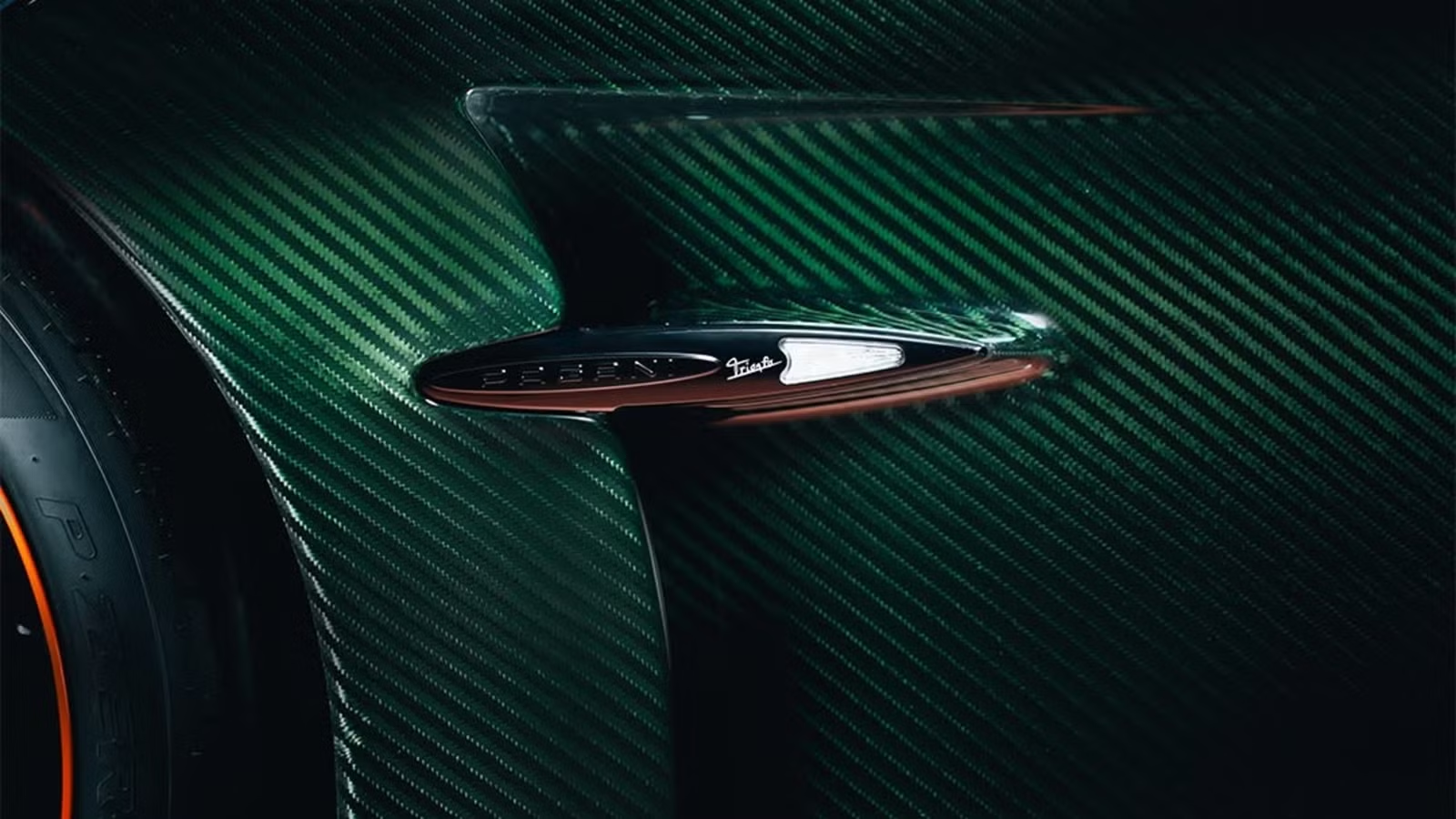
There’s plenty to love about the Pagani Huayra Roadster BC. Enthusiasts rave about features like its jewel-like interiors, exposed gear linkages, dramatic quad exhausts, and powerful V12 engines. But while those are some of the more obvious draws of this hypercar, the real story lies much deeper within its actual structure.
Here, Pagani employs a unique carbon/titanium composite architecture that gives this vehicle a distinct material identity. It’s a very unusual process that enables the manufacturer to make such boutique materials work at hypercar scale. And such complexity may explain why other builders like Koenigsegg and Bugatti decided to take a very different approach to their craft.
The Hypercar Material War Moved Under The Skin
2020 Pagani Huayra Roadster BC from abovePagani
2020 Pagani Huayra Roadster BC Specifications
Engine
6.0-liter Pagani/Mercedes-AMG 60-degree twin-turbo V12
Transmission
Xtrac 7-speed transverse AMT
Drivetrain
Rear-wheel drive
Power
791 hp
Torque
774 lb-ft
As a manufacturer, if you’re going to chase some ridiculous horsepower numbers, you’d better make sure the structure of the vehicle beneath is as solid as possible. After all, while well-heeled buyers may be attracted to the idea of a 1,800-hp car, they’d also want to know that the vehicle can deal with huge energy transfers, carry suspension loads, and protect occupants should everything go wrong.
Hypercar manufacturers quickly discovered that carbon fiber was an obvious answer. This material offered an exceptional stiffness-to-weight ratio compared to traditional metal structures, and a carbon monocoque became a common starting point for constructing a world-class performance machine.
While builders determined that carbon fiber was the best approach, different manufacturers still developed their own interpretations of the idea. For example, Bugatti leaned into immense strength and stability at extreme speed, with repeatable precision. Koenigsegg went on to develop a highly rigid carbon tub with an aluminum honeycomb construction and integrated fuel tanks.
However, Pagani took the most interesting approach of all, following a highly artisanal, materials-led route. The founder of the company, Horacio Pagani, had a background in composites, which gave the organization an extra advantage. Pagani was able to develop the chassis into a defining object in its own right, rather than just a container for performance. And with this type of commitment to an exotic craft, carbo-titanium came into the picture.
Carbo-Titanium Is Pagani’s Real Engineering Signature
2020 Pagani Huayra Roadster BC from rearPagani
For the Huayra and other special models, Pagani decided to use innovative carbo-titanium, featuring carbon fiber woven into titanium fabric, resulting in a far stronger material than carbon alone. It had already used this approach on its track-based Zonda R before deciding to introduce it to the type-approved Huayra road car.
The Huayra Roadster BC featured a Pagani carbo-titanium HP62 G2 and carbo-triax HP62 monocoque with front and rear tubular steel subframes. The Roadster BC derived its power from a twin-turbo Mercedes-AMG V12 that produced 791 hp and 774 lb-ft of torque, and boasted a dry weight of only 2,756 pounds.
Pagani patented its specific carbo-titanium and carbo-triax formulas, including the naming, layup knowledge, and production know-how. Certainly, the broad idea of bonding or combining titanium and carbon composites had been around for some time before Pagani went down this road. Still, the company was clearly very focused on protecting its hypercar advantage. The automaker felt that it had the manufacturing discipline, internal knowledge, and, crucially, the recipe to build cars around a very unusual and demanding composite strategy.
The Weaving Secret Involves A System Of Materials, Layers, And Labor
2020 Pagani Huayra Roadster BC at the factoryPagani
Based on publicly available information, Pagani uses a hybrid fabric architecture that integrates titanium into a carbon composite. This improves characteristics such as energy absorption and resistance to splinter propagation. Engineers weave the titanium alloy into carbon fabric, although Pagani closely guards the precise details, including the resin system, stacking sequence, fiber orientation, and cure cycle.
It’s important to understand that a modern hypercar monocoque isn’t simply resin poured over a piece of cloth. Instead, it’s an engineered laminate composed of many sections, each contributing differently to the overall objective. Some areas require torsional stiffness, while others need heat tolerance, crash adaptability, or controlled deformation. Apparently, each Pagani chassis has 240 carbon-based components, using different composites depending on the required stiffness and strength.
To make this complicated construction process work, Pagani developed an Italian ecosystem. It started with Pagani Composite Research, which later became Modena Design. Angeloni Group also came into the picture with some of its core activities, including weaving multiaxial fabrics and pre-preg high-tech fibers. At the same time, Dianese helped develop technical fabrics and structural elements for the roof systems.
Koenigsegg And Bugatti Proved There’s More Than One Correct Answer
Koenigsegg Jesko AttackKoenigsegg
While Pagani was taking its own very specific approach, other hypercar manufacturers weren’t entirely sitting still. Koenigsegg has its own advanced composite philosophy, with its Jesko Attack featuring a carbon-fiber monocoque with an aluminum honeycomb core and torsional rigidity of 47,900 lb-ft/deg. The body also used pre-impregnated carbon fiber, Kevlar, and lightweight sandwich reinforcements. And while Koenigsegg wanted to build an extremely rigid, light, and safe cell for this wildly powerful car, it just took a different approach. The company focused on low-mass packaging, serviceability, and in-house solutions like the Light Speed Transmission and advanced carbon wheel technology instead.
Bugatti also decided to take a different approach, engineering its carbon-fiber monocoque for the Chiron around massive power, stability, precise weight, and high-speed capability. The company used 3,440 square feet of carbon fiber to develop the Chiron’s monocoque and talks about a torsional rigidity of 36,900 lb-ft/degree. When it came to the newer Tourbillon, Bugatti stepped up to the next-generation T800 carbon composite structure, which now integrates the battery as a structural part of the monocoque.
Bugatti didn’t need to lean on a boutique Italian hybrid weave, and Koenigsegg didn’t need Bugatti’s material identity to achieve its own targets. But both manufacturers understood that if they were to try to copy Pagani, it would bring manufacturing complications, increased sourcing complexity, additional costs, and detailed certification work.
The Performance Payoff Is As Much About Feel As The Spec Sheet
2017 Pagani Huayra Roadster Exterior Finished In Exposed Blue Carbon FiberPagani
Pagani’s carbo-titanium monocoque approach gives a vehicle like its Utopia Roadster an exceptional ratio of lightness to structural rigidity. With a stiffer and lighter structure, engineers have been able to tweak the suspension so that the car responds faithfully to steering, braking, and load transfer.
Related
Pagani’s Latest Hypercar Has More Exhausts Than Most Cars Have Cylinders
The Huayra Codalunga Speedster is stunning to behold, and it has a manual transmission.
In the Huayra Roadster, Pagani had to focus even more on reinforcement because convertibles typically need extra work to compensate for the missing roof. By using formulas like carbo-triax HP52 with carbo-titanium, Pagani achieved a 176-pound reduction compared to the previous 2017 coupe, but crucially, a 52% increase in rigidity. Pagani can make the best use of these materials wherever they fit into a broader engineering goal of stiffness, safety, low mass, and tactile response. And this may be why a Pagani feels like a machine built properly from the inside out.
Why Pagani Is Not About To Share The Recipe
Pagani UtopiaPagani
Pagani obviously feels it has a very special and productive approach with its carbo-titanium build, and there’s clearly no reason it should describe this process to the rest of the industry. After all, the company is in the business of selling rarity, craft, engineering, personality, and exclusivity, while also recognizing that its rivals have their own successful approaches. The likes of Ferrari, Lamborghini, Bugatti, and Koenigsegg all have access to world-class composites, and some of them collaborate with major suppliers. A few have substantial capabilities in-house and are perfectly capable of crafting hybrid material solutions of their own.
Related
Only Two Cars Were Made Using White Carbon Fiber
The Koenigsegg CCXR Trevita was the only car made using white carbon fiber, through the Swedish automaker’s Diamond Weave process.
Meanwhile, Pagani has spent years making its particular carbo-titanium language unique and central to its cars. The company also knows that other manufacturers don’t have the very specific supplier relationships, layup knowledge, tooling discipline, and design philosophies to mimic the same approach.
And so Pagani’s carbo-titanium story sits at the intersection of engineering and identity. It doesn’t suggest that Pagani has been any more successful than Koenigsegg or Bugatti at building a hypercar. But it does show how one small manufacturer can craft a defensible niche by mastering one particular area. In effect, Pagani has used carbo-titanium to make the chassis a part of the art. And while it’s possible to understand the concept, it’s not so easy for those others to simply duplicate the result.
Sources: Pagani, Koenigsegg, Bugatti, Composites Portal.
