

Ford’s quality team must be working overtime, because in addition to the dozens of voluntary repair orders the automaker has already released this year, it is also asking owners of certain F-150 models to return to their dealers for a recall of a recall – somebody call Christopher Nolan. It seems as though some 2014 examples previously recalled for unexpected downshifting may not have had their powertrain computers reprogrammed correctly to solve the issue, a problem shared with certain 2018 trucks that previously needed a software update to prevent the transmission from incorrectly reading the position of the column-mounted shift lever.
Base Trim Engine
3.7L V6 Gas
Base Trim Transmission
6-Speed Automatic
Base Trim Drivetrain
Rear-Wheel Drive
Base Trim Horsepower
302 hp
Base Trim Torque
278 lb-ft @ 4000 rpm
Fuel Economy
17/23 MPG
Segment
Full-Size Pickup Truck
Computer Programming Issues Rear Their Head (Again)
The first recall, pertaining to 2018 F-150s equipped with the 3.3-liter V6, six-speed automatic gearbox, and column-mounted shift lever, will rectify a fix previously announced all the way back in 2017 – before many of the affected trucks were even sold. At the time, Ford realized that if a driver were to move the shift lever from park to drive in less than 30 milliseconds, the powertrain control module (PCM) might not accurately register the shift and instead engage reverse. Within one second, the computer would rectify the problem and move to drive, but that momentary mis-shift had the potential for unintended vehicle movement.
2018 Ford F-150 front 3/4Ford
Recently, Ford realized that some 2018s may not have actually had the correct PCM reprogramming installed, despite being marked complete on the recall list. As a result, Ford wants to arrange for customer vehicles to return to the dealer for the correct software to be installed. The automaker anticipates that 10,742 trucks are involved in the recall.
Yet Another PCM Issue
Incidentally, computer reprogramming is the solution for the other recall announced June 9. In 2024, Ford announced a campaign for any 2014 F-150 equipped with the 6R80 six-speed automatic transmission, a gearbox installed behind everything from the base 3.7-liter V6 all the way up to the top-dog 6.2-liter V8, plus the EcoBoost V6 and 5.0-liter V8 in between.
Related
Ford’s Record Number Of Recalls Is Bad, But Not As Bad As You Think
Ford has shattered the record for most recalls in a year, but it says fixing the problem has made the short term worse.
At the time, the automaker anticipated that 550,915 trucks were affected by an intermittent failure of the transmission’s output shaft speed sensor, which would send an erroneous signal to the PCM to initiate a shift all the way down to first gear. The solution was to reprogram the PCM with software that would correct for those momentary signal failures, as well as to repair the sensor if it wasn’t working correctly.
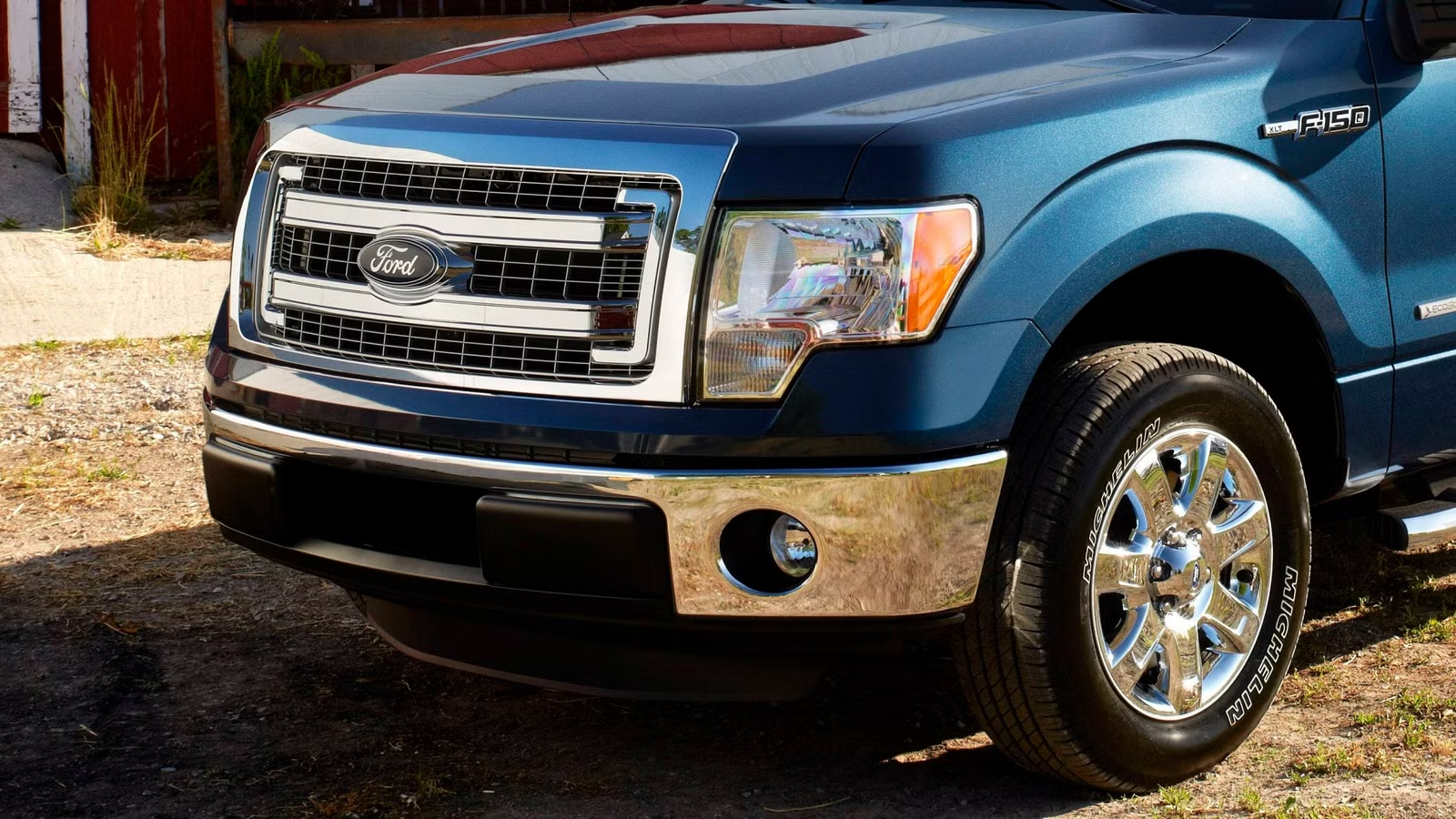
Front 3/4 view of the 2009 – 2014 Ford F-150Ford
But as with the 2017 recall, Ford realized that about 44,000 of the trucks may not have actually been repaired in 2024, so this latest campaign will correct that oversight. Obviously, shifting down to first gear when traveling at higher speeds could cause significant transmission damage and even cause a loss of vehicle control from the sudden deceleration.
Related
Ford Just Recalled 100,000 F-150s, Is Yours One Of Them?
A stripped axle spline could leave you stranded or let your truck roll away at the worst possible time.
CarBuzz Insight – Why This Matters:
Ford claims that its steady stream of vehicle recalls is proof that its quality control efforts are working, with the automaker identifying issues that were previously unaccounted for and repairing them appropriately. That may be true, but unfortunately, its customers still have to deal with the inconvenience and perceived unreliability of having to return to the dealer time and time again. While it’s laudable that Ford is taking responsibility for a decade-plus of unresolved quality issues, these recalls are doing major damage to the company’s reputation, and it could take several years’ worth of trouble-free products for the jokes to subside.
Source: NHTSA (1, 2)
