

In a world of tightening emissions regulations, forced induction, and hybridization (none of which are necessarily bad things), Dodge remains true to itself by refusing to toss aside its massive Hemi V8s. Buyers can still find themselves in a brand-new 2026 Durango SRT with its supercharged 6.2-liter V8 that makes 710 horsepower. The only problem is that it costs $80,000. Families looking for a powerful people-mover on a smaller budget must shift to the used market. There are plenty of powerful used family SUVs these days. However, to stand out today, one can look to the popular body style of old: the station wagon.
Before the SUV’s rise in popularity, families found wagons practical. While their heyday was decades ago, Dodge wasn’t about to be left out of the fun. Hence, the introduction of the Dodge Magnum and its high-performance SRT8 variant. Buyers might be surprised to see how many of these production-model muscle wagons are still around, and what they’re worth on the used market. They’re not perfect, as they follow the trend of many used Chrysler products with some important issues to address, but the performance and practicality might sway your opinion.
Specs have been sourced directly from the manufacturer. Used car values vary depending on factors including mileage, number of owners, location, condition, and more. The prices quoted in this article are averages, and may not reflect exactly what your Magnum is worth, nor do they reflect exactly what you might buy one for.
The American Wagon Legacy: A Brief U.S. History Lesson
2005 – 2007 Dodge Magnum – rear 3/4 angle in red with hatch openDodge
Station wagons have a long history in America, dating back to the Ford Model T Depot Hack in 1910. Third-party manufacturers would buy Model T frames, then build out a wagon body to create a covered area for moving passengers and cargo between train stations. Wagons like this were primarily considered commercial vehicles, and didn’t become recreational or family-oriented until later.
The body style boomed in the post-war era, when families were growing more quickly. In fact, in the ’50s and ’60s, station wagons accounted for one-fifth of the cars sold in the United States. By the 1990s, the few remaining wagons had evolved by using sleeker, more car-like proportions, with many examples based on sedan platforms. Once SUVs began to take over around the end of the ’90s and early 2000s, the station wagon era was beginning to close. There are still some wagons on sale today, but the final station wagon sold by an American automaker was the 2020 Buick Regal Tour X.
Muscle Wagons and the Magnum’s Positioning
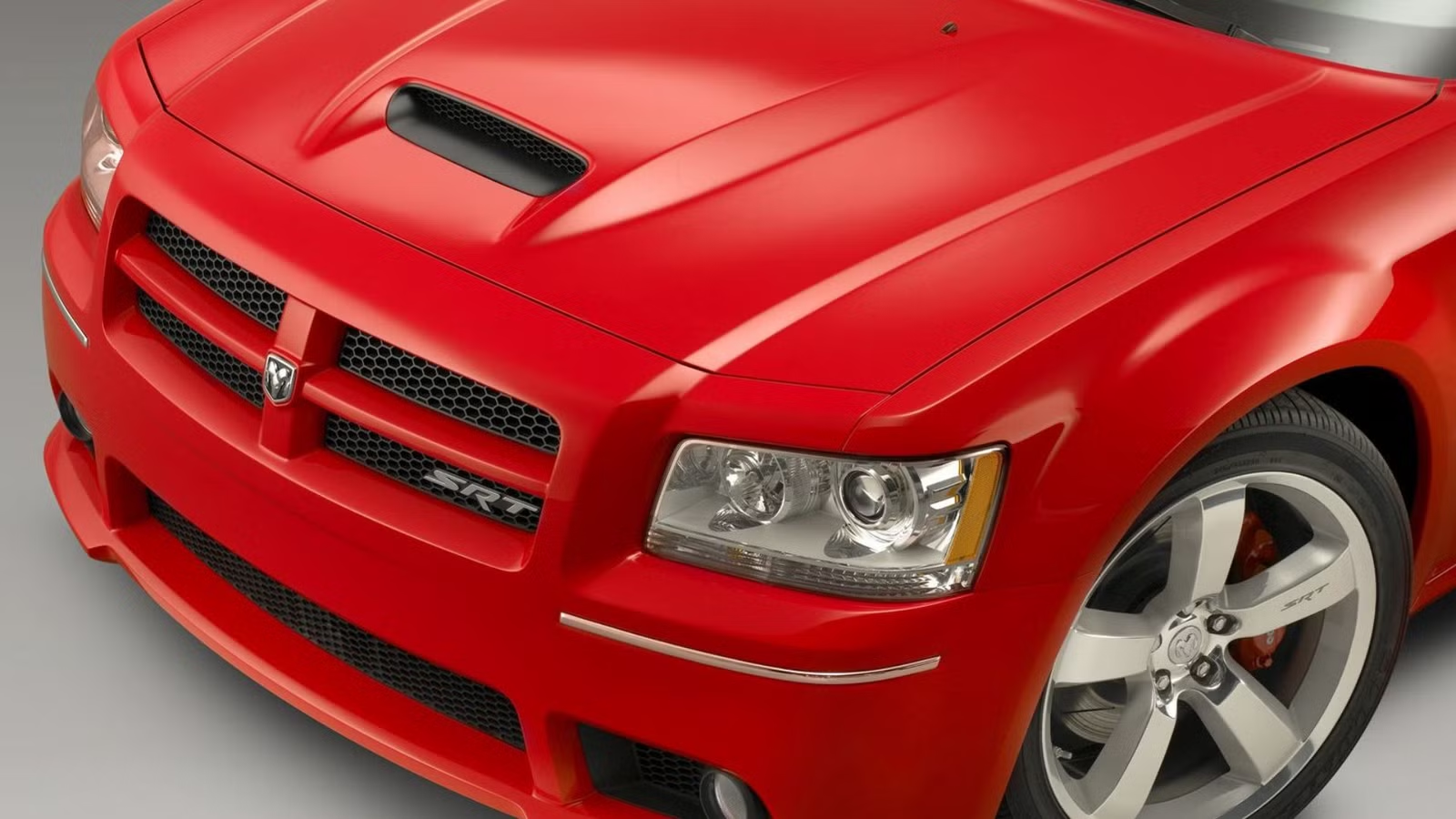
2008 Dodge Magnum SRT8 front 3/4 angle in red while parked in a studioDodge
We’ve seen high-performance versions of just about every type of car, truck, and SUV on the market. SUVs are all the rage, so automakers like Dodge offer the Durango with an SRT trim, and luxury brands love shoving twin-turbo V8s under the hoods of their SUVs, such as the Audi RS Q8.
Muscle cars are no different. The muscle era may have peaked in the 60s and 70s, but there will always be a need for American muscle. When it comes to practical vehicles like this, there aren’t many options — that’s where the Dodge Magnum comes into play. Sold for the 2005–2008 model years, the Magnum was a family-oriented station wagon that packed some serious heat under the hood. Not all trims were hot, of course, but the SRT8 variant offered more than enough power. There weren’t many direct rivals, either. A few years after the Magnum’s demise, Cadillac offered the CTS-V as a wagon, but families who wanted a muscle car were fairly limited in the 2000s.
The 6.1 Hemi Decision
2006 Dodge Magnum SRT8 6.1L NA Hemi V8 EngineDodge
2006–2008 Dodge Magnum SRT8 Specifications
Engine
6.1L NA V8
Power
425 hp
Torque
420 lb-ft
0-60 mph
~ 5 seconds
Top Speed
170 mph
The Magnum was built on the Chrysler LX platform, meaning it shared parts with the Dodge Charger and Chrysler 300 from the time. This platform was developed in conjunction with Mercedes-Benz. The front suspension came from in-house, while the rear setup was pulled straight from an E-Class. Mercedes-Benz also provided the rear-wheel drive LX platform’s five-speed automatic transmission.
As Chrysler’s reintroduction to RWD vehicles in its lineup, engineers knew they had to give buyers what they wanted. That meant jumping into the deep end of the pool with SRT. The SRT8 variant wasn’t introduced until a year into the Magnum’s life. Chrysler decided to equip this relatively boring family hauler with a 6.1-liter naturally aspirated V8 that made 425 horsepower and 420 lb-ft of torque. The wagon was capable of reaching a top speed of 170 mph, and it could launch from 0 to 60 mph in about five seconds. It wasn’t quite as quick as the Charger SRT8 or the Challenger SRT8 that followed, but wagon buyers were satisfied.
What the Magnum’s Other Trims Offered
5.7-liter Hemi V8 engine in the 2005 – 2008 Dodge MagnumDodge
2005–2008 Dodge Magnum Specs Overview by Trim
Trim
SE
SXT
RT
Engine
2.7-liter NA 6-Cylinder
3.5-Liter NA 6-Cylinder
5.7-Liter Hemi NA 8-Cylinder
Power
178-190 hp
250 hp
340 hp
Torque
190 lb-ft
250 lb-ft
390 lb-ft
Transmission
4-Speed Automatic
4 or 5-Speed Automatic
5-Speed Automatic
Drivetrain
Rear-Wheel Drive
Rear or All-Wheel Drive
0-60
10.7 Seconds
7.5 Seconds
5.9-6.3 Seconds
Buyers who didn’t feel like the SRT8 was necessary could get away with owning a Magnum in any of the three lower trims. Its two most basic trims can’t be considered muscle cars. They both used V6 engines with barely enough power to get up to freeway speeds by the end of the on-ramp. The RT came with a Hemi 5.7-liter V8 that was tuned to match the Charger RT.
What the Package Actually Delivered
2008 Dodge Magnum SRT8 front angle in redDodge
This writer has plenty of experience with the Magnum RT, as his family owned one from new. It lasted from 2006 through 2024, when its engine finally locked up beyond reasonable repair after nearly 270,000 miles of constant maintenance and upkeep. During that time, the power and performance were more than adequate for daily driving and commuting.
In an interview with our Magnum’s primary owner (my dad), he claimed he “wanted straight-line speed and torque off the line, and that’s what I got.” He also mentioned how he “wanted that in a car that can still haul a family around. It fit the bill perfectly.”
On that note, the SRT8 fits those exact parameters even better. It’s more aggressive. Power outputs aside, the Magnum SRT8 came with stickier tires, larger 20-inch wheels, and stiffer independent suspension. Its revised suspension setup lowered the car by half an inch compared to the RT, making the variant more responsive and stable through the bends. It had more responsive steering, and it came with four-piston Brembo brakes.
Related
The Dodge Magnum Is The (Nearly) Ideal Used Car For Large Families That Want To Go Fast
It’s basically a Dodge Charger disguised as a wagon.
The Durability Reckoning: Ownership Costs
2006 Dodge Magnum SRT8 front cabin viewCars and Bids
The Magnum SRT8 isn’t especially rare, but there aren’t enough to justify assigning exact ownership costs to it. That said, the Magnum generally makes a good starting point for estimating maintenance and repair costs. According to RepairPal, a Magnum will cost about $474 per year to repair and maintain. That includes regular oil changes, air filters, and miscellaneous upkeep. This source notes some more expensive repairs, though:
- Brake Booster Replacement: $936–$1,027
- Exhaust Manifold Replacement: $621–$753
- Airbag Clockspring Replacement: $478–$526
While those are some of the more expensive, relatively common problems noted by RepairPal, actual owner complaints to the National Highway Traffic Safety Administration and Car Complaints tell a different story.
Dodge Magnum Complaints and Recalls
2006 Dodge Magnum SRT8 rear trunk viewCars and Bids
Most of the Magnum’s issues are reported for the 2006 and 2007 model years. The most common complaint, by far, to the NHTSA and Car Complaints is related to the Magnum stalling while driving – typically soon after refueling. While NHTSA never issued an official recall, Dodge sent owners letters offering to replace the fuel tanks free of charge.
Another common issue reported by owners is the gear shift assembly getting stuck in park due to a small pink plastic lever that’s supposed to drop out of the way when the key is turned, but often gets stuck, preventing the shift lever from moving. Again, no official recall was ever issued for this problem, despite its widespread nature.
Related
Dodge Built The Least Boring Family Car Of The 2000s
While most family cars are built to be reliable, affordable and well, boring, Dodge took a different stance. It built a wagon that was far from dull.
From Overlooked to Collectible
2006 Dodge Magnum SRT8 front seats view from frontCars and Bids
The Magnum, in general, isn’t all that collectible. Most examples on the road today are aging with hundreds of thousands of miles, and there aren’t many left without modifications. Successful auction results in the last twelve months suggest an average value of $19,841. We wouldn’t take that number too seriously, though, since it only accounts for 19 sales. All the highest sales include SRT8s. Seven out of eight sales over $20,000 were for the SRT8, with some reaching $35,000 (modified with a supercharger), $47,000 (low-mileage survivor), and even $49,500 for a low-mileage example with light mods.
Auctions typically represent the best of the best. More average examples sell on the used market through private sales without publicly confirmed sales prices. Nevertheless, the Magnum SRT8 is sure to be a future classic. With models in great condition and with low mileage selling for more than their original MSRPs, we wouldn’t be surprised to see them hold that value. There are no more American station wagons on sale in 2026, so muscle fans have no choice but to turn to used options like the Dodge Magnum.
Sources: Dodge, Classic.com, RepairPal, NHTSA, CarComplaints, Hagerty, BringaTrailer [2], Mecum
