

Plug-in hybrids are an interesting middle-ground that is either a “best of both worlds” or “worst of everything” proposition, depending on your mentality. While, yes, they’re less efficient than a pure EV or a pure hybrid, Toyota clearly thinks they’re worthwhile enough to offer two, the Prius Plug-In Hybrid and the RAV4 Plug-In Hybrid. They even expanded the availability of the plug-in powertrain with the 2026 RAV4 to now include it as an option for the Woodland and new GR Sport trim in addition to the previously available SE and XSE trims.
It’s easy to see the appeal of plug-in hybrids, especially when they’re done as well as they are by Toyota. Depending on the vehicle, they’ll do between 39 and 54 miles of all-electric range, enough for the average American’s commute to be done completely on electricity, yet they have an efficient gas engine to keep you going for high-mileage days or for the frequent road-trippers that still want gas convenience and the perks of an EV.
From Toyota’s standpoint, they’re also better for the environment due to using far smaller batteries while accomplishing the same all-electric commute as an EV. Let’s go over Toyota’s two plug-in hybrid options, and which one is the right one for you.
All pricing is for the 2026 model year and all vehicles and specs discussed are for the US market.
Prius Plug-In Hybrid
2025 Toyota Prius Prime PHEV XSE Front AngleToyota
The Prius Plug-In Hybrid is undoubtedly the more efficient, more aerodynamic and more thrifty of the two. It needs only a 13.6 kWh battery (gross capacity) to get between 39 and 44 miles of electric range, depending on the trim. It’s also rated at between 114–127 MPGe, much better than the Rav4 that just barely cracks over 100 MPGe. The Prius PHEV also uses a smaller 2.0-liter engine compared to the bigger battery and bigger engine of the Rav4. That does mean the Prius is the slower of the two, but it’s still no slouch, posting a 0–60 mph time of about 6.5 seconds and doing a respectable 220 horsepower combined.
It’s also the less capable of the two though, being offered only with front-wheel drive, versus the standard all-wheel drive of the RAV4 PHEV. It’s much lighter weight also helps in corners, making it the sportier of the two, aside from possibly the GR Sport version of the RAV4 PHEV with its handling goodies.
2025 Toyota Prius Plug-In Hybrid PHEV Interior Front CabinToyota
The interior of the Prius is mostly good, aside from the forward-view-blocking gauge cluster, but it obviously falls well short of the RAV4. Firstly, just due to its size and shape. For this generation of the Prius, Toyota took it in a smaller, sportier direction, which made it less practical than the last generation, with tighter headroom and a smaller rear hatch. It seemed to be a fairly safe gamble with the Rav4 being available right next to it in the showroom for those looking for a more practical PHEV, but it just limits the usability of the Prius these days, which is probably part of why its sales haven’t been particularly strong recently, even with high gas prices.
The other way the Prius falls short of the RAV4 is in its freshness. The Prius has been around since 2023 in its current generation, which isn’t typically a long time for an interior, but now with the pace of innovation for interiors and software, the Prius is simply behind the brand-new RAV, with older software on its smaller screens and other missing features that the RAV4 now has, like a bigger and better-placed gauge cluster screen and a built-in dashcam. In the Prius’ defense, though, similar things could be said for any other Toyota right now until they get brought up to speed with the RAV4’s new stuff.
Thankfully, the exterior has aged better, with still-sharp styling and one cool thing it offers that the RAV4 can’t match: a solar roof that’s actually capable of recharging the drive battery. This makes the Prius PHEV somewhat immune to both gas and electricity prices, and able to be driven no matter what happens, as long as the sun still shines. Hopefully, the RAV4 gets the same option someday, especially for the Woodland variant, where the extra power could come in handy for camping.
2025 Toyota Prius PHEV plugged into charging portToyota
Lastly, for the Prius, let’s talk about its pricing. They start at just $33,775 plus $1,295 for destination and freight, compared to the Rav4’s much higher $41,500 starting price, plus $1,595 destination. And even a fully loaded XSE Premium trim is $7,650 less than a comparable XSE RAV4 PHEV.
So clearly, the Prius is the better deal if you don’t need all the Rav4’s perks, which we’ll get into now.
RAV4 Plug-In Hybrid
2026 Toyota RAV4 PHEV chargingToyota
2026 Rav4 hybrid
Prius hybrid
Engine
2.5L Hybrid
2L I4 Hybrid
Power
324 hp @6,000 rpm
220 hp @6,000 rpm
Torque
163 lb-ft @ 3,600 rpm
139 lb-ft @ 4,400 rpm
Electric Range
49–54 miles
39–44 miles
With new enhancements for 2026, the RAV4 Plug-In Hybrid is undoubtedly the range king and the most impressive PHEV that Toyota currently offers. It runs Toyota’s newer 5th generation hybrid system that combines a bigger 2.5-liter inline-4 with a bigger 22.7 kWh battery to produce 324 hp, a 5.4 second 0-60 mph time, and an electric range of 49–54 miles. And while it’s less efficient than the Prius, it still manages an MPGe rating of 86–101.
Related
Toyota Prius Generations: Key Updates Across All Model Years
From a slow, ugly duckling, to a punchy looker, the Prius has come a long way since the early 2000s, but it’s kept fuel economy as a priority.
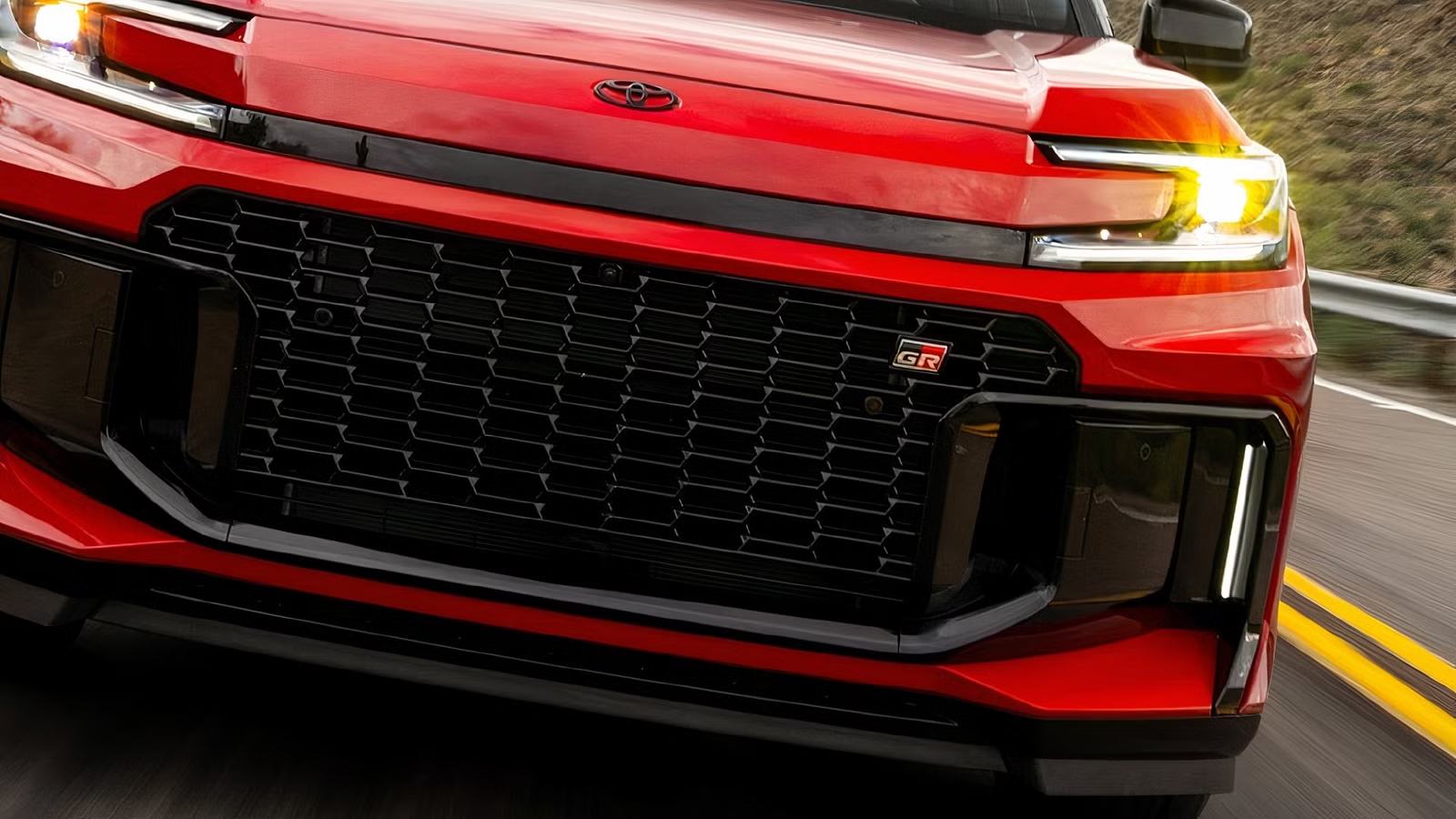
Thanks to the addition of the Woodland PHEV along with standard all-wheel drive, the RAV4 is also superior for those that see bad weather and/or venture off the beaten path. For those wanting a sportier plug-in, the GR Sport trim provides real performance upgrades to handling to go along with the sportier look, two things the Prius unfortunately can’t match. Hopefully those Toyota executive dreams of a Prius GR Sport materialize into a real car someday. Until then, the RAV4 GR Sport is the enthusiast’s choice.
2026 Toyota RAV4 PHEV GR Sport interior view of the front cabinJared Rosenholtz/CarBuzz/Valnet
Like we mentioned earlier, the Rav4 has the obvious interior advantage both in space and in tech. You get a 12.3-inch gauge screen and a 10.5-inch touchscreen as standard, with a 12.9-inch touchscreen coming on the higher trims. Those screens run Toyota’s newest software with a variety of improvements that we’ve already covered previously. But the highlights are an easier-to-use design and faster responses, but the downsides are that they’ve also absorbed the climate controls and ditched physical HVAC controls. For those that aren’t into that, the Prius still has traditional controls.
The exterior of the RAV4 is fresher too, since it just debuted for the 2026 model year, and continues with a conservative but attractive evolution of the last generation, ensuring that it doesn’t rock the boat too much for shoppers of Toyota’s bestseller.
2026 Toyota RAV4 PHEV rearToyota
Like we’ve already mentioned, all the advantages of the RAV4 PHEV do come at a significant cost over the Prius, but that’s to be expected. And especially if getting the most power, space and/or electric range are important factors for you, the RAV4 PHEV’s pricing, ranging from the $41,500 starting price, plus $1,595 destination to the $50,565 fully loaded price (plus the same destination fee) are well worth it since they not only beat the Prius, but also all the RAV4’s other plug-in hybrid competitors.
Which One Is Right For You?
2026 Toyota RAV4 PHEV rearToyota
We’ve already made the differences known for these two, so depending on what your price constraints are, along with your wants and needs for space, power, and range should clearly point you in the direction of one over the other. The subjective differences for the exteriors and interiors of both can also be influential, especially the Prius’ physical climate controls or the RAV4’s better gauge cluster and visibility.
Related
2026 Toyota RAV4 First Drive Review: The Compact Crossover That Will Dominate America
Toyota took a bestseller, and just added more things customers wanted. Here’s why the new RAV4 will break even more sales records.
At the end of the day though, they’re both great cars, but the RAV4 boasts all the better specs and features that matter to buyers. And if you find yourself hung up on the Prius but are wishing for more electric range, new styling or the newest interior touches, it should be due for a refresh fairly soon, so that could bring some – or all of those – changes.
In the meantime, it’s great that Toyota offers two very compelling plug-in hybrids, and it’s a shame more companies haven’t followed their lead.
Sources: Toyota
