

Typically, when we think of automakers with a long history of building great engines, names like Toyota, Honda, Ford, or General Motors come to mind. However, other manufacturers have also produced mills that earned them status as icons. Just look at Jaguar’s XK inline-six, it stuck around for a whopping 44 years, from 1948 to 1992. In other words, the lesson here is that even automakers without a reputation for reliability can, and have, built world-renowned engines known for being long-lasting.
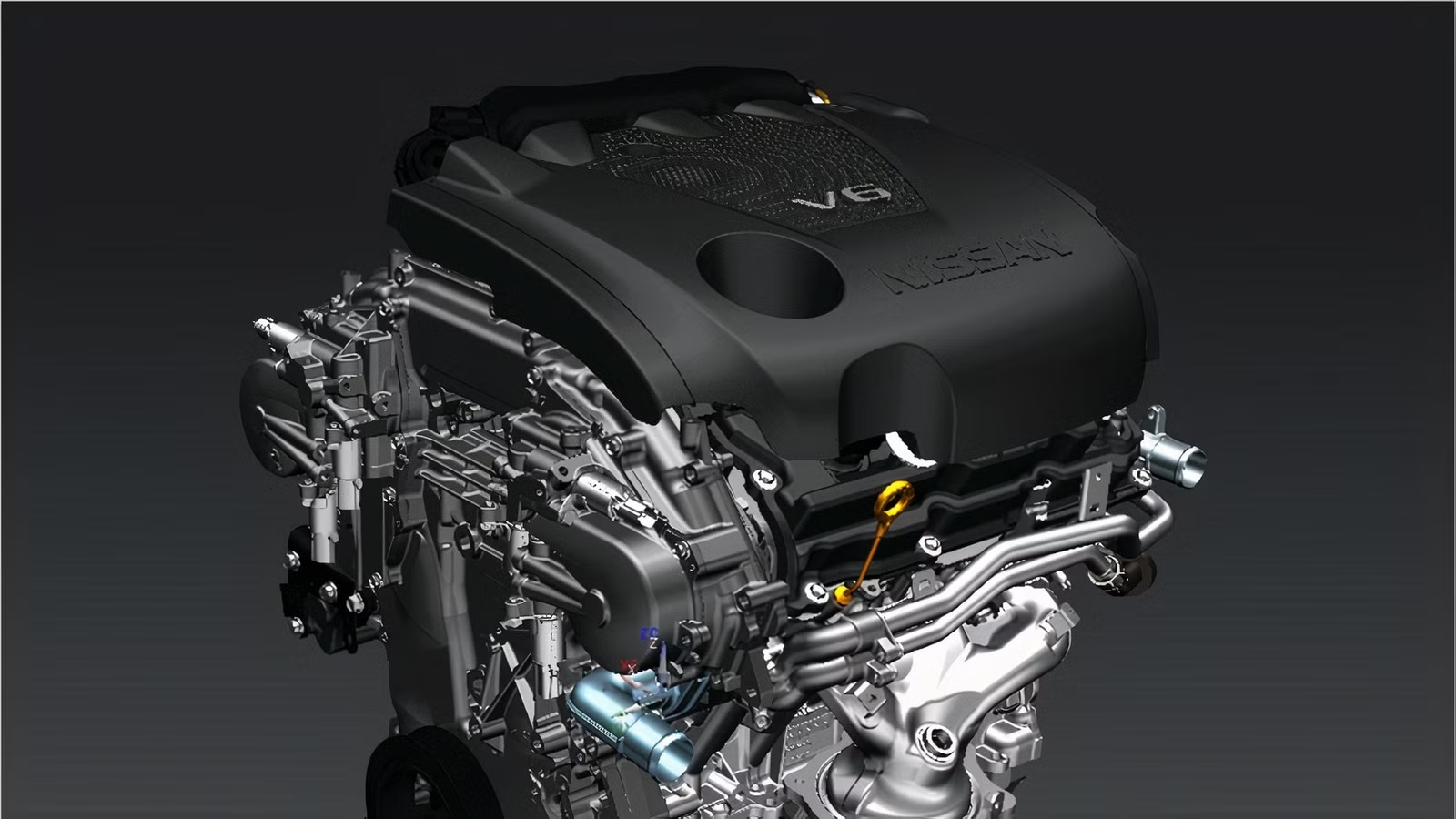
Nissan also belongs on the list of automakers that you wouldn’t expect to build a highly reliable engine. The mill in question is actually a family of engines called the “VQ” series. Every member of said family is a V6, and it first hit the market in the early 1990s. Since then, roughly 17 different variations, ranging from 2.0-liters to 4.0-liters in size, have been produced. In addition, the VQ engine has been mentioned in Ward’s 10 Best Engines a whopping 16 times, making it the single-most awarded engine family in automotive history.
Nissan
Founded
26 December 1933
Founder
Yoshisuke Aikawa
Headquarters
Nishi-ku, Yokohama
Owned By
Publicly Traded
Current CEO
Ivan Espinosa (as of 1 April, 2025)
A Monumental Hot Streak
1995 Nissan Maxima V6 engineNissan
Like a newborn pony, the Nissan VQ engine came running right out of the gate. The first iterations of the VQ to hit the market in 1994 were a 2.0-liter, 2.5-liter, and 3.0-liter V6. In its first year on the market, the three Nissan VQ engines had already managed to earn a respectable amount of clout in the automotive world. Just one year after its debut, the VQ engine managed to win its first mention on the Ward’s 10 Best Engine list in its 3.0-liter iteration. The winning 3.0-liter carried the engine code “VQ30DE”, and its 1995 win was just the start of its seven-year-long winning streak, earning its final spot on the list in 2001.
However, beginning in 2002, the VQ engine’s then-new version, dubbed the “VQ35DE”, was mentioned on the fabled list. The new mill had grown in size to 3.5 liters, and is most commonly associated with the Nissan 350Z. The VQ35DE would remain a staple on Ward’s 10 Best Engines for five consecutive years, including 2002. By 2006, an updated version of the mill called the “VQ35HR” took the reins and continued the VQ engine’s winning streak for another year.
V6 engine in the Nissan FrontierNissan
The final award-winning variation of Nissan’s fine-tuned V6 came about in 2008, dubbed the “VQ37VHR”. It had been newly featured in Infiniti’s G Series – specifically the G37 – and managed to win itself a spot on Ward’s list thanks to its variable valve even and lift (VVEL) tech. It also boasted 330 horsepower and a relatively high rev limit. All three attributes were cited as reasons for its inclusion on the list by WardAuto itself.
The VQ Engine Family’s Winning Years And The Engine That Won
1995: VQ30DE
1999: VQ30DE
2003: VQ35DE
2007: VQ35HR
1996: VQ30DE
2000: VQ30DE
2004: VQ35DE
2008: VQ37VHR
1997: VQ30DE
2001: VQ30DE
2005: VQ35DE
2012: VQ 3.5L HEV
1998: VQ30DE
2002: VQ35DE
2006: VQ35DE
2016: VQ35DE MPFI
Following the VQ37VHR, the VQ series’ winning streak ended for a short time. However, come 2012, it was again thrust into the spotlight. That year, the Nissan-Renault alliance had produced the VQ 3.5L HEV hybrid-electric engine that was used in the Infiniti M35h, although it would only sit on the list for a single year. The final award-winning VQ-series engine hit the list in 2016 as the VQ35DE thanks to its use of multi-point fuel injection, among other things.
The VQ’s Ins And Outs
Close-up of 2015 Nissan Frontier V6 engineNissan
The VQ engine family’s penchant for reliability can be traced to numerous components and features, some of which were unique to the family. For starters, all VQ engines utilize timing chains, rather than timing belts. Timing chains are better-suited for longevity and durability, simply because the metal chain can withstand more strain and use than a belt, although this is a generalization. However, in the VQ’s case, its timing system is typically considered reliable, although it’s also known to be noisy in some applications.
Related
Mainstream And Premium Cars That Share The Same Engine
While many brands use different engines for their cheaper and more premium offerings, others share their powerplants no matter the final price tag.
However, its robust engine block and cylinder heads also help the engine last longer. Aluminum is used for both components, and its bottom end features a more robust bed plate, which is used to help support the engine’s main bearings. Its oil pan is also set up for longevity, as it sports more baffling (a critical system of metal panels and seals that manages cooling airflow in air-cooled engines) than usual, which helps prevent oil starvation under hard acceleration, braking, and cornering. Oil sloshing under those conditions can be catastrophic, because if the oil pickup is left dry, the motor can potentially seize from lack of lubrication.
Bumps In The Road
Close-up of 2015 Nissan Frontier V6 engineNissan
There were one or two issues with the VQ series engine right at the beginning. Early models suffered from a higher-than-normal rate of oil consumption, even when they were still fairly new. Nissan pinpointed the issue’s causes early on – those being faulty piston rings, high crankcase pressure causing oil to be blown into the combustion chamber past the faulty rings, and a PCV system that wasn’t robust enough to handle the higher crankcase pressure.
In order to combat these issues, Nissan set about revamping the entire VQ engine family. However, some improvements were made, such as switching out the PCV system for a newly designed one and making alterations to the engine’s oil gallery gasket, which seals the engine’s timing system and prevents oil leak-down back into the oil pan. Should the gasket fail, high-pressure oil is thrown into the oil pan.
Related
Pros And Cons Of V6 Engines
Six-cylinder engines are all the rage these days – here’s why the V6 configuration is the one to go for.
Notable Versions
VQ35DE
2004 Nissan 350Z Track EditionClassic.com
Engine Details
3.5L NA V6
Power
228–300 hp
Torque
246–278 lb-ft
Cylinder Bore
3.760 in
Piston Stroke
3.205 in
Compression Ratio
10.0:1–10.6:1
*Specs courtesy of Nissan
One of the most famous VQ engine types is the VQ35DE, the one featured in the Nissan 350Z. Its penchant for greatness begins in its bottom end. Down there, we find a one-piece forged steel crankshaft and forged connecting rods. Forged internals typically carry more longevity than cast, as forged components are formed by shaping a piece of metal, rather than cast, wherein molten metal is poured into a mold and cooled. It also sports low-friction molybdenum-coated pistons.
Another reason for the VQ35DE’s fame is its performance. As stock, the engine was rated up to 300 hp in some instances, and could also pump out up to 274 lb-ft of torque. In 2005, Nissan revamped the mill with an all-new variable exhaust valve timing system, a higher rev limit, and a revised oil pump allowing for a higher flow rate.
VQ40DE
Rendering of the 2015 Nissan Frontier V6 engine and transmissionNissan
Engine Details
4.0 L NA V6
Power
261–275 hp
Torque
281–294 lb-ft
Cylinder Bore
3.760 in
Piston Stroke
3.622 in
Compression Ratio
9.7:1
*Specs courtesy of Nissan
The largest member of the VQ family is the VQ40DE, a 4.0-liter V6. Unlike other VQ engines, the 4.0-liter iteration was designed specifically for use in pickup trucks and SUVs. It prioritizes torque, and delivers its extra twisting power thanks to its increased piston stroke. It was introduced in 2005, and came right off the presses with variable valve timing, a variable length and volume intake manifold, and low-friction molybdenum-coated pistons, much like the VQ35DE.
The Nissan VQ Engine’s Legacy
2003 – 2004 Nissan 350Z – front 3/4 angleNissan
These days, the Nissan VQ engine still lives. Just two survive, those being the VQ35DD and VQ38DD. The former is featured in the current Nissan Pathfinder, and was only recently axed from the Infiniti QX60’s offering list as of 2024. The VQ38DD finds itself in the current Nissan Frontier, the famous midsize pickup truck known for its reliability. The non-USDM Nissan Patrol also takes advantage of the mill.
So, 32 years into the VQ engine’s lifespan, and it’s still known as one of the most reliable engines produced by the brand. It’s no wonder it managed to win a whopping 16 mentions on Ward’s 10 Best Engines.
Sources: Nissan.
