

Think of an old-school Porsche, and you’ll typically picture a rear-engine, two-door sports car of the type that made the German brand truly famous. Today, the company is also known for four-door creations like the Panamera, but even before they dreamed up that particular vehicle, Porsche had a lot to do with a different four-door sedan.
Intriguingly, Porsche put a lot of effort into developing this car, but that sedan carried a Mercedes badge, and that’s particularly interesting considering that these two companies are great rivals. The 500 E turned out to be one of the great stealth performance cars of the 1990s, but it was developed and assembled by Porsche.
It was still a factory-sanctioned Mercedes, complete with that distinctive star, and it represents an interesting proposition on the used car market today.
A Mercedes That Quietly Became Porsche-Adjacent
1991 Mercedes-Benz 500E developed with Porsche, frontPorsche
1991 Mercedes-Benz 500 E
Engine
5.0-liter M119 naturally aspirated V8
Transmission
Four-speed automatic
Drivetrain
Rear-wheel drive
Power
322 hp
Torque
354 lb-ft
The Mercedes 500 E first appeared in the spring of 1991 as a four-door sedan. Under the hood sat a 5.0-liter V8 producing 322 hp, and it featured rear-wheel drive, with an electronically limited 155 mph top speed. It went on sale in this guise for a couple of years before Mercedes renamed it as the E500 during a 1993 facelift.
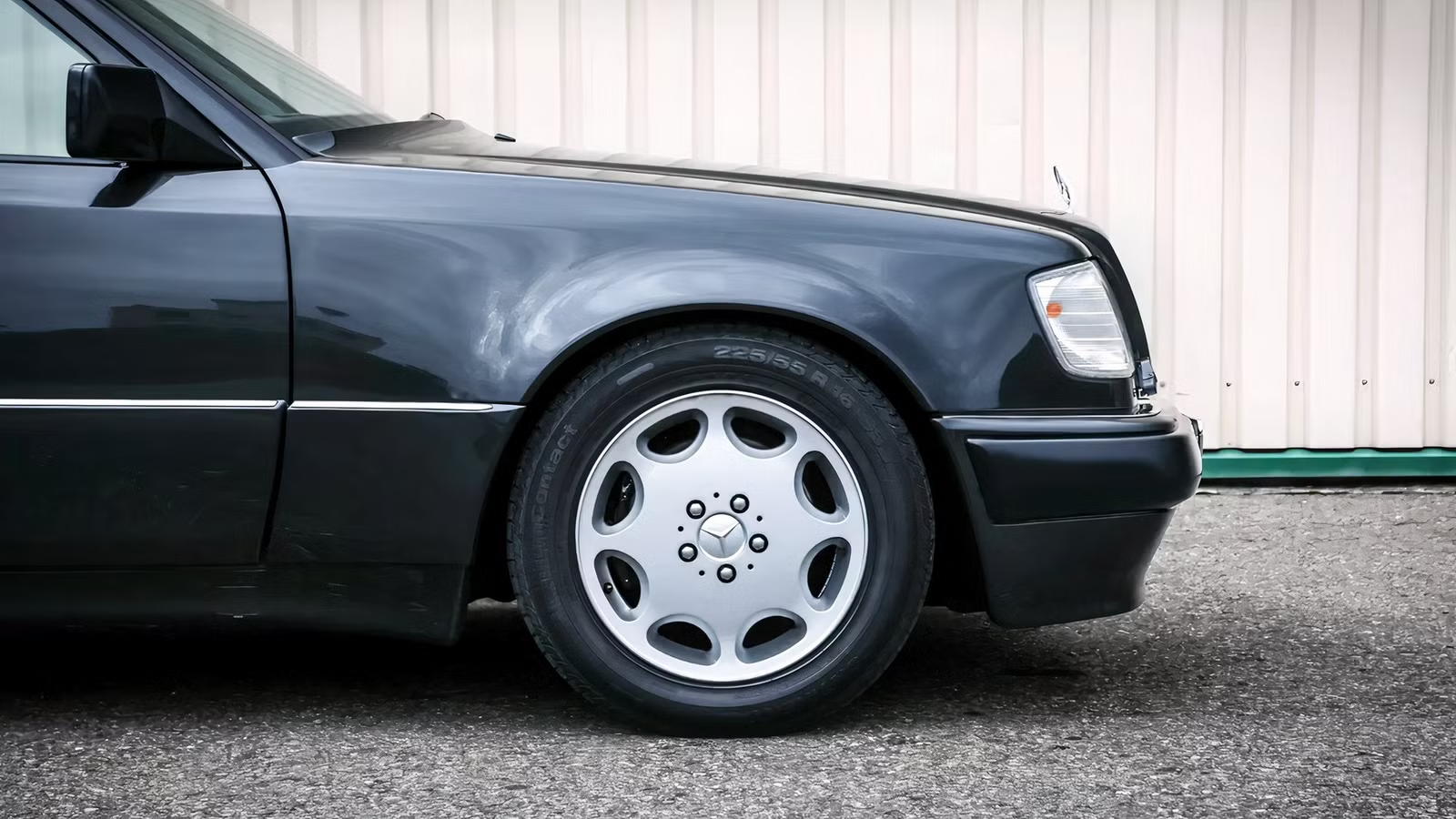
The 500 E wasn’t particularly exciting to look at and to the untrained eye, it could easily have been just another conservative W124 sedan from that restrained era. But if you looked more closely, you’d see that this particular car had a lower stance and slightly wider arches. It had an extra presence that tended to separate it from any ordinary E-Class of that time.
Mercedes intended the 500 E to be a high-speed executive sedan that would not only be typical of the company’s regular products but would also carry some extra engineering depth. However, Mercedes faced some challenges in achieving its key objectives, so for help in these areas, it turned to an unlikely rival.
Mercedes Outsourced Its Super Sedan To Porsche
1991 Mercedes-Benz 500E developed with Porsche, rear close-upPorsche
Before it could bring its 500 E concept to market, Mercedes had to overcome a specific problem. It wanted to put the 5.0-liter V8 that came from the 500SL into this W124 platform but sadly, that was easier said than done. Such a project required alterations to the vehicle’s bodywork to make it 2.2 inches wider and 0.9 inches lower than the base W124. And Mercedes was not able to achieve those goals using its own Sindelfingen production line because the line was too narrow to build that out economically.
It might have made sense for Mercedes to invest some money if this was anything other than a low-volume flagship, but as it wasn’t, outsourcing was the name of the game. After some deliberation, Mercedes turned to another big German company for help in the shape of Porsche.
Work on the 500 E project started over at Porsche in 1988. As part of the arrangement, Mercedes would supply the body parts and transport them from Sindelfingen to the Porsche facility in Zuffenhausen. There, Porsche assembled the body using some Porsche-made components, like the distinctive front wings. Porsche then sent the bodies back to Sindelfingen for paint application.
Each vehicle then went on to Porsche’s Rössle Bau facility for final assembly and engine installation. According to Porsche records, the entire process lasted about 18 days for each car and involved two separate journeys between Zuffenhausen and Sindelfingen.
For both companies, this turned out to be a marriage made in heaven. It helped fill capacity needs at both Zuffenhausen and Weissach during a challenging time for Porsche. And for Mercedes, Porsche fixed its production and engineering problems, so the 500 E was highly beneficial to both.
The 5.0-liter V8 Provides A Great Backstory
1991 Mercedes Benz 500E developed with Porsche, at Porsche factoryPorsche
The sheer scale of the M119 E50 engine gave Mercedes a lot of headaches as the company tried to move forward, but it also gave the eventual 500 E a lot of its credibility. After all, this was a serious unit, as a 90-degree V8 with an aluminum block, four valves per cylinder, and dual overhead camshafts for each cylinder bank. It came with Bosch LH Jetronic injection and an intake camshaft adjustment, and it turned out 322 hp and 354 lb-ft of torque.
In the 500 E, you’d also get a four-speed automatic transmission, rear-wheel drive, rear self-leveling hydro pneumatic suspension, and ventilated disc brakes all around. And all of that represented some serious levels of performance in the early 90s.
Back then, there weren’t too many sedans that could run with dedicated sports cars, especially if they had four doors, wood trim, leather, automatic climate control, and a soft exterior. But the 500 E was somehow able to break free from those conventional sedans. It was never a lightweight Porsche, but it still took advantage of that company’s development and assembly discipline, which added a significant amount of speed to its refinement.
Related
Mercedes-Benz E-Class Sedan Generations: Everything You Need To Know In One Place
The sixth-gen E-Class looks nothing like it did when it arrived in the 90s – here’s how the iconic sedan has evolved over time.
Mercedes sold a total of 10,479 examples of this car up to April 1995, which means that the 500 E is relatively scarce for a factory performance sedan. However, every surviving car has an interesting story to tell, being part Mercedes flagship and part Porsche production story.
Why This Porsche-Built Mercedes Is Easier To Trust Than You Might Think
1991 Mercedes Benz 500E developed with Porsche, frontPorsche
Complexity does not often translate well into the used car market, and a car with this type of origin story just sounds intimidating to own. After all, you’re looking at low-volume bodywork, specialist parts, self-leveling rear suspension, 1990s German electronics, and a big V8 up front, which are not typical ingredients for cheap classic motoring. But still, it’s worth remembering that the foundation for this project was a W124 Mercedes, which already had a very strong reputation. The M119 V8 can be really solid and reliable too, if you maintain it properly.
The 500 E is also different from many later high-performance German sedans. By early 1990s standards, it may seem complicated but it doesn’t have some of those weird and wonderful modern-day features like a dual-clutch gearbox, adaptive electronics, or a turbocharger. Instead, you get a naturally aspirated V8 and a conventional four-speed automatic transmission. The car’s strength mostly comes from chassis tuning, displacement, and overbuilt Mercedes hardware rather than fragile peak-output engineering.
Related
These Are The Rarest Porsches Ever Made
These Porsches are so rare that they make the 918 Spyder feel commonplace.
But as maintenance is key, it’s particularly important to look at the timing chain and plastic guides for the all-aluminum M119. If you can hear the chain rattling when you start up the vehicle, that might be a sign of deferred maintenance and require further investigation. A prospective owner should also check the lighting, interior trim, hydraulic suspension components, and confirm the presence of correct body panels.
If there is any evidence of neglect, tired suspension, non-original modifications, or missing documentation, then it’s probably best to move on. After all, the best 500E will probably be the one with correct parts, a clear history, and evidence that previous owners knew what they were doing.
What A Mercedes 500 E Costs Now
1991 Mercedes Benz 500E developed with Porsche, interior frontPorsche
When looking for a used 500 E, auction results show a broad spread. In the practical middle of the market, you might find something like a 1993 500 E that had 101,000 miles on the clock and sold for $35,444 in April 2026. But there are also lower mileage vehicles that command significantly more. For example, a 1993 500 E with 36,000 miles sold in early 2026 for $71,350 and a 1994 E500 Limited went under the hammer for $80,000 in April 2026.
Values snapshot for a 1991 Mercedes-Benz 500 E
Auction range
$23,000–$357,000
There are some significant outliers, such as a 1992 500 E associated with Jerry Seinfeld that went for no less than $357,000 at Gooding Christie’s 2026 Amelia Island auction. But generally, low-mileage, Limited, special-condition, or modified cars will circulate in the higher space. And it still seems possible to find ordinary-mileage cars today at somewhere in the region of $35,000. For those who may consider those prices to be expensive for a W124, it’s important to remember that this is effectively a Porsche-assembled Mercedes super sedan, so it carries some additional historic weight under its price tag.
In summary, Porsche had enough involvement with this Mercedes 500 E sedan to generate an unusual headline, and make knowledgeable enthusiasts look twice. And today, that may explain why driver-quality examples still live around the $35k mark, as buyers learn to read between the badges.
Sources: Porsche, Mercedes, Bring a Trailer, Gooding Christie’s.
