

There is a special kind of discomfort that only shows up when the road starts getting empty. Not the ordinary kind of fuel anxiety that comes from cruising around town with the warning light on, but the heavier, more persistent version that follows you into a remote country. It is the mental arithmetic of distance, detours, weather, headwinds, and the next place with fuel. It’s the creeping dread of watching the fuel gauge drop toward empty somewhere on the Trans-America Trail — forty miles of gravel separating you from the last town you passed and no cell signal.
That is what range anxiety looks like on a big do-it-all motorcycle. It is a strange contradiction. These motorcycles are built for crossing states, provinces, and time zones, yet many of them still ask for fuel every 150 to 180 miles once the pace gets rough or the wind starts pushing back. On routes like the Alaska Highway and the desolate Nevada stretches of Highway 50, distance-to-empty becomes the trip’s governing variable — not the road ahead.
The Hidden Tax Every Long-Distance Rider Pays
Ducati
Versatility is best offered by ADVs, so that’s our focus here. A lot of such flagship adventure bikes are brilliant in theory and slightly annoying in practice. They deliver huge power, premium electronics, and enough comfort to justify the price tag, but their fuel range often falls just short of what remote travel actually demands. The leading machines in the class are extraordinary in almost every respect, and yet they share this same limitation. The BMW R 1300 GS carries a 5.3-gallon tank, while the Ducati Multistrada V4 S arrives at 5.3 gallons. At real-world highway fuel economy of around 40 to 45 mpg, that works out to roughly 210 to 245 miles of usable range.
A stunning shot of a rider aboard the BMW R 1300 GS riding on highwayBMW Motorrad
On paper, 200 miles between stops sounds fine. In the real world, it is not always enough. Ride the wrong highway into a crosswind, get stuck behind traffic, spend a morning climbing and descending on loose surfaces, or simply carry luggage and a passenger, and that tidy number melts down quickly. A 200-mile fuel window does not just trim convenience; it shapes the day. It changes where you stop, when you stop, and sometimes whether a route feels relaxed or slightly tense. There is an uncanny solution, though, and it comes from Britain’s largest bikemaker.
The Triumph Tiger 1200 GT Explorer Quietly Eliminates Range Anxiety
Base Price: $23,795
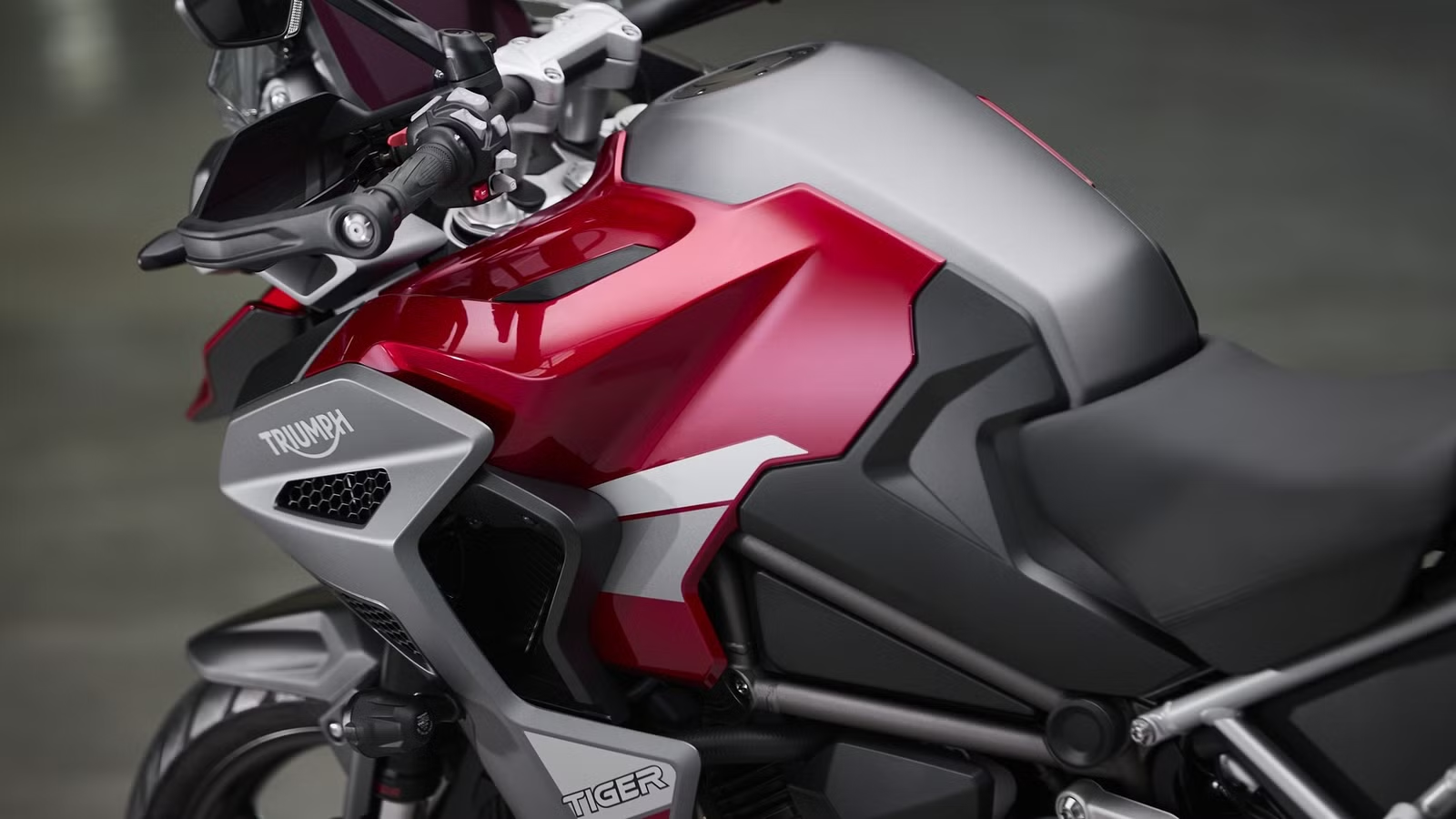
Triumph Tiger 1200 GT ExplorerTriumph Motorcycles
We’re talking about Triumph. Its response to this problem wasn’t to develop hybrid technology or experiment with aerodynamics to squeeze out a few extra MPG. The brand went back to first principles and built an entirely new motorcycle — one that happened to carry a 7.9-gallon fuel tank. The current Tiger 1200 generation, introduced in 2022 and updated for 2024, was a clean-sheet re-engineering of what had become a capable but aging platform. The result arrived lighter, more powerful, and more refined than its predecessor.
With a tank that size and Triumph’s claimed efficiency of 51.5 mpg for the platform, the Tiger 1200 GT Explorer can credibly stretch deep into the 350-400 mile territory on a single fill where other big adventure bikes are already looking for the next pump. That is the sort of thing that sounds unglamorous right up until you are 40 miles from the nearest gas station and no longer worried.
Related
10 Best Touring Motorcycles For Relaxed Weekend Rides
Tour in total comfort with these 10 top-rated sport and full-dress touring motorcycles, built for big miles, smooth rides, and stress-free weekends.
The Triple-Cylinder Engine Blends Low-End Grunt with High-RPM Character
Triumph
The engine powering the GT Explorer is derived from the Triumph Speed Triple RS and re-engineered for its adventure role. It is a large part of the bike’s appeal because it does something a lot of adventure engines struggle with: feel muscular at low revs without going dull up top. As for numbers, the 1,160cc mill produces a claimed 147 hp at 9,000 rpm and 95.8 lb-ft of torque at 7,000 rpm. The latter is one of the highest in the segment, second only to the R 1300 GS.
What sets it apart is the T-Plane crankshaft configuration — a 1-3-2 firing order with uneven intervals. That asymmetric pattern is meant to create one short gap and two long gaps between ignition events, mimicking the low-rpm tractability and rear-wheel feel of a V-twin while retaining the broad, sustained power delivery that inline triples are built for. On loose gravel or wet mountain roads, the engine communicates rather than just accelerates.
Power Without Compromise
2025 Triumph Tiger 1200 GT ExplorerTriumph Motorcycles
The headline numbers are impressive, but it’s the torque spread that does the daily work. That means overtaking at highway speeds rarely demands a gear change, and technical sections never call for constant ratio hunting. In 2024, Triumph revised the crankshaft and balancer assembly to increase rotational inertia, which irons out the high-frequency vibrations.
Less buzz through the bars, less sting through the pegs, less fatigue creeping into your shoulders by the afternoon. On paper, those are engineering notes. In real life, they are the difference between arriving tired and arriving wrecked. The lightweight shaft final drive eliminates chain lubrication, chain tension checks, and chain inspection as recurring tasks on multi-day tours.
Official Giveaway
🔥 Limited Time
Enter The Weekly Giveaway
Win Car Guy Gear
Sign up to our newsletter to enter. Follow on socials for more entries.
New giveaways every 2 weeks
Enter the Giveaway
No purchase necessary. Open to US residents 18+. Full giveaway details on the page.
Smart Suspension For Endless Highways And Technical Terrain
Triumph Tiger 1200 GT Explorer front shotTriumph Motorcycles
The 49 mm Showa upside-down front forks and matching rear mono-shock both have electronic control, making this one of the most sophisticated suspension systems fitted to a production adventure motorcycle at this price. The semi-active electronic suspension constantly adjusts damping as the road changes, doing quiet work all the time, smoothing sharp hits, and keeping the bike composed when the surface turns ugly.
The Active Preload Reduction feature is worth highlighting specifically. At a standstill, a simple button press reduces rear preload and lowers the seat height by up to 0.8 inches. The moment the bike pulls away, it automatically returns to the rider’s preferred setting. On a motorcycle of this size and weight, the difference between traffic lights and slow parking maneuvers is more significant than it sounds on paper.
Class-Leading Ergonomics and All-Day Luxury Comfort
Triumph Motorcycles
The 2024 revision brought several practical ergonomic improvements. The seat profile was flattened and widened for more room to shift position on long stints — the kind of detail that separates a comfortable seven-hour day from a painful one. Handlebar risers are rubber-damped to further reduce vibrations into the palms, and the foot pegs were repositioned for improved ground clearance and a more natural standing posture on rough terrain.
What stands out against the competition at this price point is what comes standard. Heated rider and passenger seats, heated grips, full engine protection bars, and tire pressure monitoring are all included — features that typically add $1,500 to $2,000 to the cost of a competing machine when ordered through the accessories catalog.
Related
10 Adventure Bikes With The Longest Riding Range
The most affordable 300+ mile adventure touring bike on this list is priced under $7,000 and is powered by a single-cylinder engine.
A Masterclass in Integrated Tech and Rider Safety
Triumph Motorcycles
Once aboard, you have a 7-inch TFT instrument cluster that uses full optical bonding, which eliminates the internal air gap and makes the display genuinely readable in direct sunlight. The My Triumph Connectivity System integrates phone calls, turn-by-turn navigation, and GoPro camera control directly into the interface, without requiring an additional mount or a third-party app.
Electronics-wise, the GT Explorer offers five ride modes — Rain, Road, Sport, Off-Road, and a fully rider-configurable mode — each independently adjusting throttle response, ABS sensitivity, traction control threshold, and suspension damping. The Rider mode allows individual parameters to be set independently. So experienced riders can dial in exactly the level of intervention they want.
Beneath all of it, a six-axis IMU governs a network of systems that work quietly in the background. Optimized Cornering ABS calculates lean angle in real time and modulates braking force on both wheels accordingly. Cornering Traction Control adjusts rear wheel power delivery based on actual lean angle rather than wheel speed alone. Electronic hill hold prevents rollback during standing restarts on steep inclines. None of these systems announce themselves when working correctly — and that invisibility is precisely the point.
Continental Blind Spot Radar and Invisible Defensive Nets
This is another big plus. The Blind Spot Radar system, developed in partnership with Continental and exclusive to Explorer variants, uses rear-facing radar to monitor traffic approaching from behind. Subtle warning indicators illuminate beneath the mirrors when a vehicle enters the blind spot, and the system escalates to a more prominent alert if the rider signals a lane change while something is closing fast. On American interstates — where speeds and following distances are higher than the European norm — this earns its place as a genuine safety tool rather than a spec sheet entry.
Source: Triumph Motorcycles
