

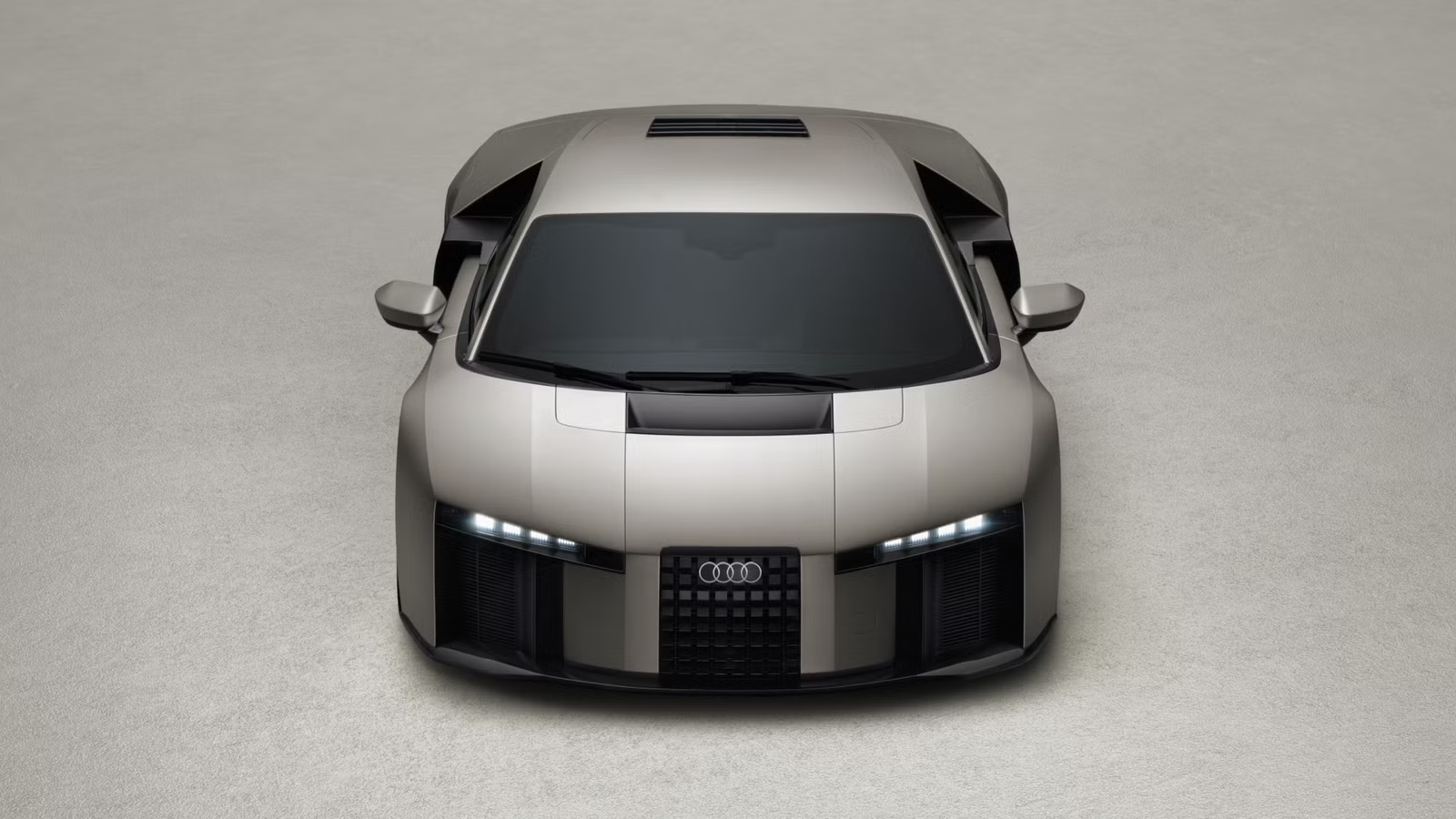
Audi has officially closed the R8 chapter and opened a new one. Revealed on June 4, 2026, the Nuvolari is the German brand’s first purpose-built supercar since the R8 ended production in 2024—and it arrives with a powertrain pulled straight from Lamborghini’s current lineup.
The Nuvolari isn’t a spiritual successor or a concept study hedging its bets. It’s a production supercar with a Lamborghini-sourced hybrid V8 at its core, a deliberate signal that Audi’s performance identity is moving in a fundamentally different direction than the naturally aspirated V10 era that defined the R8 for nearly two decades.
The R8 Is Gone—Here’s How It Ended
Audi Nuvolari
Audi
The original Audi R8 launched in 2006 and ran through two generations, becoming one of the most recognizable everyday supercars on the road. Its naturally aspirated V10, shared with the Lamborghini Huracán, made it a benchmark for accessible supercar performance. Production of the second-generation R8 ended in 2024, leaving a gap in Audi’s lineup that the brand spent roughly two years deciding how to fill.
Audi CEO Gernot Döllner had been publicly candid about the dilemma. As recently as late May 2026, he described a new R8 as a “good idea” while stopping short of confirming one—a careful hedge that, in retrospect, was covering for the Nuvolari announcement that was already in motion.
Lamborghini’s V8 Is Now Audi’s Supercar Engine
Audi Nuvolari
Audi
The Nuvolari draws its powertrain from the Lamborghini Temerario—the twin-turbocharged V8 that replaced the Huracán’s V10 and redefined what a Lamborghini could sound like at 10,000 rpm. Audi CEO Döllner had specifically praised that engine in public comments before the reveal, calling out its character as exactly the kind of performance benchmark Audi needed to anchor a new supercar.
The Nuvolari pairs that V8 with a plug-in hybrid system, following the same PHEV architecture that underpins the Temerario. Combined system output figures and the precise torque number had not been officially confirmed in detail at the time of the reveal, but the platform is the same one Lamborghini uses to produce over 900 combined horsepower in the Temerario. Audi’s application may be tuned differently to suit its own performance and efficiency targets. The shared chassis and PHEV V8 architecture represent the deepest powertrain integration between the two Volkswagen Group siblings since the R8 and Huracán shared their V10.
Related
Lamborghini Was Right To Cancel Lanzador EV, And Ferrari’s Luce Flop Proves Why
Lamborghini’s CEO says canceling their first EV was the right call—and a struggling supercar debut proves his point.
How The Nuvolari Positions Itself Against The Old R8
Audi Nuvolari
Audi
The R8 was always the approachable supercar—daily-drivable, relatively understated in design, and priced below the Huracán it mechanically mirrored. The Nuvolari appears to move Audi upmarket. The name itself is a tribute to Tazio Nuvolari, the legendary Italian racing driver who won the 1935 German Grand Prix in an Audi predecessor car—a deliberate reach into motorsport heritage that the R8’s naming never attempted.
Design details from the reveal point toward a more aggressive visual identity than the R8 carried. Where the R8 wore its performance quietly, the Nuvolari is positioned as a statement car—one that doesn’t need to borrow credibility from a Lamborghini badge because it’s carrying Lamborghini hardware under its own skin. Pricing had not been officially confirmed at the reveal, but the platform and positioning suggest it will sit above the R8’s final-generation price range.
What The Lamborghini Engine Choice Says About Audi’s Direction
Audi Nuvolari
Audi
Choosing a Lamborghini-derived hybrid V8 over developing a bespoke Audi unit—or pursuing a fully electric route—is a deliberate brand statement. Audi’s CEO has confirmed the Audi TT replacement will be electric-only, which makes the Nuvolari’s combustion-hybrid heart even more pointed. This is not a car hedging toward electrification; it’s Audi asserting that its supercar identity belongs in the high-revving, turbocharged hybrid space that Lamborghini is already defining.
The VW Group’s internal platform-sharing strategy makes this move logical from an engineering standpoint, but the brand implications run deeper. Audi is effectively telling its performance audience that the future of its halo product isn’t a scaled-up RS model or an EV flagship—it’s a proper supercar with Italian racing DNA in its engine bay. For Audi devotees who mourned the R8’s end, the Nuvolari answers the question of what comes next. Whether it can build the same kind of cultural attachment the R8 earned over 18 years is a longer story.
TopSpeed’s Take
Audi Nuvolari
Audi
The Audi Nuvolari feels like more than an R8 replacement; it is Audi drawing a hard line between its past and future. The R8 earned its reputation with understated looks, everyday usability, and that unforgettable naturally aspirated V10, but the Nuvolari signals a more aggressive, more exotic direction built around Lamborghini’s hybrid V8 tech. It may upset purists who wanted another analog-feeling Audi supercar, but this is the kind of bold halo car Audi needed to prove its performance brand still has a pulse.
Sources: Audi USA
