

Transmissions are pretty boring these days. The GLI is currently the only manual-equipped VW in the land. Corporate cousins and competitors alike have dropped three-pedal solutions, putting the stick-shift into near-extinction. As high-torque twin-turbo and hybrid applications proliferate the marketplace, hybrid power-split gearboxes, CVTs, and new 8-, 9-, and 10-speed automatics are dominating much of the landscape. Widespread parts-bin sharing, with dozens of models relying on identical, mass-produced global transaxles, is the name of the game. Still, within the endless sea of generic gearboxes, a passionate handful of performance-obsessed innovators are still building bespoke transmissions as a high-tech art form for deep-pocketed fans.
2026 Koenigsegg Jesko: Light Speed Transmission (LST)
5.0L Twin-Turbo Flat-Plane V8, 1,600 hp, 1,106 lb-ft, RWD, 0–60 mph: 2.8 s
Imagine having nine perfectly meshed gearboxes ready to engage, and being able to choose which one to select at any moment, and you’re in the conceptual ballpark of the Koenigsegg Jesko’s transmission, the LST. Where conventional dual-clutch setups rely on two shafts and a pair of clutches to pre-select an adjacent ratio, Koenigsegg’s LST instead packages nine forward speeds and seven wet multi-disc clutches into a highly compacted case that weighs just 198 lbs.
Thanks to a predictive system called Ultimate Power On Demand (UPOD), the Light Speed Transmission simultaneously engages and disengages the relevant clutch combinations to jump across multiple gear shafts in as little as 2 milliseconds. As explained by the automaker, UPOD technology “selects the optimum gear for maximum power with a light speed gear change, regardless of whether that gear is 1, 2 or even 5 gears away. If you are in 7th gear and 4th is the optimal gear for maximum acceleration, UPOD can bypass downshifts to 6th and 5th gear and put the car directly from 7th to 4th – in light speed.”
2026 Koenigsegg Gemera: Light Speed Tourbillon Transmission (LSTT)
5.0L Twin-Turbo V8 + Dark Matter E-Motor, 2,300 hp, 2,028 lb-ft, AWD, 0–60 mph: 1.9 s
On duty in the V8-poweredGemera, Koenigsegg’s Light Speed Tourbillon Transmission (LSTT) is a significant structural evolution over the original LST. Instead of sitting behind the mid-mounted engine, the LSTT uses an intricate series of gear-train cassettes that flank the 5.0-liter twin-turbo V8 engine block. This was a packaging necessity for the four-seat hypercar, and involved splitting the gear paths into two side “cassettes” that hug the crankcase in a compact Y-formation.
In this way, Koenigsegg kept the entire powertrain tightly packaged within the wheelbase while lowering the center of gravity. It’s all integrated with Koenigsegg’s 800-hp Dark Matter six-phase electric motor to achieve true four-wheel drive.
Christian von Koenigsegg notes: “We added a tourbillon to the name of the LST, as this mechanism represents the automotive equivalent of a high-end Swiss watch and is simply beautiful. This added complexity is what makes the LSTT unique and differentiates it from the regular LST.”
2026 Lamborghini Revuelto: 8-Speed Dual-Clutch e-Gearbox
6.5L Naturally Aspirated V12 + 3 E-Motors, 1,001 hp, AWD, 0–60 mph: 2.3 s
Lamborghini’s e-Gearbox is a transmission and hybrid drive system packaged into the space where the Countach of the ’80s used to keep its differential. It exists because hybrid tech was giving Lamborghini a packaging problem.
Usually, a V12-powered Lambo directs its output forward into a transmission positioned in the cabin tunnel between the seats, then routing power backwards to the differential. With the Revuelto, the transmission was evicted from that center tunnel to free up space for a 3.8 kWh hybrid battery, so the engineers got creative. A newly developed, transverse-mounted 8-speed dual-clutch gearbox was the solution, now mounted directly behind the 6.5-liter V12.
To preserve the car’s proportions and balance, this transmission had to be compact, cleverly designed, and capable of handling the additional torque input of an electric motor. Part of the compacting came from the lack of a mechanical reverse gear, with backing up now handled entirely by battery drive.
“Total weight is just 193 kg (426 lbs), which includes a new component fundamental to the car’s hybrid architecture: the rear electric motor,” explains Lamborghini. “Located above the gearbox, this electric motor doubles as the starter motor and generator. Reverse gear is provided by the two front electric motors, although if extra momentum is needed the rear electric motor can also kick in, driving all four wheels in zero-emission mode even when reversing.”
2026 Porsche Taycan: Rear-Axle Two-Speed Planetary Transmission
Dual Permanent Magnet Synchronous E-Motors, 938 hp, 818 lb-ft, AWD, 0–60 mph: 2.3 s
The Porsche Taycan EV has an interesting piece of hardware bolted between its rear wheels: a two-speed transmission. To meet the expectations of shoppers after Porsche’s first take on an EV, the Taycan needed to be able to repeatedly hit fast launch-control sprints while simultaneously delivering freight-train pulling power at higher speeds. While some EVs deliver their most impressive pulling power at lower speeds, Porsche’s engineers wanted Taycan drivers to feel the speed building as the tachometer climbed deeper into triple digits on the Autobahn.
The solution was pairing a single-speed front reduction axle with an intricate, three-shaft two-speed transmission mounted directly on the rear drive unit. Inside the rear housing, a gearset provides a roughly 15:1 reduction ratio in first gear, which amplifies launch torque to tire-shredding levels. Once the Taycan is rolling, clutches shift seamlessly into a taller second gear for sustained high-speed efficiency. Pay close attention during a full-throttle run, and you will probably feel and hear a subtle gearshift from the rear of the Taycan.
“Roughly 15 revolutions of the motor represent one revolution of the wheel,” explains Porsche, on the Taycan’s first gear. “This results in a very high wheel torque of almost 12,000 Nm [8,851 lb-ft], which allows breathtaking acceleration from a standing start. Second gear has a ratio of around 8:1 like the transmission on the front axle. Eight revolutions of the electric motor thus represent one revolution of the wheel. This enables a top speed of 260 km/h typical of a sports car and acceleration reserves at high speeds. The rear axle has a controllable differential lock.”
2026 Porsche 911 GT3: Motorsport-Derived 7-Speed PDK
4.0L Naturally Aspirated Boxer-6, 502 hp, 331 lb-ft, RWD, 0–60 mph: 3.2 s
No dead weight is permitted in the Porsche 911 GT3, so engineers removed the 8th overdrive gear ratio from their 8-speed PDK dual-clutch transmission, creating a lightweight, track-ready 7-speed unit that sheds unnecessary weight. The gearbox also gets a shorter final drive ratio for easier access to the engine’s power curve, backed by hardware and software upgrades to support extended motorsports driving.
“For both the PDK and the GT sport manual transmission, the final-drive ratio is eight percent shorter,” notes Porsche. “This enhances agility and high-revving exhilaration in all gears, as well as noticeably improved overall dynamics.”
Unlike conventional automatics, this unit can execute some of the most dramatic 9,000 RPM gearshifts seen in any road car, perfectly rev-matched every time.
2026 Koenigsegg CC850: Engage Shift System (ESS)
5.0L Twin-Turbo V8, 1,385 hp, 1,022 lb-ft, RWD, 0–60 mph: 3.0 s
Performance car transmission choices have always amounted to automatic, manual, or something somewhere in between. With Engage Shift System (ESS) in the Koenigsegg CC850, drivers now have an additional choice: both.
Built around the 9-speed, multi-clutch LST mentioned above, the ESS adds a physical six-speed gated shifter and a functional foot clutch pedal. There are no shift forks, cables, or synchronizers, but sophisticated actuators and force-feedback motors are used to simulate the distinct resistance, gate detents, and even stall characteristics of an authentic analog manual. Done ripping through the gears? Simply shift back into drive and let the LST do the work for you.
According to the automaker, “the ESS combines a 6-speed manual shifting experience, complete with clutch pedal, with a fully automatic transmission with super-fast and frictionless shifting. The driver can choose their preferred experience and can switch modes at any time.”
2026 Rimac Nevera: Dual-Axle Multi-Gearbox Electric Drive System
Quad Permanent Magnet Electric Motors, 1,914 hp, 1,741 lb-ft, AWD, 0–60 mph: 1.74 s
Building a differential to handle four-digit power and torque figures is straightforward enough when designing earth-moving equipment, but considerably more challenging when designing a lightweight electric exotic. For that application, the Rimac Nevera does away with conventional differential design altogether, ditching the central transaxle entirely for a more modern, per-wheel layout with four separate gearboxes.
According to Rimac, two front wheels are powered by separate one-speed gearboxes that each handle 1,106 lb-ft of torque. In the back, two rear gearboxes are mounted in one housing with torque shifted left to right by electric motor control, no differential required. With input speeds reaching 18,000 rpm, the motors driving each wheel act as a separate powertrain for each, with the ability to adjust torque output 100 times every second.
2026 Pagani Utopia: Transverse 7-Speed Manual / AMT by Xtrac
6.0L Twin-Turbo 60° V12, 864 hp, 811 lb-ft, RWD, 0–60 mph: 2.9 s
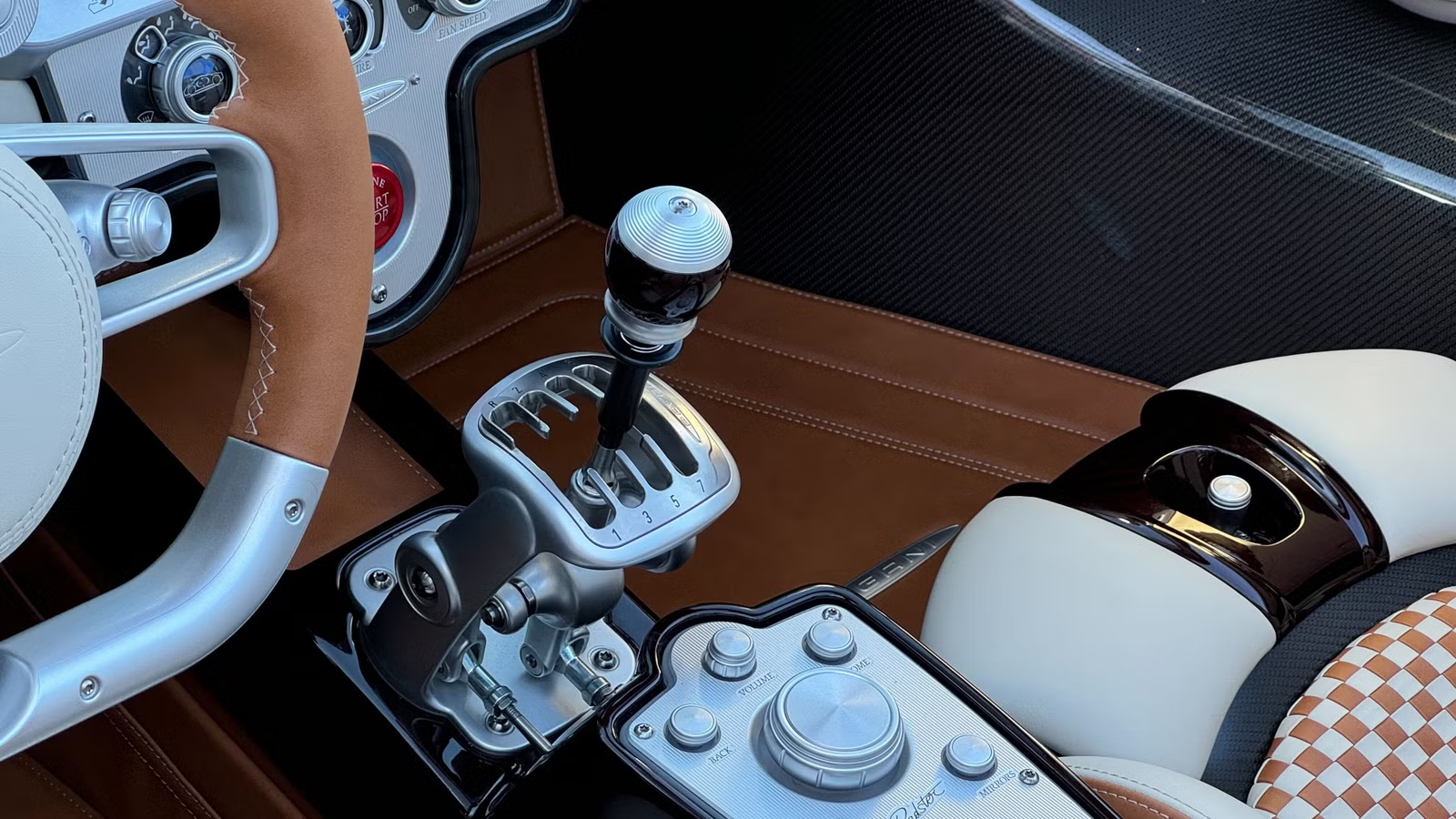
When designing the Utopia, Horacio Pagani asked loyal clients what they wanted most, and the loud and clear answer was a manual transmission. With big-dollar exotics relying mainly on dual-clutch gearboxes or purely electric drive, creating an old-school gearbox appropriate for the job was no easy feat. To that end, Pagani teamed up with motorsport specialist Xtrac to build an entirely bespoke seven-speed transmission capable of enduring tremendous stress from the twin-turbo V12 to which it is mated.
The resulting gearbox is mounted transversely behind the twin-turbo AMG V12, pairing helical gears with an electro-mechanical differential and a race-spec triple-disc clutch. Buyers can pick between an automated manual (AMT) or a true gated manual with exposed linkages that lets you work the clutch pedal yourself.
This lightweight solution represents the quickest-shifting gearbox possible with helical gears. “It was not an easy task to design such a gearbox with synchronizer rings and a mechanism able to handle 1,100 Nm [811 lb-ft] of torque, but it was an essential requirement for Utopia,” notes Pagani.
Ferrari 12Cilindri Manuale: A Dual-Clutch Automatic With A Fake Manual
V12, 819 hp, RWD, Slower Than The Automatic
Ferrari’s “Manuale By-Wire” system in the limited-edition 12Cilindri Manuale brings three pedals and a physical open-gate shifter back to Maranello. Purists may call it a fake manual, but the underlying engineering is genuinely impressive.
Rather than detuning its 819-hp, 9,500-rpm V12 to suit a fragile legacy gearbox, Ferrari mated an authentic physical gate and clutch-by-wire pedal to its eight-speed dual-clutch transmission. Sensors measure pedal travel and gear selection down to the millimeter, triggering real physical force feedback while letting you skip gears, heel-toe, or even stall if your footwork slips.
The gate controls gears one through six, leaving seven and eight for highway cruising. It sacrifices none of the modern V12’s brutal performance, yet restores the tactile drama, rhythm, and involvement of an analog gated supercar. Ferrari didn’t just digitize a stick shift – they preserved driving engagement for the high-output era.
Sources: Koenigsegg, Lamborghini, Porsche, Rimac, Pagani, AutoCar, Drive.com.au
