

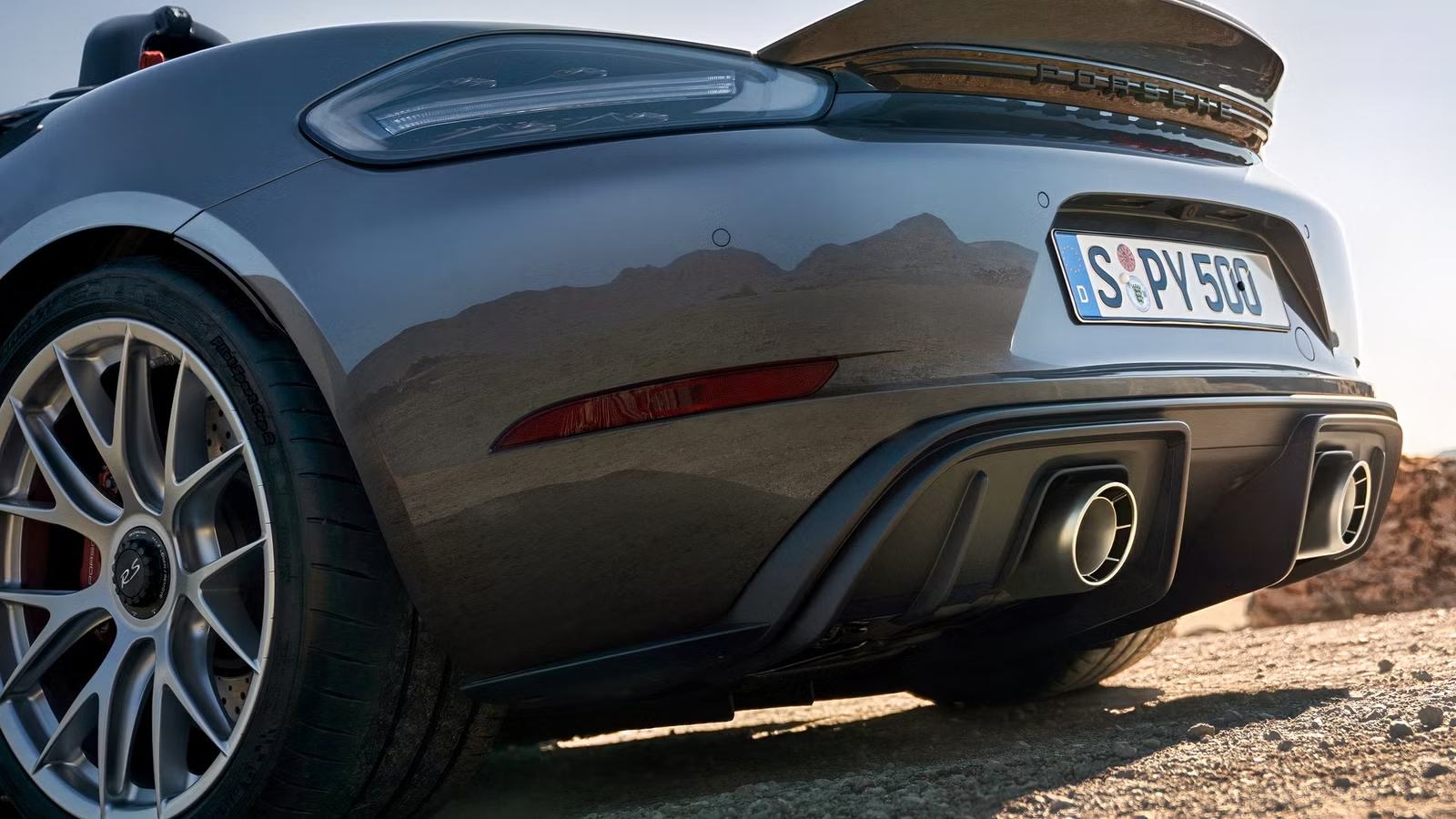
Mid-engined cars occupy a fascinating paradox in the automotive world: the layout that engineers consider closest to ideal for handling is also the one you’ll almost never find in a showroom. Tucking the engine behind the occupants but ahead of the rear axle delivers near-perfect weight distribution, yet it devours cabin space and complicates packaging in ways that make accountants nervous. The result is a configuration reserved almost exclusively for sports cars — and a surprisingly short list of models that have actually sold in meaningful numbers.
In a sports car, practical considerations are less of an issue, and that’s where you’ll find the majority of mid-engined offerings. Cars like the Chevrolet Corvette C8, Toyota MR2, and, of course, the Porsche Boxster and Cayman. Each one is known for its handling finesse, thanks in large part to that centrally mounted engine. But which is the best-selling of all time? Read on to find out.
The Porsche Boxster/Cayman and a Short History Lesson
986 Boxster, Weissach, 1993, Porsche AG With ExecutivesPorsche
2006 Porsche Boxster S 987.1
Engine
3.2-liter flat-six
Power
280 hp
Torque
236 lb-ft
0–60 mph
5.5 seconds est
The best-selling mid-engined car ever is: the Porsche Boxster/Cayman duo. They earn this accolade partly because of a long production run (since 1996 for the Boxster and 2005 for the Cayman) and because official Porsche production figures combine Boxster and Cayman data — yet few other mid-engined offerings come anywhere close.
The hardtop Cayman is now in its third generation, having been introduced alongside the second-gen 987 Boxster, and runs it close on sales figures each month. To better appreciate the success of these mid-engined marvels, it’s worth taking a quick look back at how they became such an integral part of Porsche’s lineup.
2004 Porsche Boxster S Exterior With Mountains In Distance Porsche
Porsche is best known for its range of iconic 911 sports cars, which carry their engines defiantly over the rear axle. This rear-engined layout is, in theory, prone to oversteer — but decades of engineering refinement have produced a sports car that routinely defies the laws of physics. Mostly.
Even the most gifted engineers, however, must concede that placing the engine between the axles is the optimal solution when ultimate handling balance is the goal. One of Porsche’s earlier attempts, the 914, was an awkwardly styled mid-engined creation that handled superbly but was hamstrung by underpowered engines — most likely to avoid overshadowing the contemporary 911.
Fast-forward to 1996, and a similar dynamic played out as the 986 Boxster was announced. Developed in tandem with the first water-cooled 911, the 996, it arrived at the perfect moment to capitalize on the roadster craze ignited by the Mazda Miata MX-5 seven years earlier.
2006 Porsche Boxster S front shot. movingPorsche
The mid-engined Boxster shared much of its engineering DNA with the new 911, but, like the 914 before it, was fitted with a less powerful engine. The launch model used a 201-hp 2.5-liter flat-six, compared to the 296-hp 3.4-liter unit hanging out the rear of the 996. Performance was decent, with a 0–60 mph time of 6.7 seconds, but incremental capacity increases and technology improvements made the Boxster a far more convincing sports car over the following years.
Sales were strong from the start, and this model, along with the Cayenne SUV, was largely responsible for bringing Porsche back from the brink of financial ruin. The second-generation Boxster arrived in late 2004, followed by the hardtop Cayman a year later. The 981 succeeded the 987 in 2012, and this marked the first time that a 911 engine was fitted to both the Boxster and the Cayman — in this case the 3.8-liter flat-six from the contemporary Carrera S, albeit in slightly detuned form.
2014 Porsche Cayman Yellow Front Angled ViewPorsche
The fourth-gen 982 followed in 2016 and is more commonly known as the 718 Boxster or Cayman. This is where four-cylinder turbo engines replaced the lower-rung six-cylinder models, but the introduction of a 4.0-liter flat-six in top-spec variants helped quell the critics somewhat. Porsche even introduced some proper RS variants that are genuine track-focused sports cars. After almost 30 years of production, one thing has remained constant across all mid-engined Porsche models: they have always been the best-handling offerings in their class.
What Of The Other Mid-Engined Contenders?
2023 Chevrolet C8 Z06 x2 Convertible Red Rear Coupe Orange FrontChevrolet
Make and Model
Model Years
Estimated Production Numbers
Autozam AZ-1
1992-1994
4,300
Honda Beat
1991-1996
33,600
Smart Roadster
2002-2005
43,091
Chevrolet Corvette
2020-2025
184,397
Pontiac Fiero
1984-1988
370,168
Porsche Boxster/Cayman
1996-2025
578,612
While official Porsche production figures combine the Boxster and Cayman, slightly more Boxsters were produced each year, and the Cayman only entered production in 2005. Even so, the combined figures dwarf virtually every other mid-engined car. Exotics like the Lamborghini Gallardo (14,022 built) and Ferrari 355 (11,273 built) come nowhere near these numbers, and even far more affordable offerings often sold in very limited runs.
The cheap and cheerful Smart Roadster was produced between 2002 and 2005, and while it sold reasonably well, it pales in comparison to the Boxster/Cayman figures. The quirky Honda Beat Kei car was a tiny sports car designed to exploit the lower tax rates applied to diminutively proportioned vehicles in Japan, but it too was available only in limited numbers over a short production run. The gullwing Autozam AZ-1 Kei car sold in even fewer numbers.
2000 Toyota MR2 front 3/4Toyota
The Chevrolet Corvette C8 raised a few eyebrows when it arrived for the 2020 model year. A mid-engined configuration had been considered numerous times before, but this was the first time such a radical change had been made to a production Corvette. It turned out to be exactly what was needed to keep the Corvette ahead of the competition, and sales have been steadily increasing each year. Given another decade, it will be interesting to see how the C8 fares against the Porsche benchmark.
1984-1988 Pontiac Fiero Silver Front Angled ViewBring A Trailer
Aside from a propensity for catching fire, the sporty little Pontiac Fiero was a decent American sports car that sold in big numbers and was available with a V6 engine that gave it passable performance. Plans for a second-generation model were shelved due to low profitability and slowing sales in later years. Analyzing the figures, it remains the best-selling mid-engined vehicle over a single model run, even though it was in production for just five years.
Why Are Mid-Engined Cars So Rare?
2012 Audi R8 GTBring A Trailer
Global car production has averaged between 60 and 97 million vehicles each year over the past 25 years. The total number of mid-engined cars produced over the last 50 years is not much more than one million — a tiny fraction of total output, and there are several good reasons why.
Mid-engined cars are more expensive to design, less space-efficient, and can be tricky to service. They are, however, the best configuration for sports cars where ultimate handling and responsiveness trumps all other considerations. That’s why Formula 1 cars are mid-engined, and SUVs are not. Well, the Toyota Previa minivan was mid-engined, but that was a pretty cool one-off anomaly.
Some manufacturers find that a front-mid-engine layout is a workable compromise. This is where the engine sits on or behind the front axle but ahead of the passenger compartment. Moving the majority of the weight inside the wheelbase improves handling, though it still compromises cabin space — which is why the arrangement is most common on sporty cars.
Porsche Will Keep Adding To That Figure
Front and rear shot of a 2024 Porsche 718 CaymansPorsche
We didn’t include the 2026 figures because they aren’t out yet. Given the massive gap between the Corvette and the 718, it will still be a few years before the Corvette takes the crown. Also, the Porsche is coming back, just not as we maybe want it.
The future of the Porsche 718 represents a bold paradigm shift as Zuffenhausen transitions its entry-level sports car family entirely to electric power.
With internal combustion 718 Cayman and Boxster models officially sunsetting, Porsche is engineering an all-electric successor to redefine mid-engine performance. To preserve its legendary agility, Porsche developed an innovative “e-core” battery arrangement that stacks modules vertically behind the seats rather than under the floor, mimicking traditional mid-engine weight distribution and low seating dynamics.
Expect instantaneous electric torque paired with advanced 800-volt architecture for rapid charging speeds and track-ready thermal management. While purists may mourn the loss of the high-revving flat-four and flat-six engines, Porsche aims to prove that electric propulsion can deliver genuine emotional engagement and razor-sharp handling. As the iconic 911 retains its combustion powertrain, the next-generation electric 718 serves as the benchmark for how lightweight, driver-focused sports cars will thrive in the electric era.
Sources: GM, Honda, Porsche, Toyota, Statista, GoodCarBadCar, Statista.com
