

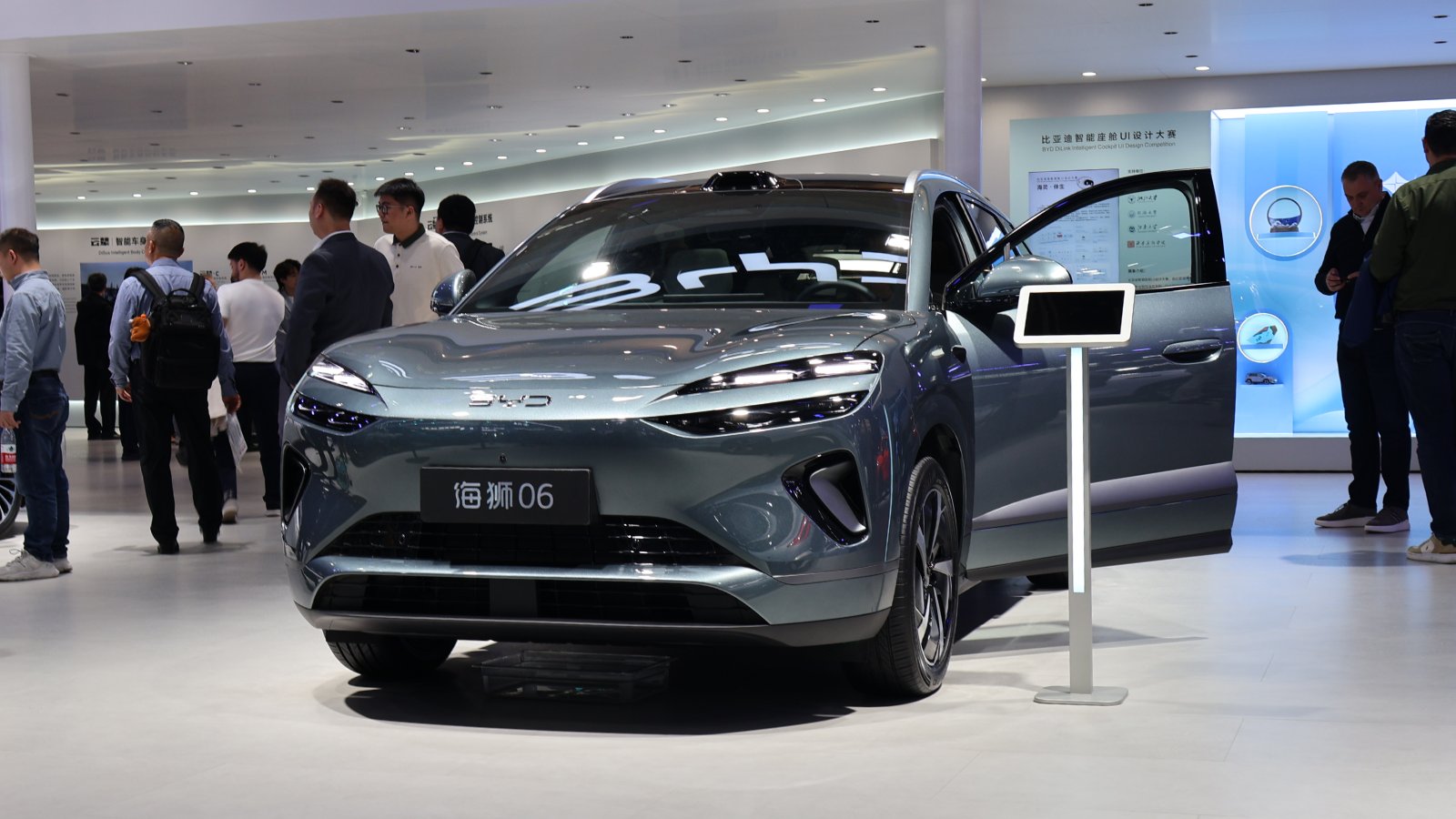
A BYD Sealion 06 SUV on display at the Beijing Auto Show in April 2026. Credit: CnEVPost
- BYD will use existing manufacturing capacity at Sime Darby’s Inokom, with models and production timing yet to be announced.
- Plans to build its own plant were reportedly shelved, while local assembly will help BYD navigate import restrictions and market competition.
BYD (HKEX: 1211) has selected a local vehicle assembly partner in Malaysia, advancing plans to produce EVs in the Southeast Asian market after reportedly shelving plans to build its own plant.
BYD Malaysia said on Thursday that it had appointed Inokom Corporation Sdn Bhd, based in Kulim, Kedah, as its completely knocked-down (CKD) assembly partner.
Inokom, part of Sime Darby Bhd (KL), already assembles vehicles for several global automakers in Malaysia. Sime Motors, another unit of the group, is also BYD’s official distributor in the country.
The companies formalized the partnership through a memorandum of understanding signed at BYD’s global headquarters in Shenzhen. The models to be assembled and the production timeline have yet to be announced.
BYD and Sime Darby representatives mark an agreement to advance local vehicle assembly in Malaysia through Inokom. Credit: BYD Malaysia
BYD said the selection followed an assessment of local market conditions and manufacturing capabilities, with Inokom’s existing facilities, skilled workforce and supply chain supporting the assembly plans.
Local assembly is an important part of BYD’s long-term commitment to Malaysia, and partnering with Sime will allow the company to draw on established automotive manufacturing capabilities, said Jacob Ma, managing director of BYD Malaysia.
The arrangement will see BYD work with a local partner to expand its manufacturing footprint. The company announced plans in August 2025 to build a CKD plant in Malaysia, with production then expected to begin in 2026.
However, local news outlet The Edge reported in September that BYD had dropped plans to build its own assembly plant in Tanjung Malim, Perak, while remaining committed to local CKD operations.
Conditions for the original project included exporting up to 80% of output, with the remaining 20% sold locally priced above 200,000 Malaysian ringgit ($48,980) per vehicle, according to an earlier report by The Edge.
Local assembly is becoming increasingly important to keeping BYD’s mainstream models competitive. Under the CKD model, vehicles are imported as parts and assembled locally, qualifying for different policy treatment from fully imported vehicles.
Since July 1, Malaysia has required imported fully built battery electric vehicles to have a minimum declared cost, insurance and freight (CIF) value of 200,000 ringgit and a power output of at least 180 kW (245 hp), according to The Edge.
The threshold applies to the declared import value rather than the retail price. Some of BYD’s best-selling EVs in Malaysia retail for less than 200,000 ringgit, making local assembly more pressing.
BYD entered Malaysia’s passenger car market in December 2022 with the Atto 3, named Yuan Plus in China. The assembly partnership further expands its collaboration with Sime Darby.
The company is also advancing its local commercial vehicle plans. In August, BYD signed a memorandum of understanding with Malaysian bus manufacturer Bus Cap Berhad to explore establishing electric bus assembly and manufacturing facilities in Perak.
The Atto 8 is scheduled to go on sale in Europe in the first quarter of 2027 and can charge from 10% to 97% in just 9 minutes.
($1 = 4.0835 Malaysian ringgit)
