

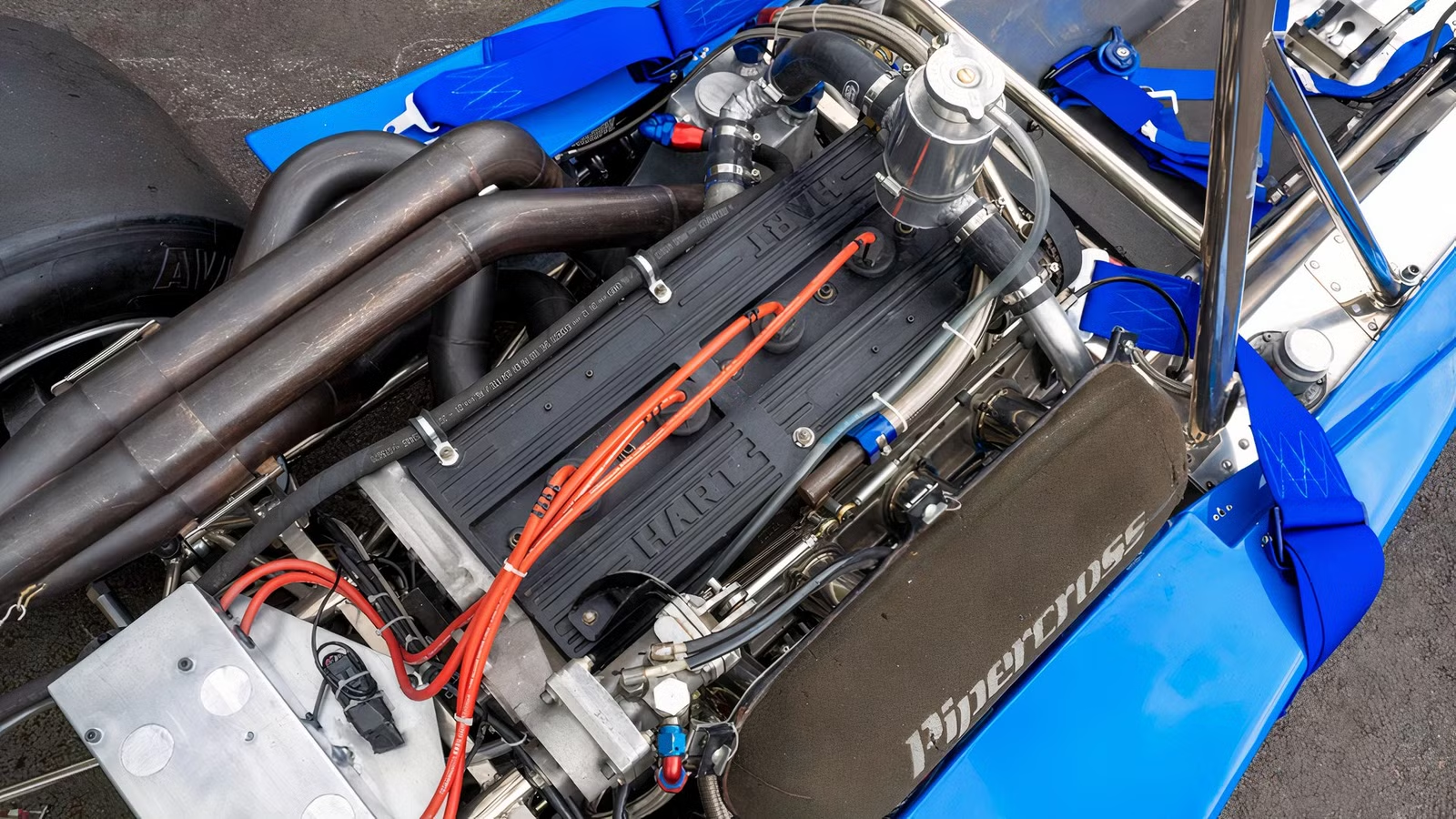
Measuring just 2.0 liters and producing up to 305 horsepower, the Hart 420S stormed onto the Formula 2 open-wheel racing scene as one of the lightest 300-horsepower competition engines of its day. The mill reportedly weighed as little as 220 pounds, and its main objective was to remove as much weight as possible, giving whichever car that used it a definitive handling advantage. The Hart 420S was also destined for sports-car racing, giving it a broad scope of potential applications.
Independent engine builder Brian Hart built the 420S amid a sea of more famous brand names, such as Ford and Cosworth. However, careful engineering and a few strokes of clever development made his powerplant one of the most definitive racing mills of the 1970s. The best part? It didn’t use any forced induction, relying solely on its ability to rev high and take in a huge amount of air for its size.
The Secret To Its Large Power Output Was Revs
Hart 420S engineRaceCarsDirect.com
When designing an engine to make a lot of power without forced induction, its ability to breathe well and spin quickly becomes paramount. The Hart 420S’s small displacement meant it needed both attributes in spades. With up to 305 hp on tap, the mill’s specific output measured a whopping 152.5 horsepower per liter. That’s akin to a modern Porsche 718 Boxster’s flat-four, and even that uses a turbo.
To fully understand what the Hart 420S could do, it’s best to understand the relationship between an engine’s horsepower, torque, and engine speed. Horsepower measures an engine’s ability to produce power over time, whereas torque is the sheer amount of rotational — or twisting — force an engine can generate. In addition, rotational speed (rpm) is how fast the engine can spin.
The Hart 420S needed to be designed in such a way to provide a good bit of useful torque through the middle and upper section of the rev range, rather than just at the bottom. That way, the engine wouldn’t run out of steam around a racetrack once it hit a certain rpm, therefore keeping it more competitive on the track. For comparison, conventional turbocharged engines deliver most of their power in the mid- to high-rev range.
Brian Needed To Make The Hart 420S Engine Breathe
1972 Surtees-Hart TS10 Formula 2 carWikimedia Commons: Brian Snelson
The 420S was closely based on the Cosworth BD engine family, which Brian Hart personally helped to design. Using his existing knowledge, he knew small, lightweight racing engines needed cylinder heads with extremely high airflow rates. They also required optimized intake passages, big valves, and precise camshaft timing to let the engine take advantage of all the above.
The Hart 420S had dual overhead camshafts and four valves per cylinder, features shared with the broader Hart 420 engine family. Because it didn’t rely on a turbocharger to force more air into the cylinders, Hart’s big-valve architecture meant the mill could suck in as much air as possible, and keep on doing so high into the rev range without having to risk losing peak power.
Its cylinder head needed to be up to the task, too. It was made from aluminum alloy, much like the engine block it mated to, and shared much of its core design with the Cosworth BD engine. It used small-port castings, a practice rarely seen in small, naturally aspirated engines anymore, along with pent-roof combustion chambers that made four valves per cylinder easier to manage.
Weight Was Just As Important As Breathing
Hart 420S engineRaceCarsDirect.com
When Brian Hart was working on his 420S and subsequent engines, portions of the racing field were moving more and more toward extracting as much power from the smallest possible package. The situation meant the engines needed to be lightweight, but also sturdy enough to withstand the forces experienced in racing. Some earlier competition engines used cast-iron blocks, but Hart decided to use a lighter, all-aluminum block.
The engine’s weight also mattered in the racecar itself. Where the engine sat mattered, as the placement altered the racer’s entire handling profile. By reducing the powerplant’s mass, a builder can better tailor the car’s behavior on the track without having to compromise as much as you would with a heavier mill. An aluminum racing engine is a good start, but the rest of it needs to be lightweight, too, without sacrificing too much strength.
The Hart 420S used special silicon-aluminum alloy pistons designed by Muhle, which were reportedly exceptionally lightweight. They were paired with shot-peened, balanced forged steel connecting rods and a forged high-tensile-strength steel crankshaft. The mill’s main bearing caps are also cast directly into the sump, giving the lightweight engine a big boost in structural rigidity without having to add much extra bracing.
Hart Forged His Reputation By Facing Down The Big Boys
A BDA Cosworth Engine pulled from a Ford Escort RS1600.Perfect Touch | London
Once getting into the performance engine field, Brian Hart worked for Cosworth. There, he honed his skills and built relationships with a few folks in the field. Then, he moved over to Ford, which had a close relationship with Cosworth. He developed the FVA and BDA engine families and, in 1969, decided to strike out on his own. Using what he’d learned along the way, he developed the Hart 420R mill, based on the Cosworth FVA. There was also the 420S, which was based on the Cosworth BDA design.
The 420R went on to become a successful Formula 2 engine, producing a similar amount of power to the near-identical 420S. Once word of Hart’s success spread, his name became etched into the fabric of racing engine pedigree. He’d eventually become involved in Formula 1 engine production, supplying engines to teams like Toleman and Jordan. By then, he was focusing on four-cylinder, V8, and V10 engines for various racing applications.
However, none of that would likely have been possible without the successes garnered by the 420 engine family and the 420S. It was an ambitious project, but the family’s multiple Formula 2 wins throughout the late 1970s and early 1980s proved Brian’s vision correct.
Sources: Historic Motorsport Central, Motorsport Magazine, Racecars Direct.
