

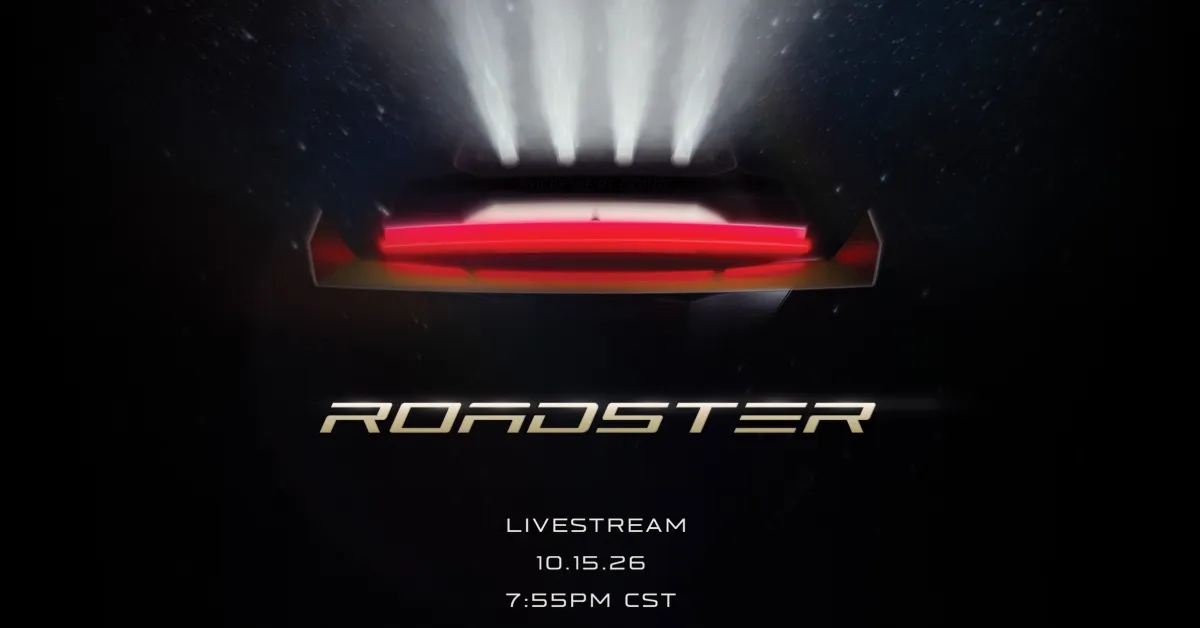
Tesla says it will finally stream its next-generation Roadster event this Thursday, October 15, at 7:55 pm Central, two weeks after it was supposed to happen.
It’s the latest date in a long list of them. Tesla first showed the Roadster in November 2017 and promised production in 2020. Nearly nine years later, it hasn’t delivered a single one.
The event was originally scheduled for October 1 in Texas. On September 28, Tesla called it off, saying it had been “tracking the weather closely with local meteorologists” and that the show “can only be held outdoors.” The new date was set for October 15, and Tesla confirmed the livestream time on X last night.
An outdoor-only event tells you what kind of show this is. Tesla isn’t planning a car launch in a showroom. It’s planning a stunt.
Every Roadster delay, so far
Here’s how we got here. The production timeline first:
- November 2017: Prototype revealed at the Semi event. $50,000 reservations, $250,000 Founders Series, production promised for 2020.
- July 2020: Pushed to 2021.
- January 2021: Pushed to 2022.
- September 2021: Pushed to 2023.
- May 2023: Musk said production would “hopefully” start in 2024, adding that “this is not a commitment.”
- February 2024: Musk said the design goals had been “radically increased,” with a demo by the end of 2024 and production in 2025.
- November 2025: Production moved to 2027 or 2028.
And then the unveil itself started slipping. A demo planned for the end of 2025 became April 1, 2026, a date Musk said gave him “deniability.” In March, it became late April. On the Q1 earnings call, it was “maybe in a month or so.” Then late May or June, then August or later as SpaceX worked on the cold gas thruster system. In mid-August, Musk teased a “flying” demo with no driver that month. That turned into October 1, which turned into October 15.
That’s at least six production slips and seven unveil dates. And this time, Tesla blamed the weather.
A thruster demo with a car attached
Everything Tesla and Musk have teased points in one direction: SpaceX cold gas thrusters. Musk has claimed 0-60 mph in under one second with them, and the demo has been scaled back from “flying” to a short hover. The demo car is reportedly remote-operated and not street-legal.
The teasers also point to a full redesign with Tesla’s angular “Cyber” styling, which we argued last month the Roadster never needed.
A recent filing for a fan-car patent to create a vacuum underneath the vehicle could also point to Tesla trying to demo the feature with some upside-down driving, which wouldn’t be the first time an automaker has attempted it.
Electrek’s Take
You would think that as someone with two referral award Roadster reservation, I would be excited about this, but I have a hard time getting excited about Thursday.
What people reserved in 2017 was a car: a four-seat, 620-mile, 0-60 in 1.9 seconds electric roadster for $200,000. That was already absurd for the time, and it would still be a great car today. Nobody put down $50,000 or $250,000 for a remote-controlled prototype that hops off the ground on compressed gas for a few seconds in a field in Texas.
But that’s what this event looks like it’s built around. A cold gas thruster gets a few bursts per tank, does nothing for you on a normal drive, and adds weight and cost. It’ll make a great clip for X and do nothing for the people waiting on a car.
The thing I’d want to see Thursday is boring: a production car, a real price, a real start of production, and a straight answer on what happens to the 2017 reservations. Tesla has shown the Roadster plenty of times. It has never shipped it.
If you’re waiting on a new EV, Roadster or not, the cheapest way to fuel it is with sunlight from your own roof. With electricity rates up almost 10% last year and expected to keep climbing, going solar is one of the best ways to protect yourself against rising costs. And with lease and PPA options, you can do it with zero upfront cost and start saving immediately. If you want to find the best deal, check out EnergySage. It’s a free service with hundreds of pre-vetted installers competing for your business, so you save 20 to 30% compared to going it alone. No sales calls until you pick an installer. Get your free quotes here.
FTC: We use income earning auto affiliate links. More.
