

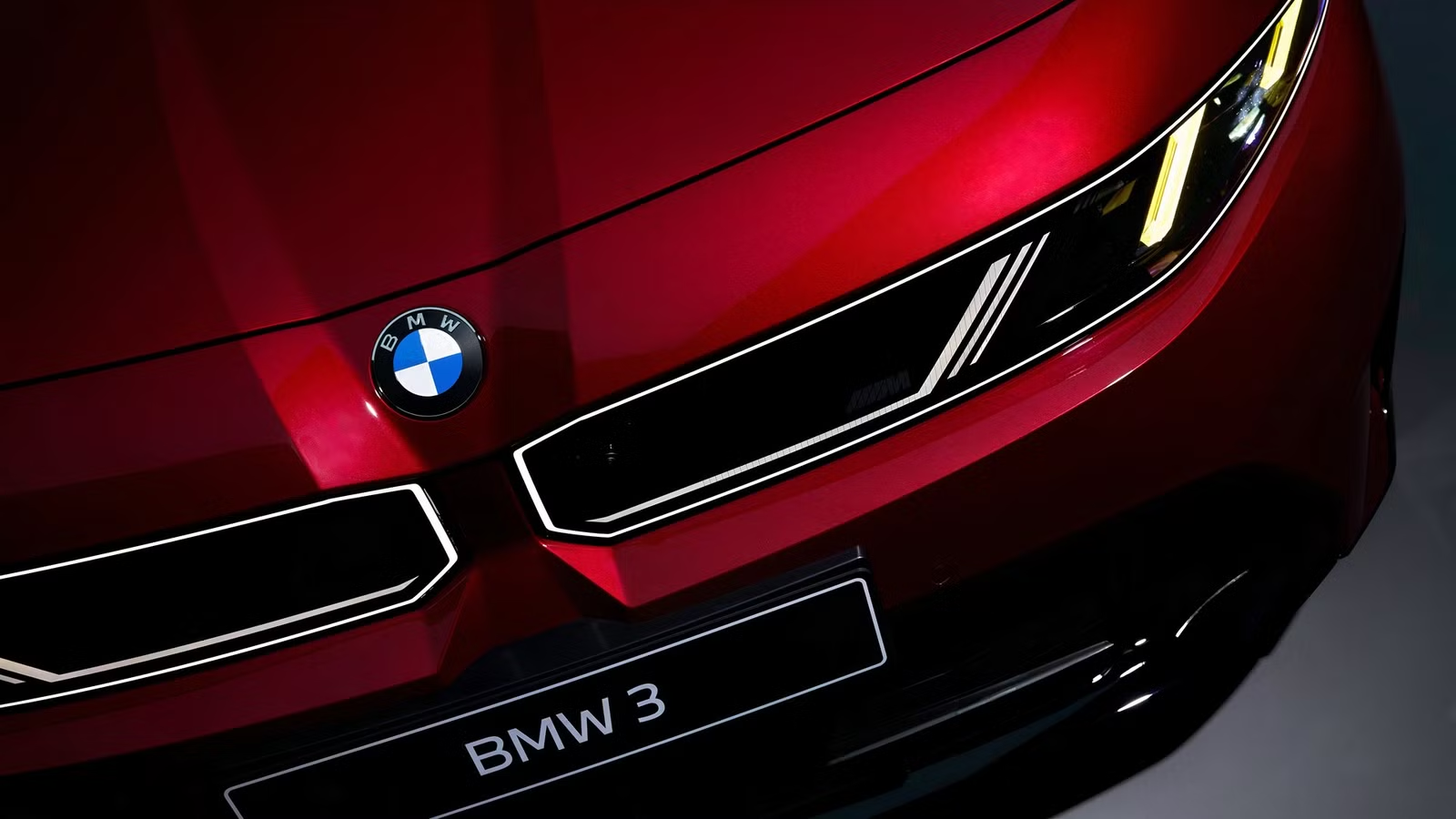
Diesel-fueled passenger cars never really took off in the United States, but American automakers have continued to develop these powerplants for heavy-duty pickups. Meanwhile, even European commuters who drive long distances daily have started looking at ultra-efficient gas engines as diesel prices have gone through the roof. BMW certainly knows this, and it’s why its latest generation of the 3 Series sedan does away with a diesel engine option.
Instead, the German manufacturer has gone all in on making its B48 four-cylinder and B58 six-cylinder engines as efficient as possible with hybrid systems. The company has been selling diesel-powered 3 Series models since the vehicle’s second generation way back in the 80s, but incoming regulations have forced the company to change strategy. It’s a shame, and here’s why.
Emissions Regulations Force BMW’s Hand
2027 BMW 3 Series introductionBMW
In Europe, the popularity of diesel was never restricted to heavy trucks like it was (and still is) in the US. It was great for business people who wanted to get across a country without stopping for fuel. Oil burners have been synonymous with the 3 Series since the model’s second generation (known internally as the E30) that went into production in 1982. In many parts of Europe, a “d” badge on the trunk lid meant fuel efficiency, bulletproof reliability, and sometimes a better driving experience thanks to all that torque.
Building a new engine has become extremely expensive, though, and with incoming Euro 7 regulations in Europe, the company thought that there was no point in redeveloping a powerplant that was slowly becoming the second choice behind new gas motors. That money would be better spent on creating the incoming plug-in hybrid model, which should be revealed within the next few months.
While it may be sad not to see a new diesel 3 Series on European roads, it’s simply a safer business decision. The four-cylinder 320d models (which never made it to America) were a safe bet for long-term ownership. However, fewer people are buying cars outright in the 2020s, too. In addition, people who have access to company car fleets can get great tax incentives on hybrid engines. There are very few use cases for a diesel engine that cannot be made up with an efficient (and usually cheaper to run) electrically assisted powerplant.
The New 3 Series Bets On Electrons Instead
2027 BMW 3 Series introductionBMW
The choice always used to be either diesel or gas for your new 3 Series. Now, the new choice is how much electricity you want running through the powertrain. That’s because there’s a mild hybrid, a fully electric version, and a confirmed plug-in hybrid joining them sometime in 2027. We don’t know the gas model’s exact range, but expect it to go farther than before thanks to a 48-volt system and switchable exhaust valves that apparently reduce engine drag torque by 66%.
The other option at the moment is the all-electric i3. While diesel has been losing popularity, electric vehicles haven’t yet been gaining popularity at the same rate. The switch may be slow, but the new EV’s 468-mile range means there are fewer reasons not to consider one. Pair that range with Europe’s fuel prices, plus the rise of solar panels, which makes electricity super-cheap, and it all just makes sense.
The plug-in hybrid version may be the best choice for most people. Diesel never really made sense for those with a short commute or who only used their cars to go grocery shopping. The 3 Series PHEV will have a useful electric range (some say around 50 miles), and if the owner has a wall charger at home, there might not be any reason to visit the gas station at all. With the new B48’s efficiency, the highway range should also be great.
Diesel Was Losing Popularity Anyway
2017 BMW M550d xDrive quad turbo dieselBMW
The diesel engine really peaked with the fifth-generation 3 Series (the E90), which launched in Europe in 2005 and came to the US for the 2006 model year. At times, diesel accounted for 80% of the model’s sales across Europe. At the time, gas engines weren’t quite as efficient, emissions restrictions weren’t as strict, and electric cars hadn’t taken off. The aftermarket exploded with the possibility for torque-filled engine tunes and ways to squeeze even more efficiency out of these powerplants, but that has truly died off now.
One of the reasons for this drastic change was the Volkswagen Dieselgate scandal, which pretty much destroyed the oil burner market in the US and created a distrust of this fuel type across Europe. Volkswagen pivoted massively to electric vehicles after this, and while BMW continued to offer the diesel 3 Series in some markets, its sales started to drop. In 2015, the market share in Europe was 50%, but in 2025, it’s under 10%.
We can’t imagine it returning any time soon. The Iran war and tariffs have caused diesel prices to explode all over Europe, which was the main buyer of these cars. Pair that with the requirement to use AdBlue, an expensive additive that reduces the harmful gases emitted, as well as exhaust gas recirculation valves that can notoriously get blocked, and you have a recipe where people look to hybrids as the future.
BMW Will Still Sell One Diesel Model In 2027
In 2027, if you’re in Europe and in the market for a diesel BMW, the only way to experience it is through the latest X5 SUV. In fact, the diesel engine is one of five powertrain choices, which is the most of any BMW ever. The diesel engine is the same B57 previously used in the M340d. However, it had to lose power to comply with the latest regulations. The engine has lost 40 hp and 37 lb-ft of torque compared to the old model, bringing the output to 308 hp and 494 lb-ft.
Those aren’t low figures, but the X5 40d xDrive trim wouldn’t be the first choice for most people thanks to these stats. The S68 V8 engine in the M5 was also detuned to comply with Euro 7 regulations, so it’s not just dirty diesels that are affected by this, leaving the electric motors to make up the difference in the M5. These slightly lower figures for the diesel probably mean it’s the last time we’ll see an oil burner under a BMW-badged hood.
What Other Automakers Still Make Diesel Engines?
2027 Audi A6 AllroadAudi2024 Kia Sorento Exterior front end during water crossing Kia
BMW isn’t alone in getting rid of most of its diesel cars. Only a few diesel cars remain in Europe, and they’re mostly there to pick up the pieces for those who still need to do incredibly long miles or need the pulling power. For example, the Kia Sorento 2.2-liter diesel engine has 324 lb-ft of torque, which is 40 lb-ft more than the base gas motor. That’s not a big difference, but it could help towing over long periods. With Euro 7 emissions coming in soon, our European readers shouldn’t expect to see this car much longer.
Audi still sells a diesel A6 sedan in many parts of Europe, but with BMW now taking a stand against them in their most famous model, we can’t imagine the other big German companies staying with this engine fuel for years to come. Audi’s attachment to the Volkswagen group means it will probably also cease development for funds to be allocated to its EV program. In the US, there are still diesel trucks, of course, and we can’t see these leaving any time soon with the relaxation of emissions regulations.
Sources: BMW
