

Dropping $30,000 on a highly depreciated used Volvo S90 instead of a sensible new Subaru Forester isn’t a smart move for everybody. Still, for those willing to mitigate the challenges and risks, choosing to travel in a slightly used luxury flagship can be an excellent way to elevate motoring satisfaction to world-class levels on the relative cheap. Of course, that’s provided you understand how to mitigate a few risks and challenges, and that shockingly low prices don’t tell the full story.
2020 Mercedes-Benz E-Class Sedan side angle while parkedMercedes-Benz
Here’s the thing: luxury resale value is on the collective decline, and the trend is hitting hard across the market. Big new names, long-running headliners, gas, electric – it doesn’t matter. Luxury resale values are slipping, and the forces driving this trend have been particularly unkind to sedans. If you’re a value hunter, this means you’ve now got access to Mercedes S-Class tech at family-Camry money, and it’s a pattern, not a fluke.
This is giving the car-buying public access to driving experiences overflowing with previously unheard-of luxuries at lower prices than ever, though high-end luxury carries potential high-end risks for owners as vehicles age.
The CT6 That Cost $55,000 New Now Sells For $16,892 – And It’s Not Alone
2025 Volvo S90 front top viewVolvo
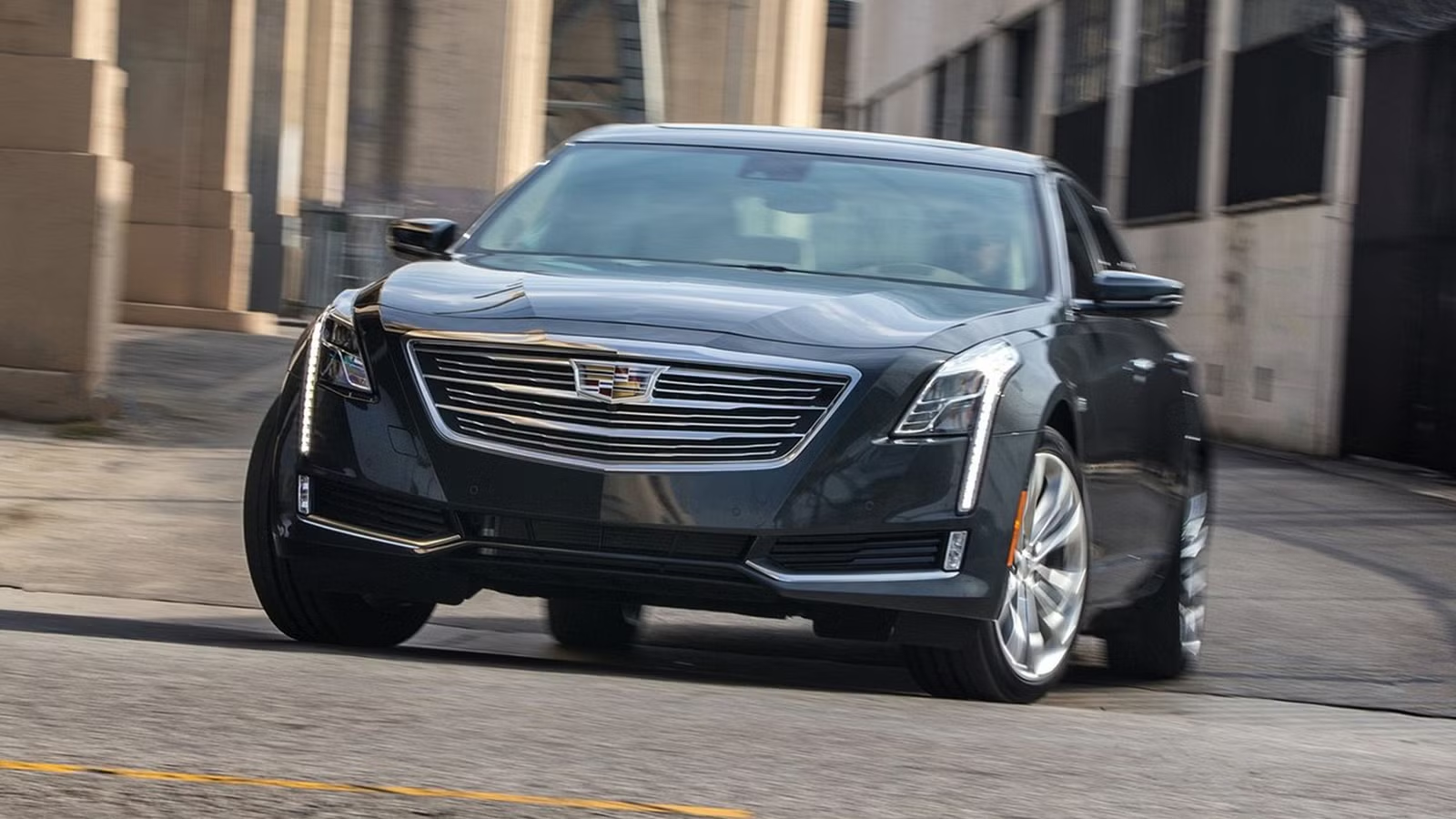
If you’re looking for a particularly dramatic example of the trend, consider the Cadillac CT6. Once the brand’s flagship sedan, average paid prices for the model are today as low as $16,892 for a machine that originally came with an asking price north of $55,000. The CT6’s story ended abruptly when Cadillac pulled it from production after the 2020 model year, shelving a sedan that had only launched four years earlier and would never receive an encore.
That short run further damaged residual values as buyers recognized the CT6 to be an abandoned platform with no successor. If you’re considering a second‑hand CT6, you’ll find information here.
Another example of the trend comes from the Mercedes‑Benz E‑Class. According to data from iSeeCars, the 2020 E‑Class, despite being the top‑ranked used luxury midsize car under $30,000, still bleeds off more than 52 percent of its value after five years. Today, that gives it an expected resale value of around $30,000.
For context, 2020 saw the E-Class updated via mid-cycle refresh, bringing updated tech, revised styling, and the last major round of enhancements before the W213 generation wrapped after 2023. So the $29,878 average price for a used one reflects one of the freshest versions of the W213 generation, for the price of a brand‑new Honda Accord. It’s also one of the most reliable E‑Class generations going.
2017-2020 Mercedes-Benz E-Class Sedan W213 Tan Interior Dashboard at the Golden Gate BridgeMercedes-Benz
The Volvo S90 has also fallen fast. Today, units from 2020 can be had for $25,000. Volvo gave the S90 a major interior and technology update for the 2021 model year, adding mild‑hybrid powertrains and a refreshed cabin. Second-hand copies of those units can be had readily for around $30,000 today, too.
“We would say that Volvo has delivered an executive sedan that doesn’t waste money and does deliver style and substance.” — Ian Wright, senior CarBuzz writer
The Kia K900 debuted for its second generation in 2019 before being discontinued entirely in 2021, creating a short life cycle that contributed to its steep depreciation. That makes the second‑hand K900 a discontinued flagship with limited long‑term support, and it’s priced accordingly. This highly regarded luxury sedan was built to question the need to spend six figures for maximum comfort and prestige. The K900 remains one of Kia’s most ambitious engineering endeavors to date. Today, you can pick up one of the final copies for $22,000 if you shop around.
“The K900 has an adaptive suspension, so it doesn’t at all feel like you’re riding on a cloud. But if you want a Kia sport sedan, get the Stinger. If you want a not too floaty but engaging enough large luxury sedan, get the K900.” — Jay Traugott, CarBuzz writer
Those examples show how far the resale values of some of the mightiest mainstream luxury marques have fallen, but how did we get here?
SUV Fever, EV Disruption, And Worsening Reliability Created A Perfect Storm For Sedan Values
2017-2020 Volvo S90Volvo
Along the same timeline, much of the market had shifted away from sedans as the long‑held form‑factor of choice for motoring luxury. Shoppers spending big bucks on a luxurious vehicle were increasingly likely to be buying a pickup or SUV, not a four‑door car. The rapid introduction of new EV models into the luxury sedan space, aided by federal incentives, also shifted supply and demand dynamics away from traditional luxury sedans. In effect, the segment’s long‑standing customer base was being pulled in multiple directions at once.
Luxury brand dependability also failed to keep up with improving mainstream offerings, as evidenced by JD Power’s latest 2026 Vehicle Dependability Study (VDS). Back in May, we reported that the latest data proves mainstream models are the most hassle‑free buy in 2026, with a dependability advantage over luxury models that’s as wide as it’s ever been, and growing.
2017-2020 Volvo S90 rear 3/4Volvo
Specifically, premium vehicles underperform mass‑market models in seven of nine 2026 VDS categories, with experts noting this is most apparent in the areas of “features, controls and displays,” where mainstream models tend to be 5.8 PP100 (problems per 100 vehicles) more dependable, as well as “driving experience,” where mainstream brands beat premium brands by 3.4 PP100 on average.
Only the “powertrain” and “seats” categories show better performance among premium makes. With more affordable mainstream models proving to be the market’s most reliable, shoppers are finding fewer reasons to cough up extra for luxury marques, dropping demand and prices.
Heavy leasing in the segment also doesn’t do second‑hand pricing any favors. Luxury shoppers “don’t want the old one,” so they almost always return their luxury sedan at the end of its lease to get into something newer and fresher. This lease‑heavy business model drives up lease-return inventory on dealer lots, with many units returned from lease programs just as their comprehensive warranty coverage expires. That’s an oversupply of product that’s now got some big question marks for shoppers to navigate when it comes to the complexity and long‑term repair costs of some of the vehicle’s most trouble‑prone parts.
2016 Cadillac CT6 Black Side ViewCadillac
So you’ve got a six-year-old flagship with aging tech, a just-expired warranty, and a glut of lease returns on dealer lots – and the cheapest one on the lot could cost you far more than its sticker suggests. Here’s how to tell which bargain is actually a bargain.
Why the $16,892 CT6 Could Cost You More Than the $30,000 E-Class
2019 Cadillac CT6-V Black Front angle while Driving Under Steel Bridge in CityCadillac
Behind those tempting residual values lies a range of quality and dependability scores. On the surface, driving a highly depreciated flagship sedan gives you big-dollar comforts for a small initial outlay. The thing is, flagship sedans are often used as rolling showcases of an automaker’s latest and greatest technologies and engineering approaches, and this can have serious implications for your wallet.
According to iSeeCars data, the 2020 Mercedes E-Class has an 8.0/10 score for reliability, while the Cadillac CT6 is only rated mid-pack among luxury large cars by US News. The 2018 Cadillac CT6 was once a $60,000-plus luxury flagship that’s now bottomed out around $17,000. The Mercedes E-Class, with an 8.0 iSeeCars quality score and a higher average price, illustrates that the cheapest option isn’t automatically the smartest.
2020 Mercedes-Benz E-Class SedanMercedes-Benz
Aside from regular maintenance and upkeep, the CT6 you’re considering has an expected annual repair cost of $614, according to repairpal.com data. That same data shows big-ticket repair costs for certain items, including a $3,345 repair bill if your oil pump fails, $2,000 for a new sending unit, and nearly as much if you need to replace the radiator. Even replacing backup sensors could cost you $1,000 or more.
On top of its regular maintenance routine, that second-hand Mercedes-Benz E350 Sedan you’re considering might cost you an extra $788 in annual repairs, according to repairpal.com, which also shows repair prices pushing well past $1,000 apiece for AC condenser replacement, exhaust manifold replacement, or new steering knuckles.
2019 Kia K900 Gray Front Angled View DrivingKia
The Volvo S90 has an annual repair cost of $522, a little lower than its competitors on this list. Still, replacement parts and repairs can be priced well into the thousands if drivers need to replace an AC condenser or the shocks and struts.
Aside from regular maintenance, the Kia K900 has an annual repair cost of $697, and counts a $3,632 power steering pump replacement and a $1,762 AC compressor replacement among its notable repair costs. Catalytic converter replacement is listed at a minimum of $8,616.
Plotting A Course For Five Years Of Ownership
2019 Kia K900 Interior Driver AreaKia
Let’s say you’re planning to buy one of the luxury sedans we mentioned above, and keep it for five years. Up front, you’ll pay its purchase price in cash, and in each of the five years to follow, you’ll be feeding your machine a constant stream of dollars to keep it fueled, insured, repaired, and maintained. Many of these costs will vary wildly based on a long list of factors, but a few are supported well enough to nail down some ballpark costs for the longer term. We’ve assembled the key takeaways and tips to keep in mind for budgeting purposes below.
2020 Mercedes-Benz E-Class Sedan front 3/4 angle while parkedMercedes-Benz
Choosing a $25,000 Cadillac CT6? Remember the extra annual repair costs of $614, as well as the array of big-ticket repair items that could cost you $2,000–$3,000 apiece. Let’s assume the repair costs are accurate, and that the CT6 you’re considering has two big-ticket repairs during your five years of ownership, averaging $2,500 apiece. Given that the CT6 you’re considering may be much more (or much less) reliable than a unit with those particular costs, a contingency fund of about $8,000 is reasonable. That’s an extra $133 per month, if you like.
The second-hand E-Class is predicted by repairpal.com data to cost you an extra $788 per year in repairs, and has repair prices pushing past $1,000 apiece for various big-ticket items. That’s less than half the average big-ticket repair bill of the Cadillac CT6. Assuming accurate repair costs and two major repairs over five years at a cost of $1,200 apiece, a contingency fund of $6,340 looks reasonable here, or an extra $105 per month.
2021 – 2024 Volvo S90 Recharge 2nd Gen FaceliftVolvo
The S90 has just a single big-ticket item on its repair cost list, the Powertrain Control Module, which could cost you $2,300 to replace. All other common repair items listed are priced under $630. The $2,300 PCM isn’t a wear item, and you’d likely never need to replace it a second time, so factor in one PCM replacement alongside the $522 annual repair costs. That’s a contingency fund of about $5,000, or roughly $82 per month, if you like.
2020 Mercedes-Benz E-Class Sedan rear angle while drivingMercedes-Benz
Using available data for the Kia K900, we’ve got annual repairs of $697 and some fairly pricey big-ticket repairs that average a whopping $4,600, according to repairpal.com data. We’ll assume you have two major repairs in the five years for this machine, and that annual repair costs are accurate. That’s a massive contingency fund of nearly $13,000, or an extra $211 per month.
Note the K900’s $8,000-plus repair cost for new catalytic converters. It’s far from the only luxury sedan on the road that could saddle owners with a deep four-figure repair bill once its emissions component warranty has expired.
Base Trim Engine
3.6L V6 Gas
Base Trim Transmission
10-Speed Automatic
Base Trim Drivetrain
All-Wheel Drive
Base Trim Horsepower
335 hp
Base Trim Torque
284 lb-ft @ 5300 rpm
Fuel Economy
18/27 MPG
Infotainment & Features
8 /10
Sources: iSeeCars, repairpal.com, cars.usnews.com
