

Half a million miles without a rebuild sounds like the stuff of automotive legend — yet for owners of the Mercedes-Benz OM606 diesel, it’s a well-documented reality. In an era when most engines are considered long-lived if they crack 200,000 miles with minimal fuss, this 1990s inline-six has quietly built a cult following among enthusiasts who prize longevity above all else. Whether you’re a diesel devotee or simply someone who wants a car that refuses to quit, the OM606’s story is worth knowing.
That said, not all performance cars rely on standard gas. Alongside these attributes, diesels are generally stronger and more reliable than gas engines, as they have to be beefed up from the outset to deal with burning diesel fuel.
Diesel isn’t as flammable as gas, so it needs to be heated up before it’ll combust. This process forces the engine components to take more strain, so diesel engines are naturally much tougher. Still, some are more durable than others, and this 1990s Mercedes-Benz powerplant has proven more of a unit than most.
The OM606 Was An Evolution Of Its Effective Predecessor
1999 Mercedes-Benz OM606 TD engine frontBring a Trailer
1993-2001 Mercedes-Benz OM606
Layout
3.0L NA/turbocharged I6
Fuel
Diesel
Bore x Stroke
3.43 x 3.31 inches
Compression
22.0:1 (NA) 25.0:1 (turbo)
Material
Cast iron/aluminum
Power
134–177 hp
Torque
155–243 lb-ft
The powerplant at the heart of this article is the Mercedes-Benz OM606 inline-six, which was introduced in 1993. It acted as the successor to the venerable OM603 engine, which had been included in most of Mercedes’ mid-range sedans since its own inception in 1984.
Like its forerunner, the OM606 used a 3.0-liter displacement, though it lacked a turbocharger in its early guise. The naturally aspirated diesel engine wasn’t the most powerful in the world — its 134 horsepower and 155 lb-ft of torque were enough to get it moving, but more like an iceberg drifting down a gentle slope than a performance machine.
That changed in 1996, when Mercedes-Benz wanted to start fitting the engine to some of its higher-end and heavier vehicles, so a turbocharger was added. Output climbed to a much more welcome 177 hp and 243 lb-ft of torque, making it considerably more capable of gathering speed. The torque gain made the biggest real-world difference, reducing how hard the engine needed to be worked to build momentum — and as a bonus, it became a meaningfully stronger towing proposition.
Mercedes’ 1990s Diesel Enjoyed A Short Tenure
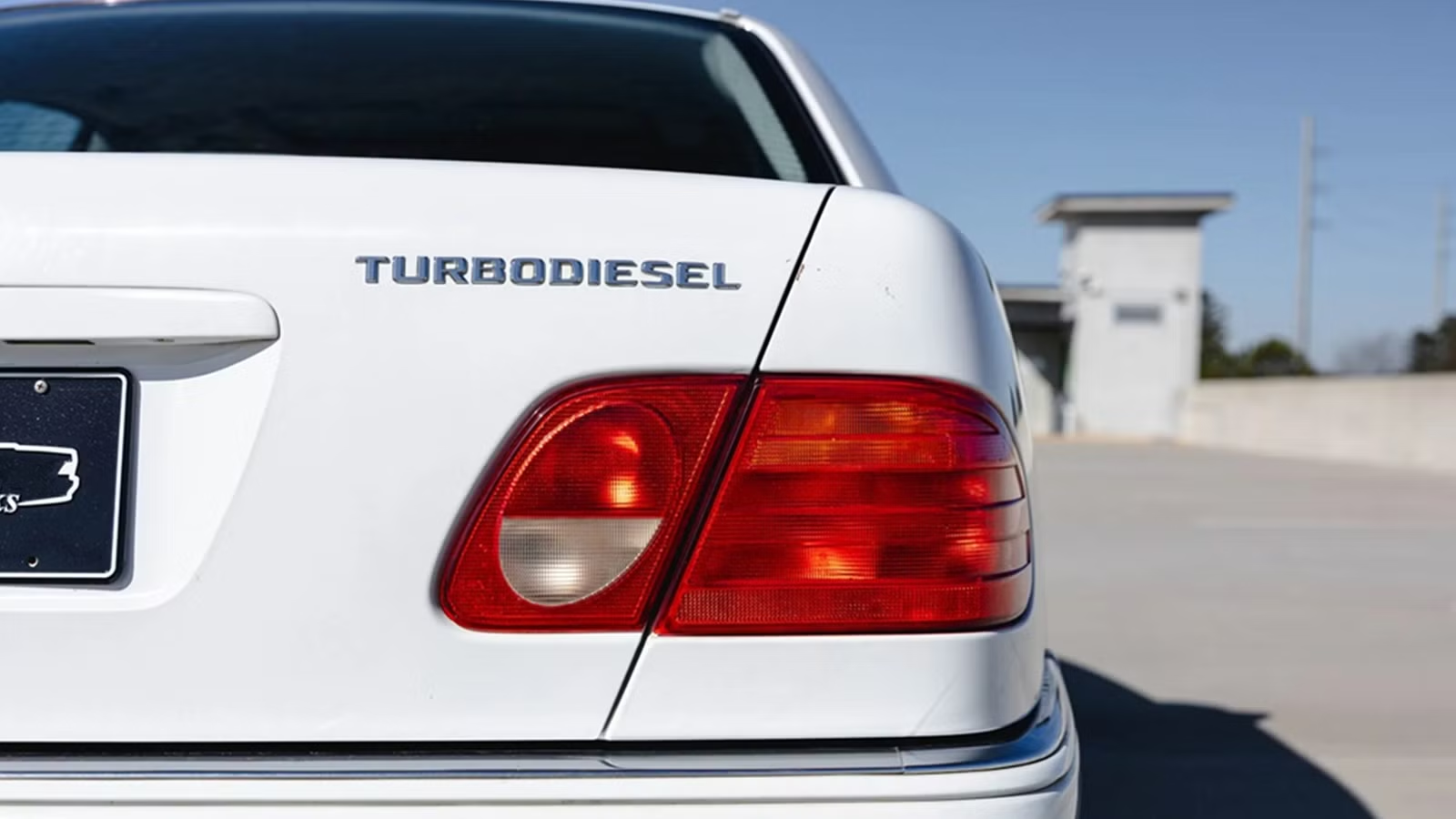
White 1999 Mercedes-Benz E300 TD rearBring a Trailer
While its OM603 forerunner ended up being built for just shy of 20 years, the OM606 couldn’t even reach a decade of service. It lasted until just 1999 in the majority of Mercedes’ sedans, when it was replaced by the significantly more powerful OM613 turbocharged six-cylinder engine. It soldiered on a little longer in the large G-Wagen SUV, but even there it only made it to 2001 before being retired.
The OM606 Has Crafted A Reputation For Being Bulletproof
1999 Mercedes-Benz OM606 TD engine from side viewBring a Trailer
The OM606 was a solid evolution of the OM603, with Mercedes’ main focus being on making it more powerful and refined than its predecessor. A key step toward that goal was the adoption of dual-overhead camshaft technology, replacing the single camshaft used by the OM603. DOHC allows for more valves per cylinder than SOHC, enabling greater power and torque — which translates to more pace and refinement in one package.
Being a diesel, Mercedes went to great lengths to ensure it could withstand the punishment of getting diesel fuel to combust. Such engines require a high compression ratio to make the fuel/air mixture potent enough to ignite, and the OM606’s 25.0:1 figure reflects that demand. To handle those stresses, Mercedes’ engineers used a tough cast iron engine block, while aluminum cylinder heads kept overall weight in check.
Forged connecting rods were incorporated to deal with the force of diesel combustion, while an effective intercooler design helped keep the turbocharged variant running cool. The result was an engine with very few weaknesses — the main one being that the glow plugs needed replacing more frequently than would be ideal. The turbocharged version ran at a lower 22.0:1 compression ratio and was fitted with oil-cooled pistons to manage the additional heat generated by the turbo.
This robustness meant these engines could travel enormous distances without needing to be completely stripped down and rebuilt, unlike many other powerplants in the automotive world.
Many An OM606 Has Reached 500,000 Miles
1999 Mercedes-Benz OM606 NA engine topBring a Trailer
And this isn’t a couple of hundred thousand miles before being killed off either — some engines have managed to hit half a million miles without needing much attention. Several owners on the Benzworld.org forum have revealed that their OM606 engines have far exceeded this mileage without major overhaul, with one having covered a monstrous 788,991 miles on the original engine and transmission. Beyond that standout example, the thread features plenty of other vehicles that have covered well north of 300,000 miles, as well as a handful of OM606s that have cleared the magical half-a-million-mile barrier.
This level of durability also helped make it a great tuning prospect, earning it the reputation of being the European Toyota 2JZ engine.
Mercedes’ Dependable Diesel Engine Found A Home In Many Of Its Higher-End Models
1999 Mercedes-Benz S-Class W140 Silver Front Angled ViewMercedes-Benz
The naturally aspirated version of the OM606 saw the least action in Mercedes’ lineup, having been produced only between 1993 and 1997. It was exclusively found under the hood of the E-Class, appearing in both the W124 and W210 generations of that model. The turbocharged variant was more widely deployed — it not only took over as the engine of choice in the E 300 from 1998, but was also fitted to the W140 S-Class full-size luxury sedan between 1996 and 1999.
Beyond those, it was also offered in the G 300 SUV between 1999 and 2001.
It Wasn’t As Popular In The US
1996 – 1999 Mercedes-Benz E-Class Sedan W210 (2nd Gen) Front Angle ViewMercedes-Benz
Should the OM606’s commanding dependability sound like something you’d love to experience firsthand, there is really only one route in. Diesel cars have never been particularly popular in the US, though Mercedes did offer the W210 E-Class with the engine in E 300 spec.
Several different versions are out there to be found. The W124 model was offered with the naturally aspirated OM606 for the 1995 model year only. W210-based cars followed from 1996, though again availability spanned just two model years. From 1998 until 1999, the E 300 came with the turbocharged OM606 inline-six.
Interestingly, both versions have held their value well over the years, and even high-mileage cars can command a strong price. Well-kept examples can easily fetch north of $20,000 with over 100,000 miles on the clock.
Less cherished examples can be picked up for around $5,000 with closer to 200,000 miles on the odometer — but given how tough these engines are, they have a good chance of going considerably further, provided they’ve been properly maintained.
The more powerful turbo models tend to hold their value better, though there’s surprisingly little difference between the two. Above all else, prioritize finding a car with an extensive service history, since even the OM606 can only tolerate so much neglect — regular oil changes are essential to its longevity.
Find a good one, though, and you’ll have a practical and luxurious sedan that will simply keep going. Don’t be surprised if it outlasts even you — and perhaps your children too, if you’ve taught them to look after it properly.
Sources: Mercedes-Benz.
