

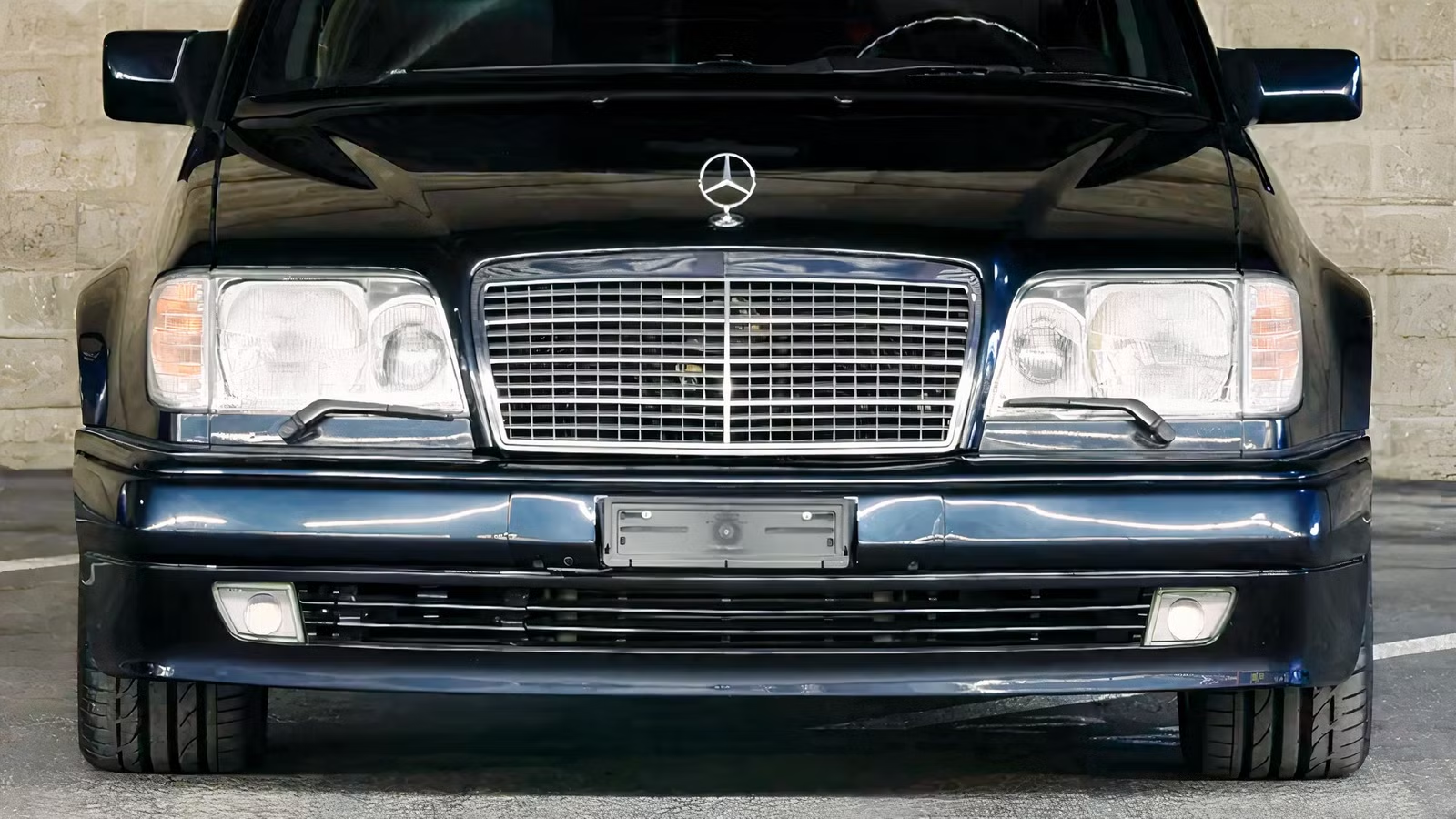
The early 1990s were a golden period for performance sedans, as Audi, BMW, and Mercedes-Benz pushed increasingly serious engineering into sporty cars that could still pass for ordinary executive transportation. Even the quickest versions often kept their visual drama to a minimum, making their abilities easy to overlook.
For some of these understated machines, recognition has taken far longer than the engineering it represents. Three decades later, collectors are looking beyond badges and styling, placing greater value on limited production numbers, documented engineering provenance, and genuine performance. That shift is transforming once-overlooked sedans into increasingly desirable modern classics, as auction results have shown in the recent past.
The W124 Was Already A Serious Performance Platform
The W124 series of mid-size models was never merely a boxy executive sedan built for luxury. Introduced in 1984, its engineering emphasized ride quality, safety, stability, and precise handling, giving Mercedes a sophisticated platform that could handle far more performance than its conservative appearance suggested. The combination of composure and everyday usability made the W124 an unusually strong foundation for a high-performance derivative.
Mercedes soon recognized the potential, but developing such a car presented a practical problem. The existing W124 production line at Sindelfingen, Germany, could not easily accommodate the wider bodywork required for this performance-focused project. Meanwhile, Mercedes’ own development resources were already heavily committed elsewhere. In 1988, Daimler-Benz therefore commissioned Porsche to undertake the design and development of a V8-powered W124 sedan.
The arrangement was more substantial than a simple engineering consultancy. Porsche handled much of the integration work and later assembled the cars at its Zuffenhausen facilities. At the same time, Mercedes supplied the platform, drivetrain, and body components, painted the bodies at its Sindelfingen plant, and retained responsibility for the finished product and customer deliveries. The result was a distinctly Mercedes project shaped by Porsche expertise, creating an unusually close collaboration between these two Stuttgart manufacturers.
Porsche Turned A Mercedes Sedan Into A Hand-Built Sleeper
The Mercedes 500E arrived in 1991 as the ultimate expression of the W124 formula, combining the familiar four-door body with hardware developed to deliver genuine sports car performance. Its Porsche connection was unusually hands-on. From 1990, Porsche assembled the bodies at its Werk 2 facility in Zuffenhausen before they returned to Mercedes in Sindelfingen for painting – around 15 miles away. They then went back to Zuffenhausen, where final assembly and engine installation took place. The complete production process took 18 days, with every car making the journey between the two factories twice.
Under the hood was Mercedes’ M119 5.0-liter, four-valve V8, producing 320 horsepower and 354 pound-feet of torque in the version for the United States. It was enough power for a 0-to-60-mph run in 5.5 seconds (as tested in period by Car and Driver) and an electronically limited 155 mph top speed.
By April 1995, just 10,479 examples had been built. That combination of limited production and serious performance was wrapped in remarkably restrained styling. Flared wheel arches and subtle aerodynamic changes hinted at its abilities, but compared with more overtly aggressive performance cars of the period, the 500E remained deliberately discreet. Michael Mönig, from Porsche’s Prototype Management, described it accurately: “Plenty of power, but without being ostentatious, both dynamic and luxurious at the same time. The 500E is not a showy vehicle. It represents pure understatement, and catches the eye only at second glance.”
It Was Built To Challenge The Best Performance Sedans
The 500E was not simply an expensive V8 version of the W124. When it arrived, it entered a particularly competitive part of the European performance sedan market, where BMW’s M5 had already established the template for combining four-door practicality with serious pace. A contemporary Car and Driver comparison placed the 500E against the BMW M5 and Audi S4, describing all three as among the most powerful production four-door sedans of their time. The Mercedes also covered the quarter mile in 14.1 seconds.
Its character, however, differed from the M5. The BMW emphasized a more overtly sporting driving experience, while the Mercedes delivered its performance with greater composure and a substantial reserve of torque. That distinction helped make the 500E unusual even among its peers. It was a genuinely rapid performance sedan that could cover long distances in comfort without demanding that its driver adopt a sports car mindset. Contemporary comparisons therefore placed it firmly among the era’s elite performance four-door sedans, rather than treating it as merely a high-specification Mercedes sedan.
The 500E Has Gone From Used Sedan To Six-Figure Collectible
The 500E’s value story is more complicated than a simple rise towards six figures. Hagerty currently puts the average Condition 3 example, depending on year, between $40,000 and $48,000, representing a 31% increase since 2020. Actual auction results show how widely values can vary by mileage, originality, and provenance. A 36,000-mile 1993 example sold for $75,000 on Bring a Trailer in August 2025, while higher-mileage cars have continued to trade around $25,000-$35,000.
At the opposite end, the market has now demonstrated genuine six-figure potential. A 2,000-mile 1992 500E associated with Jerry Seinfeld sold for $357,000 at Gooding Christie’s Amelia Island sale in March 2026, setting a remarkable benchmark. That result needs context, however. It was an exceptional, celebrity-owned, ultra-low-mileage car and should not be treated as representative of ordinary 500E values. Indeed, recent Bring a Trailer results show that usable examples remain much cheaper. The widening gap between ordinary cars and well-kept ones is perhaps the clearest indication that collectors are increasingly paying for condition, provenance and rarity rather than simply the model name.
Scarcity And Porsche Provenance Are Changing How Collectors See It
The 500E now occupies a different part of the market from an ordinary W124, increasingly finding itself compared with cars such as the BMW M5 and period AMG performance sedans. That positioning reflects the unusual combination of limited production, a 5.0-liter V8, and Porsche’s involvement in development and assembly. Its collector appeal comes not from a single specification, but from the fact that those elements rarely appeared together in a discreet four-door Mercedes. Online sales data also shows the distinction within the W124 range, with the 500E carrying a value far above regular W124 variants.
More broadly, collectors have increasingly turned their attention to overlooked performance cars from the 1980s and 1990s, particularly those with documented provenance, factory originality, and genuinely limited production. Further proof of this fact can be seen in the values of other manufacturers’ performance cars from this era as well.
The 500E illustrates why that approach by collectors can pay off. Cars that were once judged primarily as used vehicles can acquire a completely different status once enthusiasts begin valuing the engineering story behind them. Its market remains far from uniform, but the growing premium for exceptional, original examples shows how a previously underappreciated performance sedan can move toward blue-chip territory without ever being designed as a collector car.
Buying A 500E Now Means Looking Beyond The Badge
Buying a 500E today requires rather more scrutiny than simply finding the lowest odometer reading. Condition, originality, and a documented service history should carry considerable weight, particularly because deferred maintenance on an aging W124 can become expensive quickly. Hagerty specifically highlights the complicated systems, including the suspension, the ABS braking system, and the accessory drive, and recommends a thorough pre-purchase inspection and checking for comprehensive records. Rust, worn mechanical components, and evidence of neglected maintenance could therefore turn a seemingly cheaper car into a more expensive purchase.
Ownership also demands access to mechanics and technicians familiar with these cars and their aging systems. Parts can still be sourced, and repairs can be done, but specialist knowledge matters when dealing with components that are now more than three decades old. As mentioned, recent sales demonstrate the spread. The lesson for collectors is straightforward: the 500E is no longer an undiscovered bargain, but buyers can still separate genuinely desirable examples from cars whose asking prices are simply borrowing credibility from the exceptional sales.
Sources: Hagerty, Classic.com, Porsche, Mercedes-Benz, Bring a Trailer, Car and Driver
