

The Drive 🤝 your inbox. Every weekday
The Daily Brief wraps up the biggest stories and our exclusive reporting on the auto industry and car culture.
For all of the news that China’s car industry makes for breakthroughs in, say, battery tech, it’s their attention to detail that personally impresses me the most. Like how Zeekr, one of the country’s leading automakers that also happens to be affiliated with Volvo through their shared corporate parent, Geely, went to the trouble to re-engineer the foam used in the seats of its minivan, the Zeekr 009. And the company is so proud of the result that it put it to the test by crushing it with nine EVs, plus a tractor-trailer for good measure.
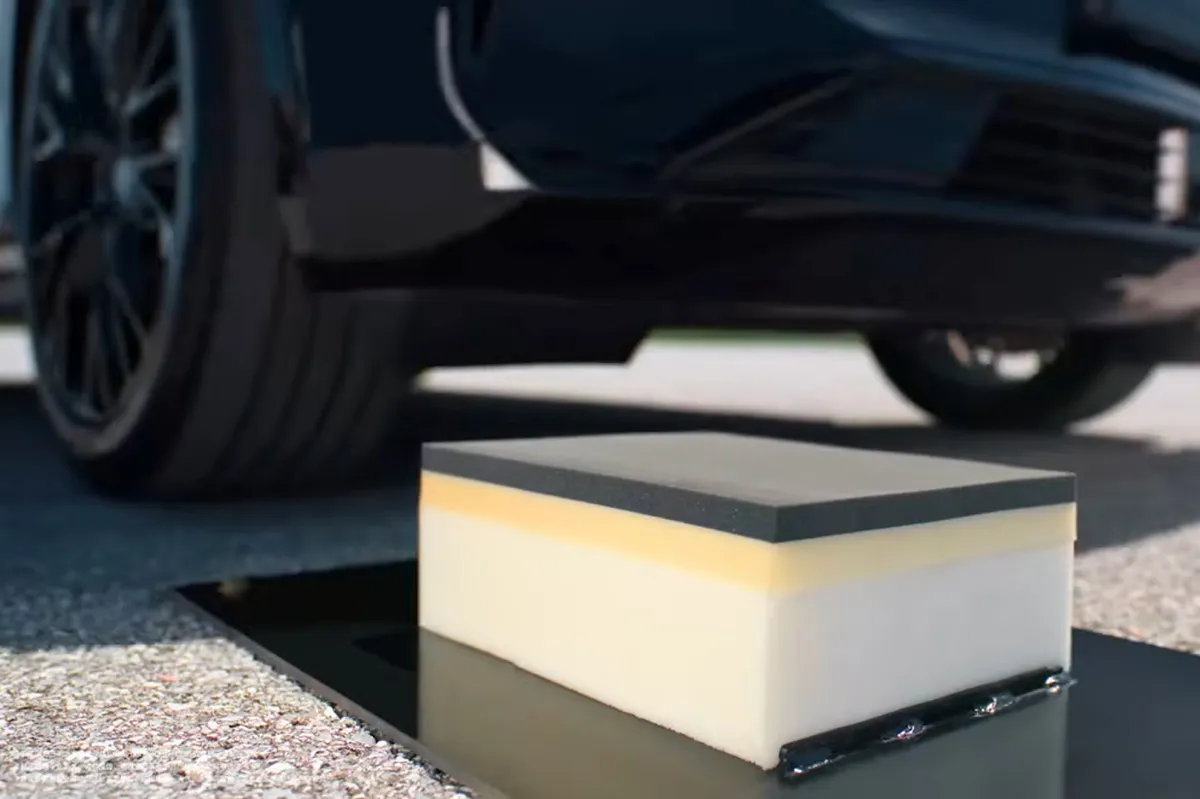
We won’t go too far into the weeds of foam chemistry here, but the important thing to note, courtesy of CarNewsChina, is that Zeekr designed this material by mashing together three layers: a very resilient foam at the top, a denser material that responds more quickly below, and a big heap of soft foam at the bottom. The manufacturer says it’s 1.5 times better at dampening vibration than common seat foam, so that’s a great start.
But how does it perform under stress? Extreme stress? To evaluate that, Zeekr put a block of it on the ground and drove over it with 10 vehicles, starting with nine of its own passenger EVs. Given that we’re talking about battery-electric cars, that procession would’ve been especially heavy. But, as if that wasn’t enough, the company sent a 20-ton semi-truck to crush the foam too, and see what, if any, damage would result. Would it be smushed like a Tempur-Pedic mattress? Permanently deformed? Or would it bounce right back up?
Zeekr 009 MPV’s seat foam was run over by 20-ton truck and remained the same
As you probably guessed, Zeekr likely wouldn’t have gone to the trouble of making a video like this if the latter scenario wasn’t virtually guaranteed. The foam block is stained with tire particles and road detritus, of course, but running back the same test from earlier in the video, with a glass of water sat atop the block, demonstrates that the very same piece of foam is still performing adequately and vibrating less than the store-brand stuff.
Is this exercise weird? Of course! Does any of this guarantee that the Zeekr 009’s seats won’t stand up to a decade of normal wear and tear from the repeated forces of butts? Nope. But it’s a focus on the little things, which I appreciate. And no matter how your next car is powered, or whether you drive it or it drives itself, seat comfort’s going to matter. I suppose that’s one refreshing constant of this ever-changing world.
Got a news tip? Hit up tips@thedrive.com
Add The Drive as a preferred source on Google to see more of our reporting.
Backed by a decade of covering cars and consumer tech, Adam Ismail is a Senior Editor at The Drive, focused on curating and producing the site’s slate of daily stories.
