

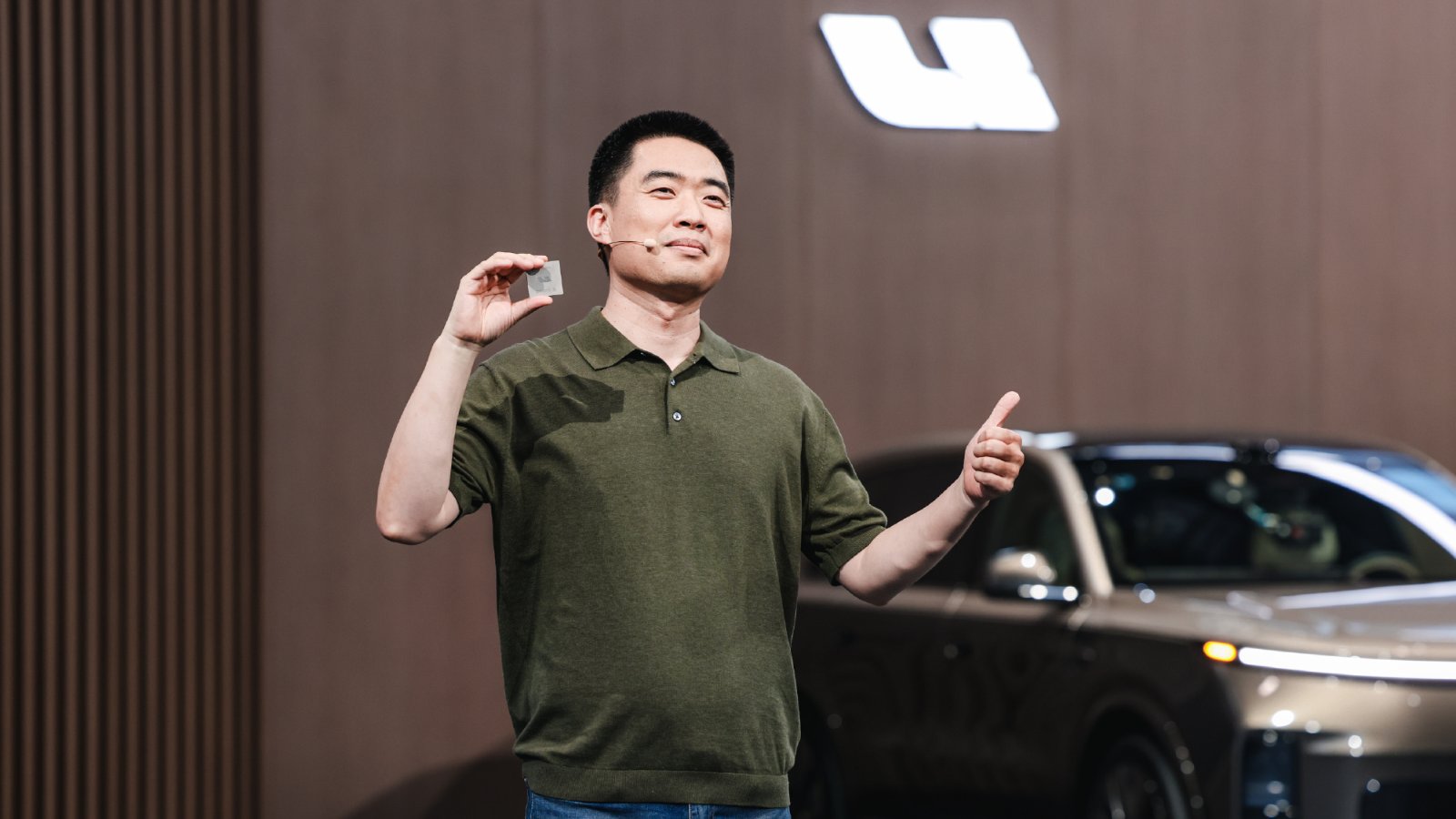
Li Auto founder, chairman and CEO Li Xiang shows the company’s in-house Mach M100 chip at Livis Day in June 2026. Credit: Li Auto
- Li Auto plans to raise several billion yuan for its chip business at a pre-money valuation of about 15 billion yuan ($2.22 billion).
- Nio’s chip unit Shenji completed its first funding round in February at a post-money valuation of about 8.27 billion yuan.
Li Auto’s (NASDAQ: LI) chip subsidiary is moving ahead with its first round of external financing at a pre-money valuation of about 15 billion yuan ($2.22 billion), local media outlet LatePost reported on Monday.
The Chinese electric vehicle (EV) maker plans to raise several billion yuan for the business, according to the report. It marks the latest step in Li Auto’s push to run its semiconductor business independently after setting up a chip company entity in July.
Li Auto’s path resembles that of local peer Nio Inc (NYSE: NIO). Nio’s chip subsidiary GeniTech Co Ltd (Shenji) completed a 2.257 billion yuan first funding round in February at a post-money valuation of about 8.27 billion yuan, according to Nio’s statement at the time.
After the financing, Nio holds 62.7% of Shenji, outside investors hold 27.3 percent, and the remaining 10% is held by an equity incentive vehicle for the core team and employees. Shenji has raised nearly 3 billion yuan in total since it was founded in June 2025.
Several Chinese investors will inject RMB 2.257 billion ($330 million) into Nio’s chip business, valuing the operation at about RMB 8.27 billion.
Another reference point is inference chip company Sunrise. LatePost said the company was spun off from SenseTime’s large-chip division at the end of 2024 and has completed 7 funding rounds in a little over a year as an independent company, raising about 4 billion yuan in total at a valuation of more than 10 billion yuan.
Business registration records show a company named Mach Intelligent Cores Limited was incorporated in Hong Kong on July 14. On August 4, Shanghai Mach Zhixin Intelligent Technology Co Ltd, wholly owned by the Hong Kong company, was established, with Li Auto CTO Xie Yan as its legal representative.
A few days later, Shanghai Mach Zhixin in turn set up wholly owned Shanghai Mach Xin Technology Co Ltd, whose legal representative is Li Auto joint company secretary Wang Yang, the report noted.
Li Auto had earlier registered Xinchuang Zhihe (Shanghai) Technology Co Ltd in Shanghai on July 13, with a business scope covering chip design and Wang also serving as legal representative. LatePost’s report did not explain the relationship between that company and the new structure.
Li Auto’s in-house chip team has about 200 people, mainly working on AI (artificial intelligence) computing architecture, chip design and related software development, according to the report. The company is pursuing both vehicle-side and cloud-side in-house chip projects at the same time.
An employee told LatePost that Li Auto’s human resources department has been in talks with chip division staff about adjusting their employment relationships, indicating the team is being moved to the new entity.
Xie heads Li Auto’s systems and computing group and was a key driver of the Mach M100 chip project.
When he joined in 2022, he advocated benchmarking the first chip directly against Nvidia’s top offering at the time, and opted for a dataflow architecture rather than the mainstream GPGPU (general-purpose computing on graphics processing units) architecture.
The Mach M100 is Li Auto’s first mass-produced in-house chip. Built on a 5nm automotive-grade process, it delivers 1,280 TOPS of computing power per chip and is used in several new or refreshed models launched this year.
Li Auto is also developing a cloud inference chip that likewise uses a dataflow architecture, which could take over some inference tasks that currently run on GPUs, LatePost said.
Industry insiders consider the approach technically feasible, with the difficulty lying in bringing the inference cost of the whole solution down to a level that is competitive in the industry.
Extending from vehicles to the cloud requires sustained R&D spending. Li Auto posted a net loss of 3.98 billion yuan in the first half of this year, and bringing in outside capital could help fund its chip development.
Financing in China’s semiconductor sector totaled about 162.7 billion yuan in the first half of this year, with AI computing one of the main destinations for the funds.
In June, Li Auto granted a total of 35 million share options to Xie, president Ma Donghui and CFO Li Tie, of which Xie received 10 million. The options are tied to market capitalization and become fully exercisable when Li Auto’s market value in Hong Kong reaches HK$1 trillion, LatePost noted.
A separate equity incentive plan could also help boost morale and retain talent. LatePost previously reported that Jin Yihua, head of chip software development at Li Auto, and Dai Jie, head of front-end design team one, have left, with more core technical staff moving to embodied intelligence companies.
Li Auto is also looking for external customers for its in-house technologies. At a media briefing earlier today, Ma said chips and silicon carbide modules are small and highly versatile, and other manufacturers can adapt them, adding that in-house components that can be turned into standardized products can be sold externally.
But Li Auto’s in-house battery packs are custom-developed based on its own vehicle requirements and model characteristics, and their capacity planning is matched to its own vehicle output, so they cannot be supplied externally, he said.
Morgan Stanley says GeniTech’s debut at WAIC 2026 takes Nio’s stock narrative one step further toward a vertically integrated AI chip platform.
($1 = 6.7487 yuan)
