

When the C8 Chevrolet Corvette made its debut in 2019, it made waves for its status as the first mid-engine production Corvette. Today, the C8 Corvette is popular and beloved among car enthusiasts, having captured the attention of the automotive world with its performance and design.
Car designers, however, had been planting the seeds for an American mid-engine supercar long before the C8 Corvette arrived on the market. In this list, we are looking at seven concept cars that made use of this layout but never got a production run of their own.
Chevrolet Corvette Indy Concept
Close
We start with the Corvette Indy Concept, one of several mid-engine Corvette concepts that preceded the current C8 generation (the first production Corvette to use this layout). While the Indy was built in 1986, its design anticipated many elements of the C5 generation, which wouldn’t hit the market until several years later.
At the heart of the concept car was a 2.65-liter twin-turbo V8. Its exact power output figure is unclear, but we do know it was rumored to produce over 600 horsepower. Power was sent to all four wheels; the Indy was also equipped with drive-by-wire four-wheel-steering and traction control, both advanced features for the era.
Several other ahead-of-their-time features could be found on the Indy, including a rearview camera, an early infotainment system with navigation, and Kevlar and carbon fiber bodywork.
The initial example of the Indy made its debut at the Detroit Auto Show. Soon afterwards, two more cars were built. A few years later, a separate concept car based on the Indy was introduced: the CERV III, powered by a 5.7-liter twin-turbo V8 that produced 650 hp. However, neither the Indy nor the CERV III resulted in a production model.
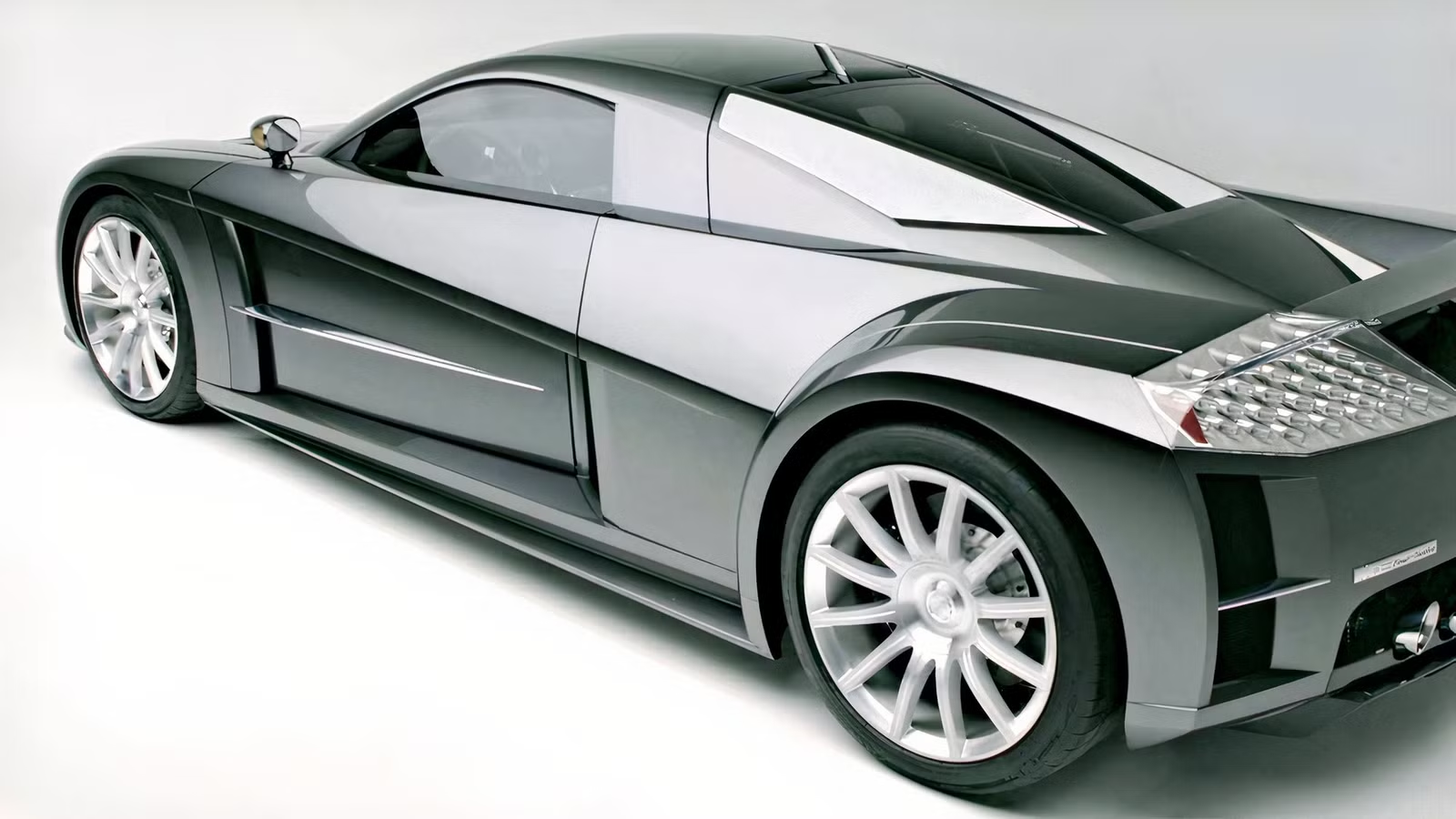
Chrysler ME Four-Twelve
The Chrysler ME Four-Twelve took its name from the thundering engine that powered it, and its placement. “ME” stood for Mid-Engine, while Four-Twelve was a nod to the engine itself: an AMG-developed quad-turbocharged V12, which produced 850 hp and 850 lb-ft of torque sent to the rear wheels. The ME Four-Twelve was introduced in 2004, making its debut at the North American International Auto Show.
The design of the ME Four-Twelve was just as impressive as its powertrain, with a sleek, futuristic look and heaps of carbon fiber on top of an aluminum honeycomb monocoque tub. The shape of the car was developed with the help of a wind tunnel to maximize aerodynamics; one of the key aero elements was a computer-actuated rear spoiler, which could create an additional 925 lbs of downforce at 186 mph.
The two-seat interior was awash in high-quality leather and metal, and came with comfort features such as automatic climate control and a high-end audio system. The carbon fiber tub was visible from the cabin, blending luxury and performance.
Vector W8 And WX-3
The next car was built by a small, obscure manufacturer with a fascinating history. Vector Motors started out in the late 1970s; its first creation was a one-off concept called the W2, which later served as the base for a different car called the W8. While the W8 got a little further than its predecessor, it never got a full-scale production run, with only 19 units being built in total.
The W8’s design was characterized by a wedge-like shape and sharp, sleek lines reminiscent of those seen on the Lotus Esprit. Louvers and a rear wing further contributed to its futuristic character. Among the materials used in the bodywork were carbon fiber, aluminum, and Kevlar. Power came from a 6.0-liter twin-turbo V8 built by General Motors, producing around 625 hp sent to the rear wheels via a three-speed automatic transmission.
Shortly after the W8’s release, an improved version called the WX-3 was unveiled. However, only two examples of this car were built: the first had a roadster body style and was finished in purple, while the second was blue and had a coupe body style.
Cadillac Cien
This Cadillac concept car made its debut in 2002 at the Detroit Auto Show, in celebration of Cadillac’s 100th anniversary. Its name comes from the Spanish word for “one hundred”. Its design took inspiration from fighter jets, with sleek lines and an active rear spoiler for improved aerodynamics. It was penned by designer Simon Cox, who was also responsible for several other Cadillac concepts.
Power came from a 7.5-liter V12 engine, a rare layout in post-war American cars. The engine produced 750 hp and 650 lb-ft of torque; it was equipped with several advanced features, including an early cylinder deactivation system, a direct injection system, and a carbon fiber intake manifold with twin throttle bodies. A six-speed, F1-style automated manual transmission sent power to the rear wheels. The Cien could hit 60 mph in just 3.5 seconds, and reached a top speed of 217 mph.
The car was fitted with 19-inch wheels at the front and 21-inch wheels at the rear. Its interior was highly luxurious and packed with technology; leather upholstery, several screens, and blue glass created a high-end, futuristic feel.
Ford Indigo
The Ford Indigo concept car was built as a celebration of Ford’s involvement in the world of motorsport, more specifically in IndyCar. The Blue Oval supplied powertrains as part of a collaboration with legendary firm Cosworth, together building several successful racing engines over a period that spanned decades.
One such engine was the X-Series V8, which was introduced in 1992 and three years later propelled Jacques Villeneuve to victory at the Indianapolis 500. The following year, the Indigo made its debut at the Detroit Auto Show, highlighting Ford’s technological capabilities that had made that victory possible.
The Indigo’s design was heavily inspired by IndyCar, with a wedge-shaped front end and an aerodynamic package that included a large front spoiler. The car was built on a carbon fiber composite monocoque chassis, developed by British manufacturer Reynard Motorsport. Power came from a 6.0-liter V12, which produced 435 hp; a six-speed transaxle sent power to the rear wheels.
The first, fully functioning car was followed by two more examples of the Indigo, which were simply show cars with no engine on board.
Saleen S5S Raptor
The S5S Raptor was created in 2008 by California-based high-performance automaker Saleen. It was designed to be a more affordable counterpart to a model that did get a small production run: the S7, of which around 80 units were produced. The S5S’s expected price was $185,000, while the S7 was around $400,000 more expensive. However, due to the impact of the 2008 financial crisis, the S5S did not make it to production, with just one car being built.
The S5S Raptor was powered by a 5.0-liter supercharged V8 built by Saleen itself, unlike the 7.0-liter V8 found in the S7 which was sourced from Ford. The car’s name itself reflects the engine that powers it: the first “S” stands for “Saleen”, the “5” stands for five liters, and the second “S” stands for “supercharged”. The S5S could accelerate to 60 mph in just 3.2 seconds, and boasted a quarter-mile time of 10.9 seconds.
Ford GT90
Most car enthusiasts have heard of the Ford GT40 and its successor, the Ford GT. However, there was also a one-off concept car in the Ford GT family that is far less famous: the GT90. Originally intended for production as a potential rival to the McLaren F1, the GT90 never made it past the concept stage.
Its engine was a custom-built quad-turbocharged 5.9-liter V12, based on the Ford Modular engine series. This engine, which had been tested in a Lincoln Town Car before being installed in the GT90, was notable for being the first V12 Ford had built since 1948. A five-speed manual transmission, built through a partnership between British companies FF Developments and Ricardo, sent power to the rear wheels.
The GT90 was futuristic not just in its sharp, angular design, but also in its features. Many components were derived from aerospace technology, including ceramic tiles used as heat shielding in the exhaust system. There were a few creature comforts on board as well, including air conditioning, an in-car phone, and a 10-speaker sound system.
Sources: Ford, Saleen, Cadillac, Vector, Chrysler, Chevrolet
