

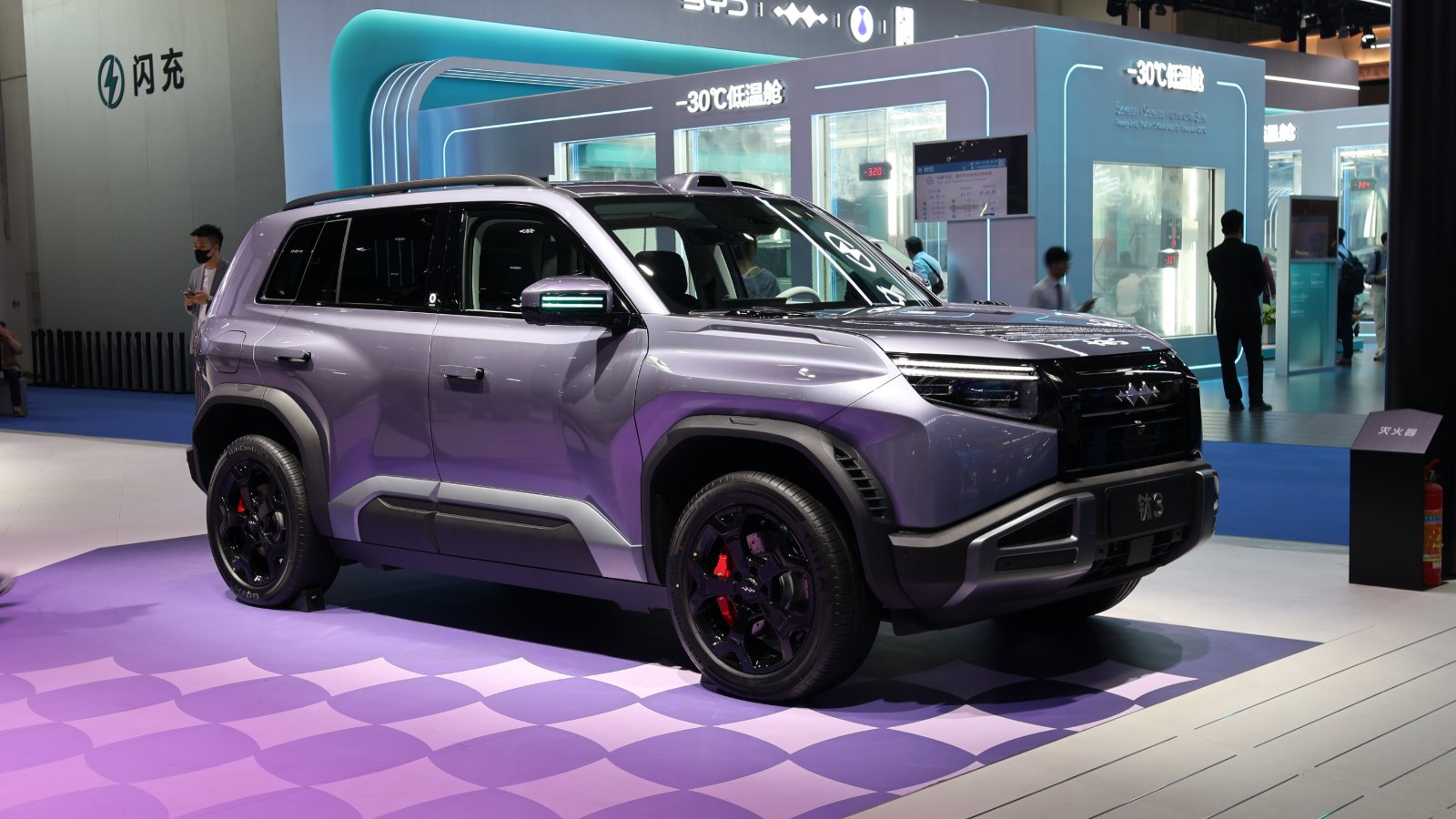
A BYD Fang Cheng Bao Tai 3 SUV on display at the Beijing Auto Show in April 2026. Credit: CnEVPost
- China’s commerce ministry rejected voluntary export restrictions on hybrids, saying any solution between China and the EU must comply with WTO rules.
- The EU reportedly wants China to voluntarily limit hybrid exports to the bloc or potentially face higher tariffs.
China’s commerce ministry said so-called voluntary export restrictions seriously violate World Trade Organization (WTO) rules, rejecting their use to resolve automotive trade disputes between China and the European Union.
The ministry issued a statement on its website on Friday, responding to a media report that the EU wants China to voluntarily limit hybrid vehicle exports to the bloc or potentially face higher tariffs.
“So-called voluntary export restrictions seriously violate WTO rules and run counter to market principles and fair competition. China firmly opposes them,” a ministry spokesperson said.
Any solution between China and the EU must balance their interests, comply with WTO rules and their respective domestic laws, and fully accommodate the interests of both sides’ industries, the spokesperson said.
The response underscores differences over hybrid vehicle trade. Hybrids are emerging as a new point of contention after the EU imposed additional tariffs on China-made battery electric vehicles (BEVs).
The EU is asking China to voluntarily limit hybrid vehicle exports to its market or potentially face higher tariffs, the Financial Times reported on September 17.
The report cited an EU official as saying the bloc would take action if China failed to curb exports, with the aim of preventing deindustrialization. The EU hopes to negotiate an export restriction arrangement.
Rapid growth in hybrid imports is a key factor behind the EU’s consideration of further action.
The bloc’s hybrid imports from China rose from 3,800 vehicles in October 2024 to 50,000 in July 2026, while average prices fell over the same period, according to the report.
The EU imposed countervailing duties on China-made BEVs in October 2024, bringing total tariffs to about 45% at the highest rate when existing duties are included. Hybrids are subject to a 10% tariff.
Since then, China’s BEV exports to the EU have grown modestly, while hybrid imports have surged. Several reports this year have suggested the EU was considering additional tariffs on Chinese hybrids, though none have been imposed.
The EU hopes voluntary export restrictions could encourage Chinese automakers to increase investment in Europe or partner with local manufacturers, the Financial Times said, citing people familiar with the matter.
The trade dispute comes as overseas markets become an important source of growth for China’s auto industry. China’s vehicle exports rose 65.3% year-on-year to 1.01 million in August, according to the China Association of Automobile Manufacturers (CAAM).
Of that total, new energy vehicle (NEV) exports reached 526,000, up about 130% year-on-year and accounting for about 52.1% of total vehicle exports that month, according to data compiled by CnEVPost.
Those figures cover China’s exports to global markets, rather than just the EU.
Domestic NEV sales in China fell 4.6% year-on-year over the same period, underscoring the importance of overseas demand to the industry’s growth.
The EU is seeking a negotiated deal to limit imports of China-made hybrids and may raise tariffs if no agreement is reached.
