

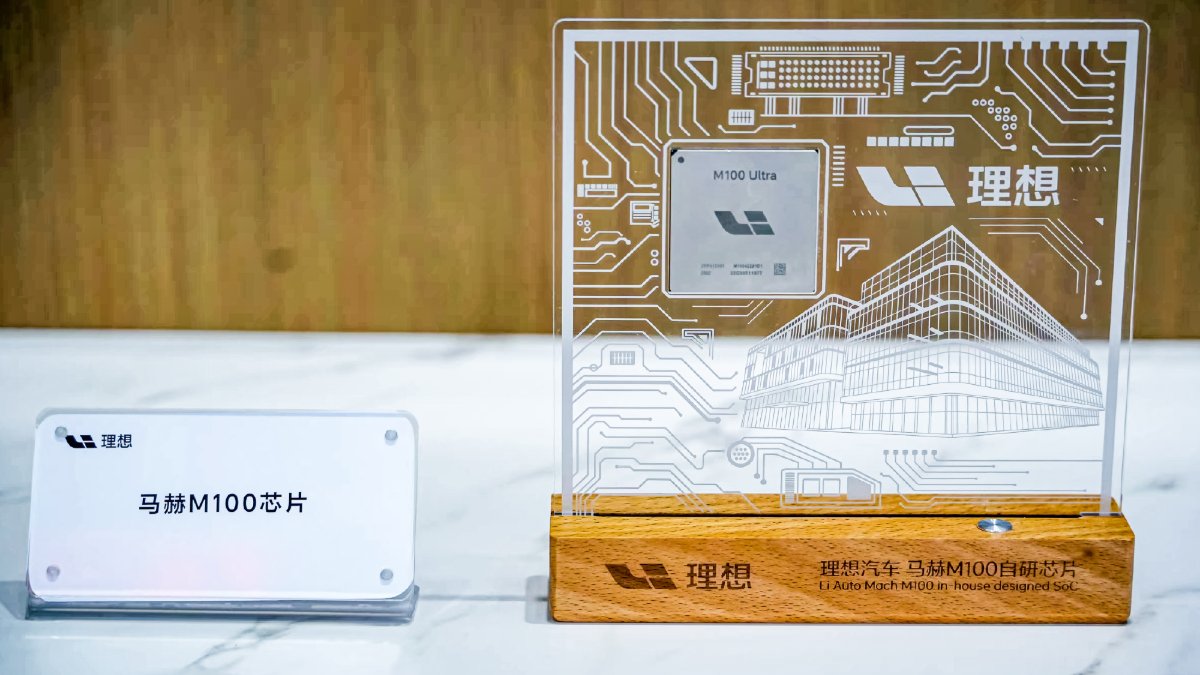
Li Auto’s in-house-developed Mach M100 driver-assistance chip on display. Credit: Li Auto
- Li Auto is moving to operate its chip and silicon carbide businesses independently and seek external customers, with some units planning to bring in outside capital.
- Domestic peers Nio and Xpeng are pursuing similar efforts.
Li Auto (NASDAQ: LI) is reportedly moving to supply its Mach chips, silicon carbide modules and range extenders to external customers, seeking to turn in-house technology into revenue beyond vehicle sales.
The Chinese automaker has launched plans to supply several core technologies externally since the start of this year, while moving some businesses toward independent operations and outside funding, local media outlet 36Kr reported on Friday, citing multiple industry sources.
The push would extend technologies developed through years of investment beyond Li Auto’s own vehicles to third-party customers. The report, however, did not disclose any signed supply contracts, order volumes or related revenue.
Li Auto’s senior management has approved a spinoff of its chip business, with business development efforts proceeding in parallel, according to the report. Executives have held talks with embodied AI companies and pitched the Mach chip to them.
Whether potential customers adopt the chip may still depend on the difficulty of migrating their algorithms. The report did not name the companies involved in the discussions or say whether any purchase agreements had been reached.
Li Auto established a wholly owned company, Xinchuang Zhihe (Shanghai) Technology Co Ltd, in Shanghai on July 13. Its business scope includes integrated circuit chip design and sales, providing a corporate entity for independent chip operations.
The Mach M100 is Li Auto’s first mass-produced driver-assistance chip. Built on a 5 nm automotive-grade process, it delivers 1,280 TOPS of computing power per chip and is already used in the company’s vehicles.
Sike Semiconductor began moving toward independent operations ahead of the chip business. The silicon carbide module company, established jointly by Li Auto and Hunan Sanan Semiconductor in 2022, is seeking to expand its external customer base.
Sike changed its reporting structure in February, with management reporting to its own board rather than Li Auto’s manufacturing division, according to 36Kr. It now operates independently and is responsible for its own profits and losses.
Li Auto currently holds a 70% stake in Sike. The company is seeking external funding and has begun preparations for an initial public offering (IPO), people familiar with the matter said.
Bringing in outside capital could help Sike reduce its reliance on Li Auto and ease other automakers’ concerns about buying from a supplier controlled by a competitor.
Beyond semiconductors, Li Auto has also signaled that its range-extender systems are open to external customers. The company now develops and manufactures its third-generation range extender in-house.
Li Auto has no plans for now to supply its in-house batteries externally. The high degree of battery customization makes supplying outside customers more difficult, industry sources said, according to the report.
The commercialization push comes as Li Auto’s profitability remains under pressure and research and development spending stays elevated.
The company posted a second-quarter net loss of 1.7 billion yuan ($251 million), compared with a net profit of 1.1 billion yuan a year earlier.
Li Auto still held 87.5 billion yuan in cash reserves at the end of the second quarter, but quarterly research and development spending had remained at around 3 billion yuan for 6 consecutive quarters.
External orders could help Li Auto expand the use of its in-house technology and spread research and manufacturing costs across a larger business, while outside capital could help fund the units.
Other Chinese electric vehicle makers are exploring similar paths. Nio Inc (NYSE: NIO) has spun off its chip business into GeniTech Co Ltd (Shenji) and is seeking third-party customers.
The M97 chip jointly developed by Shenji and Axera Semiconductor has attracted interest from Geely, 36Kr reported on September 2, though no supply agreement or mass-production plans were disclosed at the time.
Xpeng (NYSE: XPEV) also plans to offer technology to more overseas customers beyond Volkswagen, covering electrical and electronic architecture, cockpit systems, chips and driver-assistance software, Reuters reported on September 17.
The new-generation Li Mega and upcoming Li i9 will gradually switch from CATL batteries to batteries developed in-house by Li Auto.
($1 = 6.7521 yuan)
