

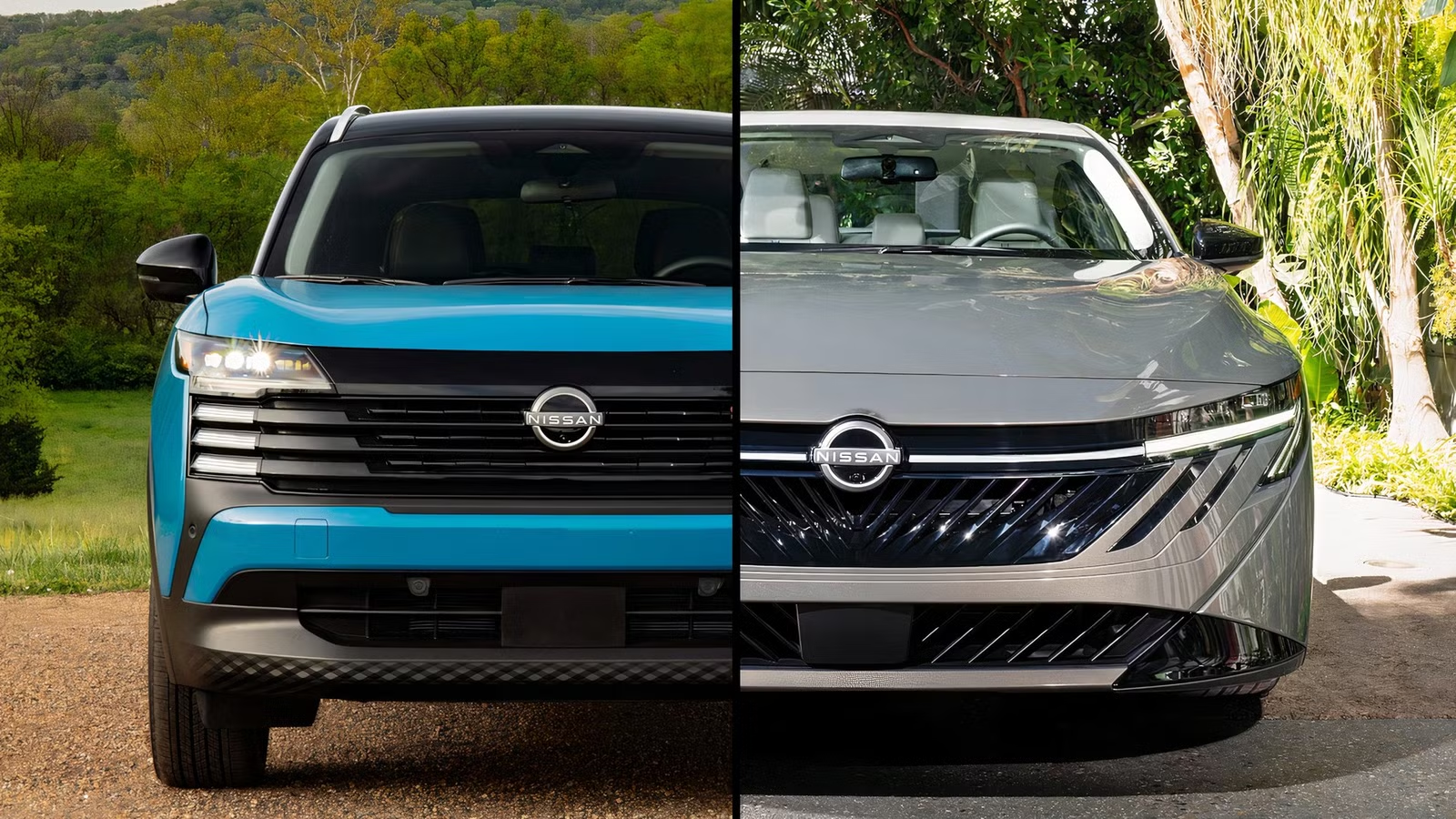
Cars are getting more expensive, and at an alarming rate too, with $50,000 now becoming the new normal for anyone looking to secure themselves a fresh set of wheels in 2026 and beyond. However, not every shopper needs a midsize or larger, and not everyone cares to keep up with the Joneses, either, and for those, Nissan has a pair of compelling answers.
Buyers don’t need to part with $50,000, they don’t even need to spend half that in securing a brand-new car. And what’s more, Nissan will even give you choice in the matter, too.
No Automaker Is Catering To Cost-Conscious Buyers Like Nissan Is In 2026
It is no secret that Nissan has seen its fair share of financial troubles in recent years, with massive losses reported and merger talks with Honda proving fruitless. However, the storied Japanese automaker isn’t one to go down without a fight, and following some internal restructuring and cost-saving measures, Nissan is showing some vital signs of recovery.
Core to Nissan’s – and indeed any automaker’s – success is a clear target audience and compelling cars to offer said audience, and in the Kicks and Sentra, Nissan has exactly that. Between these two, we find some of the most competitively priced new cars on the market right now. Nissan covers all bases by splitting its value-focussed options across two body styles, with the Sentra as a traditional compact sedan, and the Kicks covering the booming subcompact SUV space. The approach looks to be working well for Nissan, with the Sentra and Kicks bringing in a respective 39,817 and 26,251 sales during the last quarter alone.
These are not the cheapest options on the market; models such as the Hyundai Venue and Kia K4 undercut them in both segments, but the combination of Sentra and Kicks does cement Nissan as a key player in the value space, regardless of whether individual models from other automakers are able to sneak below their MSRPs. For reference, the Sentra is available from just $22,890, while the Kicks represents a $100 saving, coming in at $22,790.
While choice is obviously welcome at the budget end of the market, the existence of both the Sentra and the Kicks does pose a dilemma for cost-conscious buyers in 2026; which do they opt for? Exploring the practicality, performance, pricing, and more minute details of both sub-$25,000 models should help to highlight a champion.
Exploring The Obvious Differences Between Kicks And Sentra
2026 Nissan Kicks sideJared Rosenholtz/CarBuzz/Valnet
One is an SUV, and the other is a sedan – that much is clear. Naturally, then, key differences will include styling and dimensions, so let’s start there. In a nutshell, the Sentra has more legroom, while the Kicks provides more headroom, with exact measurements coming out at 38.9 inches of headroom and 44 inches of legroom for passengers up front in the Sentra, to the Kicks’ 39.7 inches and 42.7 inches. In the rear, the sedan provides 36.7 inches of headroom and 34.9 inches of legroom, while the Kicks provides 38.5 inches and 34.5 inches.
As one might expect, the Kicks walks it when it comes to cargo space, boasting 30 cubes of space behind the second row, and 60 cubes behind the first. In AWD guise, the Kicks loses a little space, but it still manages to eclipse the 14.3 cubic-feet on offer from the Sentra. So, in terms of space, it’s the high-riding SUV which takes home the prize, although long-legged travelers may find the Sentra over so slightly easier to stretch out in.
2026 Nissan Sentra ide angle while parkedIan Wright/CarBuzz/Valnet
Another little win comes the Kicks’ way in terms of overall dimensions, too. It’s only 171.9 inches long, whereas the Sentra stretches to 183.3 inches, so the little SUV will certainly be easier to navigate tight city streets in, plus easier to park, too. There is not much between the two in terms of width, but the SUV is understandably quite a bit higher – hence the extra headroom.
Both These Value Options Share A Powertrain
Providing motivation to both of Nissan’s champions of cheap is a 2.0-liter inline-four gas engine, hooked up to a CVT automatic. The Japanese giant keeps things simple here, with no turbocharging or hybridization tech to be seen, which should help to boost reliability, in addition to minimizing that MSRP and helping to keep maintenance costs down in the future, too.
Curiously, that 2.0-liter lump does produce an extra 8 horsepower and 6 lb-ft of torque in the Sentra, though, so we do still wind up with a winner in the performance stakes. Here’s how the two stack up against one another:
- The Sentra sports 149 horsepower and 146 lb-ft of torque, which is enough to see it crack 60 mph in a respectable 8.3 seconds, in independent testing.
- As for the Kicks, it boasts 141 horsepower alongside 140 lb-ft, which provides the little SUV with an independently tested 8.9-second 0 to 60 mph sprint time.
That’s not where the powertrain story ends, though. Performance is hardly the primary attraction of either of these cars – buyers would be far better off spending their $20,000 on a heavily depreciated sports car if 0 to 60 times and Top Trumps-worthy outputs were of primary interest. It’s likely fuel efficiency is of more interest, and indeed we find the Sentra taking a trophy home too, despite the two sharing a powertrain.
- The Sentra manages 30 City / 38 Highway / 33 Combined in terms of mpg, although sportier trims – namely the SR & SL – do lose a point or two, due to larger alloy wheels and sportier body styling.
- A less aerodynamic body hinders the Kicks when it comes to efficiency, it instead returning 28 City / 35 City / 31 Combined, or slightly less with AWD equipped.
While more than respectable, the Kicks does lose out to its sleeker sibling, and with gas now averaging around $5 per gallon, every mile-per-gallon counts for budget-minded motorists.
The Kicks isn’t down and out, though. Importantly, it also offers AWD whereas the Sentra is exclusively FWD, plus it boasts a higher ride height, too. So, for anyone that prefers to take the path less trodden, or for those living in more remote areas – particularly in areas which experience harsher winters – the Kicks surely makes for a far better buy, even if it is a tad slower, and a touch less frugal.
The Kicks Emerges As A Clear Winner
Close-up of the 2027 Nissan Kicks Rock Creek front endNissan
There are great reasons to opt for either the Kicks or the Sentra, but focusing on what is likely to matter more to most budget-minded motorists, the Kicks just offers that much more. First off, it is slightly cheaper, and it does sport a wider range of trims too, which helps to inject a little more personality into the model. Something often lost on cheaper nameplates.
Secondly, that trunk space is hard to ignore, and the ability to drop the seats in order to carry significantly bulkier items is a benefit most will seriously appreciate in the real world. Furthermore, compact and subcompact models like both of these tend to make more sense in urban environments than they do in rural areas, which is where that smaller footprint will really come in handy.
While it’s not quite a match for the Sentra in terms of fuel efficiency, the Kicks still returns upward of 30 mpg combined regardless of whether the inline-four powers just the front or all four wheels, so it’s still far from being a thirsty beast, and that all-wheel-drive capability could be a real godsend when the weather turns.
Why Buyers Might Choose The Sentra Instead
Of course, that doesn’t rule the Sentra out completely. Not everyone wants to jump onto the SUV bandwagon, and it’s true that sedan body styles are coming back around in fashion now. Plus, while only marginally, it is more powerful, and it does offer more room for occupants, so those with lives spent on the highways might find it suits them a little sweeter than the high-riding Kicks.
Sources: Nissan
