

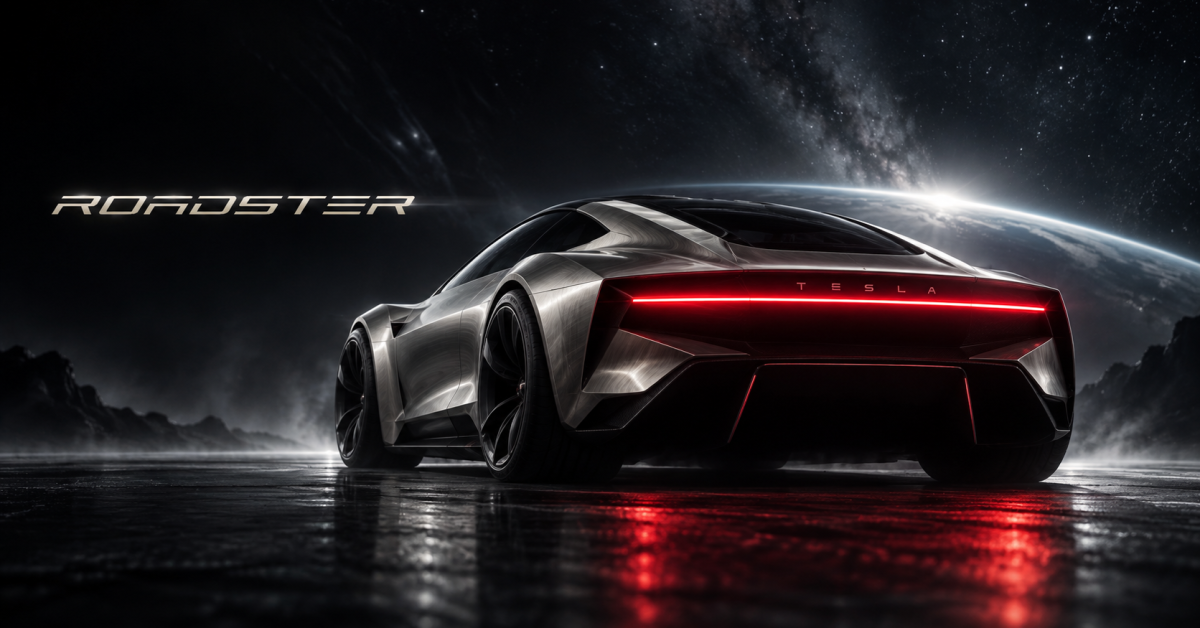
Tesla will finally unveil its new Roadster on October 1, more than eight years after it first showed the car in 2017. And a teaser this weekend suggests the production version is getting Tesla’s “Cyber” design treatment.
The teaser shows SpaceX cold gas thrusters firing out the back, and Elon Musk has promised “radical design changes.” But the Roadster never needed a redesign. It needed to ship.
Tesla has been stuck in a design rut
The 2017 Roadster was genuinely great. Low, clean, and fast, it still looks good eight years later. That’s the problem for Tesla: the best-looking car it has ever designed is nearly a decade old and never made it to production.
Look at what came after. The Model Y arrived in 2020 and became the best-selling car in the world, but let’s be honest about what it is: a slightly taller Model 3 with a hatch. A great product. Not a design leap.
Since then, it’s been all “cyber.” The Cybertruck. The Cybercab. The Robovan. Tesla took its stainless-steel, low-poly, cyberpunk-wannabe styling exercise and started bolting it onto everything. Now the teaser suggests the Roadster is next, with a full-width light bar and the same angular language as the robotaxi.
A “flying” car that cant’ really fly
Tesla plans to reveal the Roadster at an event near Waco, Texas, and the headline feature is the SpaceX package: cold gas thrusters that release super-chilled, pressurized gas for a short burst of acceleration. Musk says the car will do 0-60 mph in under two seconds without them, and under one second with them.
That’s realistic, albeit useless outside a closed track, but the problem is that Musk has also promised it will be a “flying car.”
Here’s the catch. The demo has already been scaled back from “the car can fly” to a brief hover. The demo car reportedly won’t even be street-legal, and Tesla plans to run it remotely with no driver inside because the thrusters are a noise hazard.
Now think about how you’d actually use cold gas thrusters on a road car. You get a handful of firings before the tank needs a refill, they do nothing in normal driving, and they pile weight, complexity, and cost onto a car that’s already going to be brutally expensive. Musk himself called the sub-one-second 0-60 “the least interesting part.”
It’s a gimmick. A fun one for a launch video, sure. But a gimmick.
An AI-generated render imagining a Cyber-style Tesla Roadster.
Just build the car people reserved
When Tesla unveiled the Roadster in 2017, it promised a 620-mile range, 0-60 in 1.9 seconds, a 250-plus-mph top speed, and seating for four, at a base price of $200,000. People believed it. They put down $50,000 deposits, and the $250,000 Founders Series sold out.
Then Tesla moved the goalpost, and kept moving it. By our count the reveal has slipped at least eight times since the promised 2020 production start, and high-profile reservation holders like Marques Brownlee and Sam Altman have already canceled. A former Tesla president recently suggested the delays are really about tying the Roadster’s story to SpaceX ahead of a possible merger, which fits Tesla’s habit of re-launching decade-old products for a stock pump.
An AI-generated render imagining a Cyber-style Tesla Roadster.
Electrek’s Take
Here’s what Tesla should do on October 1: deliver the car it already showed us.
Take the 2017 Roadster, update it for the fact that it’s now 2026, with 600-plus miles of range, a sub-two-second 0-60, four seats, and FSD built in, and put it into production at a price close to what people reserved. That’s it. No thrusters, no hover mode, no light bar borrowed from a robotaxi. The 2017 design still looks better than most supercars on sale today, and it’s the car tens of thousands of people actually wanted when they wired Tesla their deposits.
Tesla keeps confusing “new” with “better.” The reason the Roadster set the internet on fire in 2017 is that it was a beautiful, absurdly fast electric halo car at a price that embarrassed gas hypercars. None of that required cold gas thrusters or a “cyber” makeover. It required Tesla to actually build it.
If you’re buying an EV, powering it with home solar can cut your driving costs to nearly zero. With electricity rates up almost 10% last year and expected to keep climbing, going solar is one of the best ways to protect yourself against rising costs. And with lease and PPA options, you can do it with zero upfront cost and start saving immediately. If you want to find the best deal, check out EnergySage. It’s a free service with hundreds of pre-vetted installers competing for your business, so you save 20 to 30% compared to going it alone. No sales calls until you pick an installer. Get your free quotes here.
FTC: We use income earning auto affiliate links. More.
