

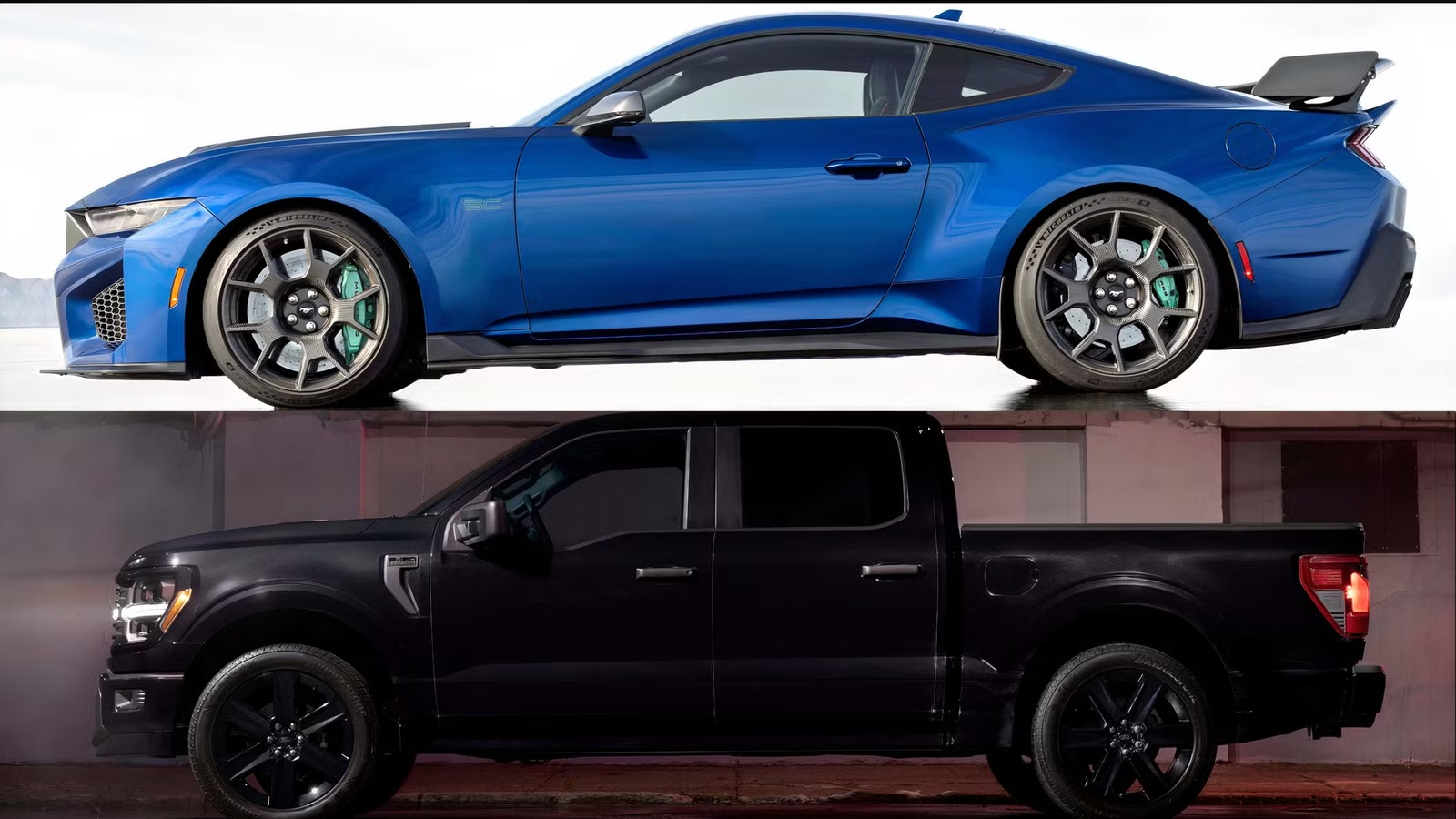
There are two models in Ford’s lineup older than any other it offers today. One not only serves as the best-selling vehicle in the country, it also holds the distinction of being the most popular pickup in the country. That’s something it doesn’t take lightly. It worked hard to get itself there. So, what about the one it produces that’s in a league of its own?
The Mustang might be the only real pony car left on the market, but it’s been lumped in with muscle cars for quite some time, even getting lumped in the generic “coupe” category to further prove its success across multiple genres. Today, it dominates all other two-doors with a Mustang state of mind.
How Far Ford Is Ahead
In the first half of 2026, Ford delivered 357,801 F-Series trucks and 28,725 Mustangs in the U.S. The F-Series maintained its reign as America’s best-selling truck, outselling its closest rival—the Chevrolet Silverado—by more than 80,000 units. Meanwhile, the Mustang completely dominated the non-premium sports car segment with a massive 22% year-over-year surge. Capturing 59% of that market, it sold over seven times as many units as its nearest competitor, the Toyota GR86 (4,007 units), while effectively standing as the sole survivor among traditional American muscle cars.
The F-150 And Mustang Weren’t Always Lacking In Competition
Close
When you’re in charge of building arguably the most impactful vehicle on the market today, you might think before changing the recipe of the truck one million Americans are expected to pay for each year. The F-Series array of trucks represents one of the most successful model lines in American automotive history. In fact, the company reached one hundred years of building pickup trucks in 2017, an impressive accomplishment that only Ford has achieved – wait, Chevrolet has also been producing trucks for a century, not to mention Dodge has also been at it since the late 1910s, so what gives?
Unlike Chevrolet and its sister truck company, GMC, or Dodge, which has been selling under the Ram moniker for 17 years now, Ford trucks have found a way to claim the top spot year after year, with competitors pressing harder and harder. General Motors may have spread its trucks across two brands to bookend the market on the low and high sides, and Ram might have been separated from Dodge to demonstrate its commitment to perfecting the pickup truck, but neither has knocked Ford from atop its perch for nearly five decades.
The Mustang, though it has no American adversaries in 2026, still has competition from other performance coupes still pumped out in Japan and Germany. At the time of the Mustang’s inception, it was a 2+2 in coupe and convertible forms with a split personality. A choice of four V8s and two straight-sixes was available, and for a short while, the Mustang was a pack of wild horses in an empty field. That is, when they weren’t being reduced to their lowly nickname of ‘secretary’s car’ before Carroll Shelby was tasked with turning that image around.
Just as it started life, the Mustang is alone again. The Chevy Camaro and Dodge Challenger would join the Mustang in the “pony car” segment it created. The Mustang survives into 2026 with plans of staying for as long as we’re still allowed to have it. By its sales figures, the Mustang is in good standing to stick around. But how much of that is owed to its singularity in the market?
The Camaro has gone underground, and the Challenger is no more; the adversaries posed by BMW through the M2 and M4, as well as Nissan’s Z and what few Toyota Supras are left, simply aren’t muscle cars. A pony car the Mustang might still be, but its muscle car pretensions and sports car adversaries have turned it into its most formidable form to date. It also made it the best-selling coupe globally for the last 10 years.
Ford Doubled-Down With Fuel Economy
Close
In order to commit to selling V8-powered, manual-gearbox performance cars, Ford needed to make sure it was well within its CAFÉ limits. Corporate Average Fuel Economy can cripple a model lineup if too many gas-guzzling vehicles appear in the fleet, a reality that pushed Ford to invest in hybrids and electric vehicles, which in turn allowed it to keep installing 5.0-liter V8s in the F-150 and the Mustang. The result? Ford bested both General Motors and Stellantis in fleet-wide emissions over the last few years while still churning out the Mustang when the others threw in the towel on their beloved coupes.
To keep the Mustang alive, Ford had to make its trucks more fuel-efficient and began offering a hybrid powertrain on the F-150 in 2020, followed by the all-electric Lightning in 2022. It didn’t have to do much with its heavy-duty trucks (F-250 and up) since the EPA doesn’t report fuel economy of anything with a GVWR above 8,500 pounds. The F-150 lands beneath that threshold and is classified as a light truck, subjecting it to harsher fuel economy standards and part of the math which calculates the average fuel economy of passenger vehicles.
2024 Ford Mustang S650 2.3L EcoBoost I4 EngineFord
The 2.3-liter turbocharged EcoBoost four-cylinder in the Mustang is doing its part, too, helping justify its own existence rather than relying on other models’ efforts to keep it alive. The 5.0-powered GT earns an average combined 18 MPG with the six-speed manual and 19 with the 10-speed automatic, saved only by the EcoBoost’s combined 26 MPG from its four-cylinder and 10-speed auto as standard. The manual gearbox available in the previous-generation’s EcoBoost is no more despite its combined 25 MPG.
The Camaro mustered the same figures in turbo-four form, too, but its 6.2-liter V8 achieved just 16 MPG with both automatic and manual gearboxes. The Challenger earned as little as 15–16 MPG in Hellcat form, up to 17 MPG for the 6.4-liter Hemi and 19 MPG for the 5.7. The 3.6-liter Pentastar V6 earned 23 MPG toward the end of its run, putting it just behind the others in its base form.
Dodge’s lineup is now just one model, the Charger, which is available in both gasoline and electric variants, allowing it to bring back the V8 whenever it pleases without fear of harming its average fuel economy. Chevrolet chose to focus its efforts on the Corvette – and we’re certainly not complaining – though, what is Chevrolet without a relatively affordable, entry-level muscle car?
The Future Is Ford’s For The Taking
Ford F-150s at the factory in Dearborn, MI.Ford
Each of the top truck manufacturers in the US has generated more headlines than planned over the last four years. Engines from both Toyota and GM have been prone to failure due to debris. Ram made the news after it dropped the Hemi from its lineup. And there was Ford, which was criticized when it proudly announced it was committing to higher quality standards while simultaneously contributing to its list of recalled vehicles – a sum that totals over 13 million and continues to grow.
Even as Ford navigates its relationship with the National Highway Traffic Safety Administration (NHTSA), it earned its first initial quality award from JD Power in 16 years. It might be fixing the vehicles that come out of the factory today and tomorrow, but that doesn’t solve the ones that rolled out yesterday, let alone a few months or a few years ago.
Now that each truck manufacturer is dealing with its fair share of problems, it could be anyone’s game for the top spot, but it won’t be a surprise if it’s Ford again. Is it because it builds the best truck? That’s relative, and since a pickup truck is one of the most versatile vehicles available, it’s different for everyone. Some people don’t use their truck for truck things, whereas others need all the utility they can get. The same goes for the Mustang. Nobody actually needs a muscle car, nor might they ever push one to its limit between the stoplights.
Ford appeals to wants and needs equally. It provides a range of trucks that satisfy the needs and wants of buyers numbering in the millions, as well as remaining the only manufacturer still offering muscle cars. It listens to its fanbase, especially with these two nameplates. These are the vehicles with the most community built around them, the ones that have captured the loyalty of families for generations. That kind of loyalty was built around vehicles like the F-150 and the Mustang, something Chevy and Dodge are working hard to ensure they don’t lose.
Sources: Ford, Good Car Bad Car, Ford Authority, NHTSA.
