

The Dodge Durango SRT Hellcat is the hottest of the hot-rod Durango variations, a three-row, high-speed family hauler. Up front, a 6.2-liter supercharged SRT V8 engine cranks out 710 horsepower, almost as much as three Toyota Highlander Hybrids. In the middle, there’s a performance-tuned TorqueFlite eight-speed automatic that handles gear-shifting duty. With seamless four-wheel traction and among the most generous low-end torque you can find in a combustion engine, Durango SRT Hellcat drivers can reach 60 miles per hour in 3.5 seconds, en route to an 11.5-second quarter-mile pass. Plus, the top speed is 180 mph, and the towing capacity is up to 8,700 pounds.
These figures make a key draw of the Durango Hellcat its ability to outrun (and out-tow) your buddy’s BMW X5 M or Porsche Cayenne Turbo at a significant cost advantage. Shoppers looking for one of the fastest second-hand SUVs for their dollar should probably consider the Tesla Model X Plaid, too.
Today, lightly used, second-hand copies of the most thunderous of Durangos are depreciating rapidly. Savvy thrill seekers are watching one of the industry’s ultimate extreme-performance SUVs depreciate into one of its best extreme-performance bargains available. Is a second-hand Durango Hellcat the right machine for you and your family? Read on for some expert context, and a look at how we got here.
From Collector Speculation To A 50% Haircut
2026 Dodge Durango SRT HellcatDodge
A few years ago, Dodge was stuffing Hellcat engines into almost everything. When it announced the Durango was next in line to receive the supercharged 6.2-liter V8 power, reservations flooded in, waiting lists grew, and dealers started adding markups for those keen to be first on the road with the latest hot-rod Dodge. Supply would be tight because at launch, the model was touted as a single-year, limited-production ordeal with around 3,000 units to be built. That kept supply scarce, drove demand up, caused a frenzy, and drove five-figure dealership “market adjustments” that pushed roughly $81,000 MSRPs past the $100,000 mark. Still, buyers lined up to pay it.
2021 Dodge Durango Price List
- SXT RWD: $31,765
- SXT AWD: $34,365
- GT RWD: $35,965
- GT AWD: $38,565
- R/T RWD: $45,305
- R/T AWD: $47,905
- R/T AWD Tow N Go: $52,900
- Citadel RWD: $47,805
- Citadel AWD: $50,405
- SRT 392 AWD: $62,995
- SRT Hellcat AWD: $80,995
“Who would pay $100,000 for a Dodge!?” shouted haters from the comments section, as Dodge rapidly sold every single unit they could build to shoppers who assumed they were getting an instant collectible with the one-year run.
Surprise! In 2022, Dodge announced that the Hellcat Durango would return for 2023. That was great news, unless you bought one for an inflated price in 2021, which almost everyone did. Furious owners sued over the alleged “bait-and-switch” tactic that would crater their investment value. A federal judge dismissed the suit, ruling that the case made for the fast SUV buyers “didn’t demonstrate an actionable misrepresentation on the part of Dodge, Stellantis, or SRT exec Tim Kuniskis.”
2023 Dodge Durango SRT Hellcat Selected Specifications
Engine:
6.2-liter V8, supercharged, dual water-to-air intercoolers
Bore × Stroke
4.09 × 3.58 (103.9 × 90.9)
Valve System
Pushrod-operated overhead valves
Fuel Injection
Sequential, multi-port
Construction
Deep-skirt cast-iron block with cross-bolted main bearing caps, aluminum alloy heads
Compression Ratio
9.5:1
Power
710 hp @ 6,100 rpm
Torque
645 lb-ft @ 4,300 rpm
Max. Engine Speed
6,100 rpm
Fuel Requirement
Premium 91 octane
Max Towing Capacity
8,700 pounds
Engine Assembly
Saltillo Engine Plant, Saltillo, Mexico
Meanwhile, record gas prices dulled the vehicle’s novelty. Plus, an increasing number of all-electric contenders joined the scene, some ready to leave the Durango SRT Hellcat in the dust at the drag strip. Dealer markups vaporized as production expanded and supply increased, dragging prices and demand down. Those early “collector” units were losing around half their value in just a few years. That’s how original Durango SRT Hellcat owners took a major hit, leaving today’s second-hand buyer with a nearly unbeatable horsepower-per-dollar proposition.
Resale Values Have Been Skydiving, Here’s What You’ll Pay Today
2026 Dodge DurangoStellantis
Let’s help set up your budget. Online auction data shows plenty of initial owners offloading those early builds. Initially bought to be collected, not driven, these are often extremely low-mileage examples, but they have suffered major losses in value. Back in 2022, the peak price for a 2021 Durango SRT Hellcat belonged to a 34-mile unit that went for $105,000. Today, virtually showroom-condition 2021 copies with between 800 and 2,500 miles on their odometers routinely trade for around $70,000.
If you aren’t shopping for collector-level odometer readings, you can find sub-7,000-mile units in the mid-$60,000 range, with some even available in the high $50,000 range. On the low end of the price scale, look for well-used units approaching 100,000 miles, bottoming out around $54,000. The sweet spot seems to be around sixty grand or so, where you can find a hearty selection of lightly driven units with 20,000 to 30,000 miles of use.
Interior shot of a 2026 Dodge Durango SRT Hellcat in blackDodge
Alternatively, late-model units and barely driven collector examples can still land between $80,000 and $95,000, with most at this price point being practically new. In addition to virtually undriven 2021s showing just a few hundred miles on the odometer, this price range can also get shoppers into newer 2023 through 2026 iterations and heavily optioned SRT Hellcat Premium trims. As a result, it’s easy to take advantage of the steep depreciation suffered by original speculators. Pristine ultra-low-mileage examples still command a $20,000 to $35,000 premium over higher-mileage, sub-$65,000 alternatives.
The Durango Hellcat Was Built To Satisfy, But Not On Tech
2025 Dodge Durango SRT Hellcat interior front viewDodge
We know the Durango Hellcat can satisfy owners with its performance, theatrics, functionality, and capability. A look at JD Power APEAL and TXI scoring data shows Dodge’s standing in thisera, based on key satisfaction metrics.
Let’s start with APEAL scoring, which measures owners’ excitement and emotional attachment to the vehicle. Top-scoring brands in this study deliver machinery owners say delights them most, earning high marks for presence, cabin design, sensory execution, and the pure thrill of the driving experience.
If you’re a used Durango SRT Hellcat shopper, this is where the deal gets really sweet. Based on APEAL scoring data over the past five years, Dodge didn’t just sweep mass-market rivals like Ford, Chevrolet, and Toyota; it routinely embarrassed luxury brands, too. In 2022, Dodge’s 882 score (on a 1,000-point scale) topped heavyweights like BMW (875) and Mercedes-Benz (876), trailing only Porsche (888), Genesis (886), and Cadillac (885). In 2023, Dodge’s 887 tied Jaguar for the highest score in the entire industry, directly beating Porsche (883), Land Rover (883), and Lexus (864). Even after a steep stumble in 2024 (dropping to 837), Dodge surged back to 868 in 2025, outscoring Lexus (864) and Audi (850) in the process. So, from 2022 to 2026, Dodge built some of the highest-rated vehicles on the road for emotional design and driving appeal.
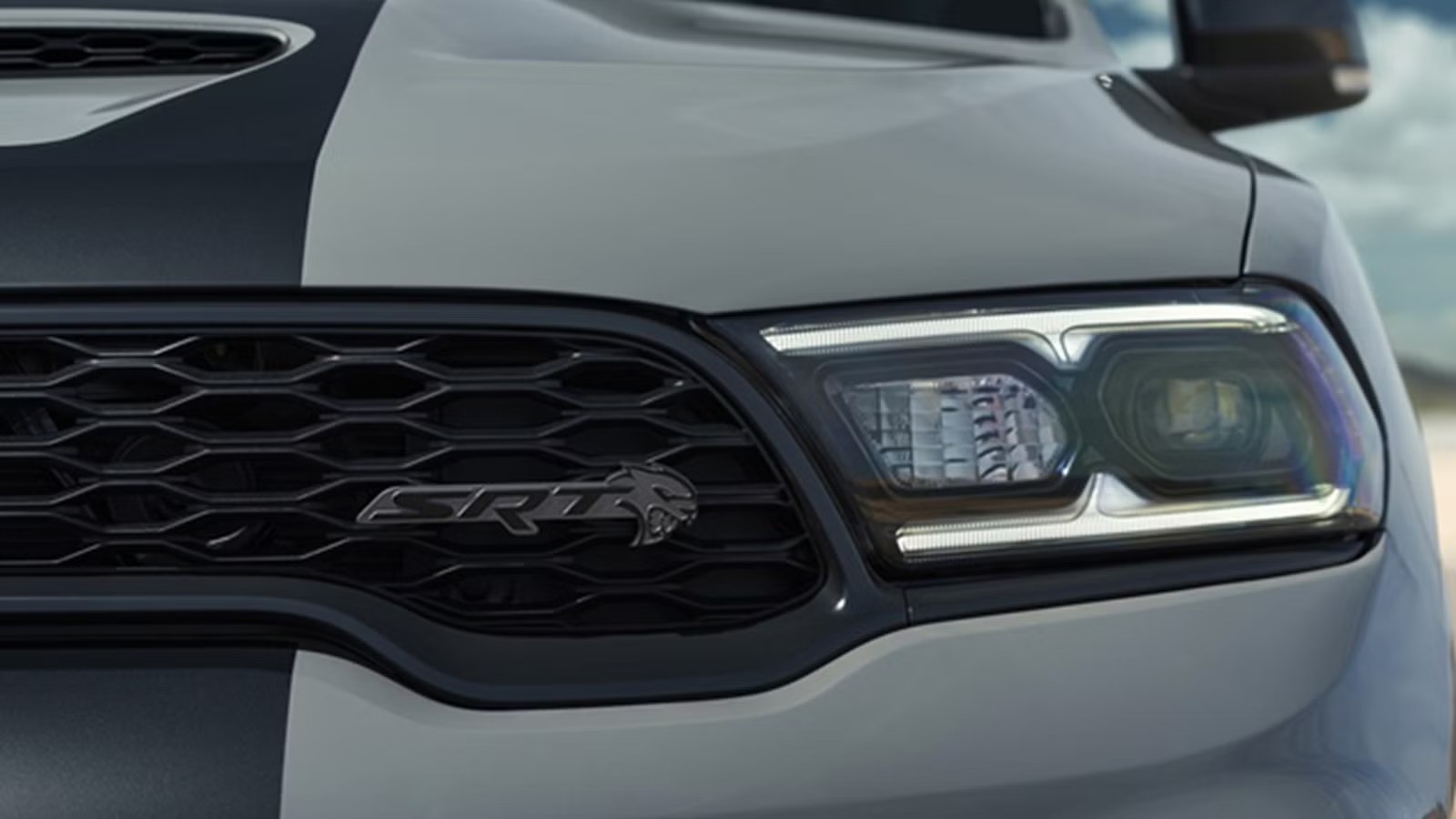
2026 Dodge Durango SRT Hellcat LogoDodge
However, the Durango suffers when it comes to technology and innovation. Looking at JD Power’s TXI scoring, which measures how effectively brands bring advanced vehicle technologies to market based on adoption, usability, and problem frequency, Dodge scored at or near rock bottom over the same period. In 2022 (429) and 2023 (424), Dodge only narrowly outranked Mazda, Mitsubishi, and Jaguar when it came to satisfaction with the brand’s latest tech offerings and innovations. Mainstream competitors like Hyundai (534 to 547), Subaru (481), and Ford (457 to 462) led Dodge by a healthy margin in tech implementation. By 2024, Dodge tanked to absolute last place in the last five years with a score of 392, beaten by every brand tracked in the study.
That’s all a very fancy way of saying that second-hand Durango Hellcat buyers are extremely likely to be extremely satisfied with the driving experience, and extremely likely to be disappointed by the on-board electronics, interfaces, and driver assistance, which are outclassed by virtually every other vehicle on the road.
These Thrills Come With Some Bills
2026 Dodge Durango SRT Hellcat Front 3/4 ViewDodge
When it comes to running costs, it is tricky to nail down exactly how much more a Durango Hellcat might cost than a more reasonable, brand-new, fully warranty-covered alternative around the same price. Durango Hellcats are relatively low volume, reliability data is patchy, and most outlets do not call out this specialized performance trim with its own data set. Still, savvy shoppers know some annual contingency cash is a good idea alongside a purchase like this, so let’s try to get you numbers that put you in the budget ballpark.
According to EPA data, the Durango Hellcat gets 12 miles per gallon in the city, 17 mpg on the highway, and 13 mpg combined. At those consumption rates, its roughly 24.6-gallon fuel tank runs dry every 320 miles. If you can’t stay out of the supercharger, you could easily cut that figure in half. Good luck. Also, you’ll need to run premium gas at something like $5 a gallon, meaning a refill would lighten your wallet by about $125. According to EPA data, that’s a $5,850 annual fuel bill for the SRT Hellcat.
2021 Dodge Durango SRT Hellcat 6.2L Supercharged Hellcat V8 EngineDodge
Go a more reasonable route, and you will find something like a decked-out Toyota Grand Highlander Platinum for around the same money that gets owners 20 MPG in the city, 26 MPG on the highway, and 22 MPG combined. Its 17.8-gallon tank runs dry in 392 miles. With regular-grade gas at, say, $4.15 per gallon, it’s a $74 fill-up, fifty bucks less than the Durango every time.
According to EPA data, Grand Highlander Platinum drivers can expect an annual fuel bill of $2,800, saving roughly $3,000 per year versus the Hellcat Durango. Keep your machine for 5 years, and that supercharged V8 will suck back a whopping $15,000 more in fuel.
Don’t forget maintenance and repairs. While the Durango SRT’s core driveline hardware has proven solid for the vast majority of owners, its big wheels, big tires, and big brakes all come with big replacement parts that all carry an extreme-performance tax. Thrill-seeking drivers or folks who tow often can wear out brakes and tires quickly. Fluids and filters may require changing more often than you’re used to, especially if you drive your Durango Hellcat as intended.
This isn’t the sort of family SUV known to go 100,000 miles solely on oil changes and air filters. Budgeting an extra $2,000 per year across a five-year ownership experience seems reasonable to cover tires, brakes, accelerated fluid swaps, and a surprise repair or two. If you’ll regularly tow with your Durango Hellcat, or use it in a motorsports setting, bumping that figure to $3,000 annually is reasonable.
Tallied up over a five-year ownership stretch, you are looking at an estimated $15,000 fuel penalty paired with an additional $10,000 to $15,000 in consumables and contingencies, versus something newer and more sensible. These numbers are safe estimates, and your results will vary.
The takeaway is the same: choosing the pre-owned Hellcat over a sensible, brand-new family SUV for the same money could handily come with additional costs approaching $30,000 as the real price of admission to the Durango SRT Hellcat’s performance. And what a performance it is.
Sources: EPA, Repairpal, Stellantis, Kelley Blue Book, Bring A Trailer, JD Power.
