

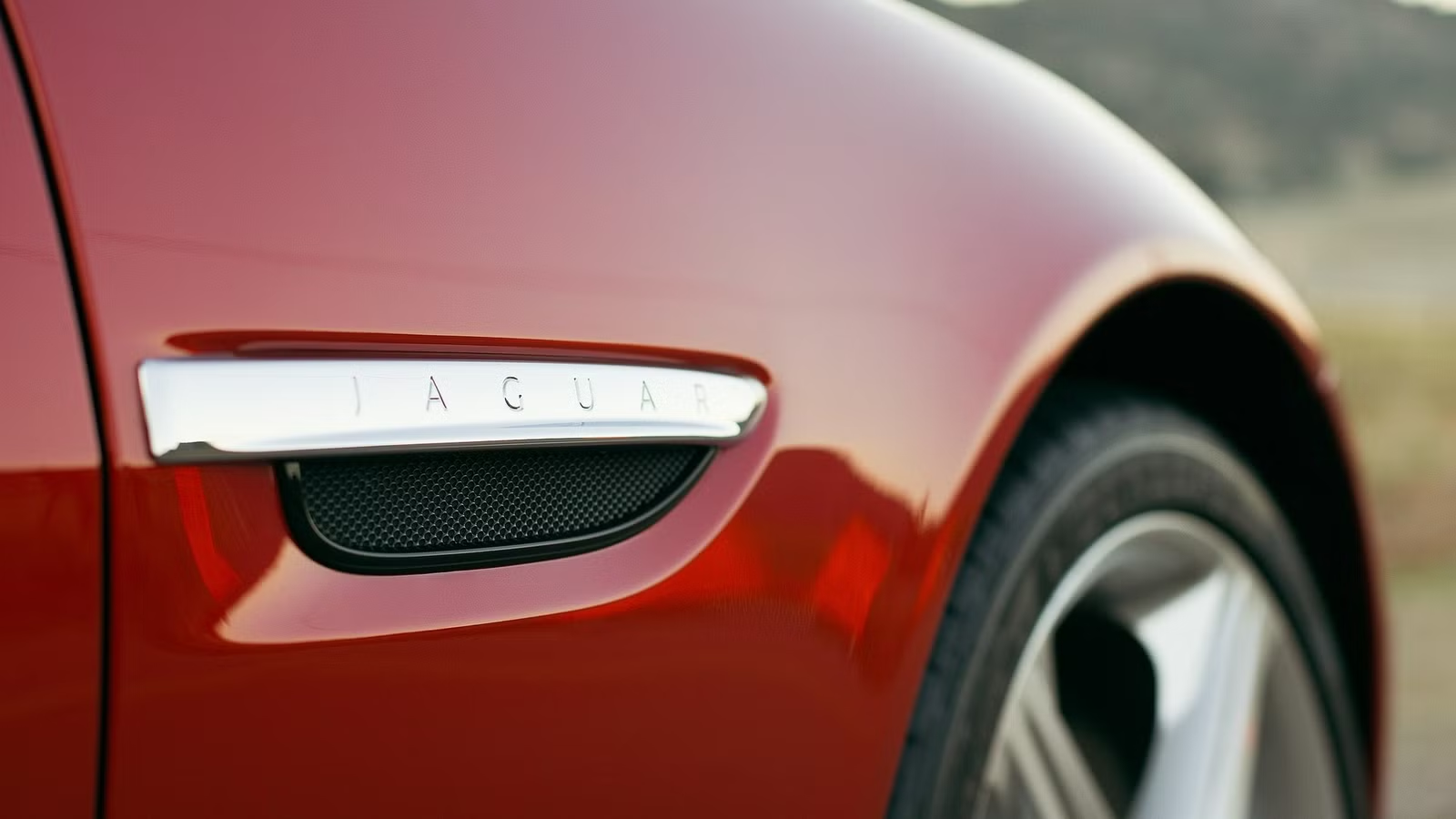
Jaguar made waves when it launched the Jaguar F-Type in 2012 to replace the long-lived XK model, primarily because its curvy lines and name took inspiration from the legendary E-Type. The F-Type was also more accessible than its predecessor due to being available with a six-cylinder engine alongside the traditional V8, as well as a four-cylinder option starting in 2017.
The thing is, you could save a lot of money today by opting for either iteration of the XK series. Each offers a thrilling drop-top V8 experience in its own right.
Jag’s New Coupe Drew The Eye From The Outset
2001 – 2006 Jaguar XKR Convertible exteriorJaguar
Let’s kick off with the first of the breed: the X100-generation XK. It launched in 1996 and went on sale in the United States for the 1997 model year. Jaguar developed the XK to give brand connoisseurs a luxurious grand tourer that paired comfort and class with a muscular V8. The setup gave this big cat some pretty sharp claws.
By the 1999 model, buyers could choose between two variants: the standard XK8 and the XKR. Both were available as a coupe or soft-top convertible. The XK8 aimed at being a comfortable cruiser that could get down the road at a solidly brisk pace. The XKR was a hardened version that you could use to scream down a country lane on a quiet Sunday morning.
At launch, the XK8 got a naturally aspirated 4.0-liter V8 that pumped out 290 horsepower, while the XKR got a similar engine, but with a supercharger. The boost allowed the peak grunt figure to shoot up to 370 hp, affording the convertible version a 5.6-second 0-60 mph effort, just shy of 1.5 seconds faster than the base XK8. In 2003, both versions received Jag’s revised 4.2-liter V8, which brought power up to 294 hp and 400 hp, respectively. The older cars put their power to the road via a five-speed automatic transmission, while the revised machines got a more durable six-speed automatic.
Both cars offered plush cabins that paired quintessential British leather and wood trim with modern toys such as automatic climate control and a premium sound system, ensuring drivers could waft home in comfort after giving that V8 a good-old thrashing. It was a Jaguar through and through, with the recipe completed in style by the sleek Fergus Pollock-styled body that harked back to the slick lines of the E-Type.
The Original XK Provides A Lot For Not Much Money
2001 – 2006 Jaguar XKR Convertible exteriorJaguar
The best thing about the XK sporting a Jag badge is that the model has struggled to hold its value. While that may not be music to the ears of those who bought one brand new, it provides an amazing opportunity for drivers looking for a used bargain. Amazingly, the average used value of the base XK8 convertible currently sits at just $10,630 in 2026, less than half the price of the cheapest new car sold in the US. For that kind of cash, you can find a late 1990s vehicle with between 50,000 and 70,000 miles on the odometer.
The thing is, you can spend as little as $7,000 and find yourself a tidy specimen with around 70,000 miles on the clock, and less than $5,000 can get you one with well north of 100,000 miles on the clock. These can be riskier, though, so you’ve been warned.
Happily, you can find the later, bigger-engined XK8s for just a few extra thousand dollars. The same story applies to the supercharged XKR, with Hagerty’s Valuation Tool reporting that the average value for a solid, good-condition 2006 machine is around $16,000 right now. If you’ve got plenty of money spare, $35,000 can get you a mint example. Or in other words, only $6,000 more than a base Toyota Camry.
Again, you won’t save much by opting for the earlier version, with Hagerty valuing them only about a grand less across the board. Since the revised 4.2-liter engine is more dependable, we recommend spending the extra cash on a newer one. Come on, you get more go-faster juice, so why not?
The XK150 Was More Of A Driver’s Car
A Jaguar XK parked on a shoreJaguar
In 2006, the X100’s ten-year reign finally ended, and the X150-generation XK replaced it. The model launched in the US for the 2007 model year, again with coupe and convertible configurations. The second-generation XK had a ground-up redesign for its chassis. The car’s handsome Ian Callum-designed silhouette sat atop an advanced aluminum monocoque, which helped it tip the scales a full 200 pounds lighter than its predecessor, despite being bigger.
The revised suspension provided a crisper and more performance-focused handling balance, moving away from the soft cruiser setup rocked by the X100. That said, the XK150 still leans more toward plushness than a razor-sharp sports-car setup; it’s just not quite as supple as its predecessor.
This embracing-technology approach was further reflected in the X150’s redesigned cabin, which went for more of a contemporary leather and aluminum trim design. It was a significant step away from the traditional wood decor that characterized earlier Jaguars, like the first-gen XK.
One thing that remained the same, at least initially, was its drivetrain. The 4.2-liter AJ34 engine from the refreshed first-gen XK still powered the new model for the 2007-2009 model years in the US. The 2010 XK8 received a new 5.0-liter V8 in both naturally aspirated and supercharged forms. The new powerplant boosted the base XK’s power output to 380 hp, around the same as the previous-gen XKR, while the new XKR had a blazing 503 hp at its disposal. This allowed it to blast to 60 mph from a standstill in 4.6 seconds.
The Newer XK Is More Money, But Still A Good Deal
A 2009 Jaguar XK on a shoreJagaur
Should the more modern and slightly more driver-focused XK150 better tickle your fancy, then don’t worry, as you can still pick them up for a steal. If you opt for the earlier 4.2-liter cars, expect to spend around $15,000 for a tidy, middling-mileage example, while the later 5.0-liter specimens add about $6,000 to your required budget. To be more specific, these average values should net you respective well-looked-after machines with around 50,000 miles on the clock.
If you’re drawn to the more-powerful XKR, the earlier examples average value of these sits around $17,800, which again nets you a tidy car with roughly 50,000 miles on the odometer. The more powerful post-2009 XKR’s come with a $4,000 premium over their standard naturally aspirated sibling, with an average value of $25,800.
“The Jaguar XK was introduced at a time when the high-performance luxury coupe reached its peak. It launched a year later than the Aston Martin V8 Vantage, and around the same time as the BMW M6 and the famous SL 55 AMG. That’s a pretty tough crowd to face, and Jag had to develop this car with some coins it found in the back of the couch. It showed in certain places, with below-par switchgear, and a silly 80s-like antenna that rose from its hips.
But it was extremely charming. It looked so modern at the time, and it still looks good to this day. Massive kudos to Ian Callum for making something as pretty as an Aston Martin at a fraction of the cost.
I think Jag was smart to make this car more of a grand tourer than an outright sports car. Yes, it can do all sorts of irresponsible things if you want it to, but it covers ground rapidly, and that glorious exhaust noise will always put a smile on your face.
Would I have one over its rivals that have suffered similar depreciation? The Aston sounds magnificent, but it’s relatively slow. You need the bigger 4.7 engine. The M6 is a stupendous car, but that engine is about as reliable as a leaky bucket. The SL 55 is tempting. I love the idea of driving a Spitfire on four wheels. But SL55s are increasing in value, and I have some advice. I’d buy the nicest XKR, and immediately put $10,000 toward fixing all the known issues, which are well recorded by now,”
– Gerhard Horn, CarBuzz Senior Editor
You can spend much less than this on a car, but since they’ll come with plenty of extra miles on the odometer, you’d need to make sure the vehicle has been thoroughly maintained throughout its life. These cars do suffer from some common issues, so it’s critical to ensure any potential ailments have been addressed, primarily for your sanity and wallet.
Be Wary Of The Issues That Could Befall You
The 2014 Jaguar XJR is powered by a supercharged 5.0-liter V8 engine. A very sensible option.Jaguar
For the most part, if you want the most reliable example of an XK, opting for any of the 4.2-liter-engined cars, either X100 or X150, is the best way to go. These engines suffer few common issues, with the most common being degraded intake manifold swirl flaps, which can cause the engine to run rough. Replacing the intake manifold is necessary to fix the problem. The 4.0-liter engines in pre-2000 X100 cars can be problematic, since they used Nikasil-lined cylinder bores. The design led to excessive oil consumption and eventual engine failure.
Jaguar revised the cylinders with new mild steel liners in 2000 to fix the problem, so make sure any early example has been upgraded before you buy. Older engines also used partly plastic timing chain guides, which were susceptible to failure later in life. Even an engine that’s not in need of a new chain could have the guides fail prematurely. Stronger steel components became available in late 2001, so again, be sure to check that any cars built before then have had the upgrade completed so you don’t risk catastrophic engine failure.
The 5.0-liter engine used in post-2009 XKs is also generally robust, but it has a couple of common issues you need to watch for. Arguably the most infamous are the steel timing chain tensioners breaking down and causing the chain to jump teeth or eventually snap. Replacing the guides is expensive, potentially costing upwards of $5,000. That said, if you don’t have the work done and the chain fails, you’d face a bill of over $20,000, essentially writing the car off.
Beyond that, water pumps are known to fail prematurely, so ensuring they have been recently replaced will help to save money longer term. Overall, if you’re after the cheapest of these XKs to run, opt for a 2006-2008 X150 version with the 4.2-liter engine. Get a good deal, though, with the scary bits done, and the newer 2009-2015 X150s are less likely to suffer from age-related problems, which the 20+-year-old X100 would be ripe with unless you get one that’s already been flooded with work, of course.
The New XKR Provides A Great Compromise
2006 – 2010 Jaguar XKR – front 3/4 angleJaguar
Choosing which XK to spend your hard-earned money on ultimately comes down to what you prioritize most from a V8-powered Jag droptop. For drivers who want to cruise in comfort and style and aren’t after a back-road blast, the X100 is perfectly suited. Those after a more rounded, engaging driving experience, but still want a convertible that’ll be comfortable to waft around in, will be better off going for the X150.
We reckon the latter provides the best compromise, because it’s still very supple, but comes with a more modern cabin, arguably better styling, and is better to drive fast. Especially in XKR spec, since its supercharged engine provides drama, smoothness, and neck-snapping pace in one exquisite package. And all for the cost of a mid-range Camry.
Sources: Hagerty Valuation Tool, Jaguar
