

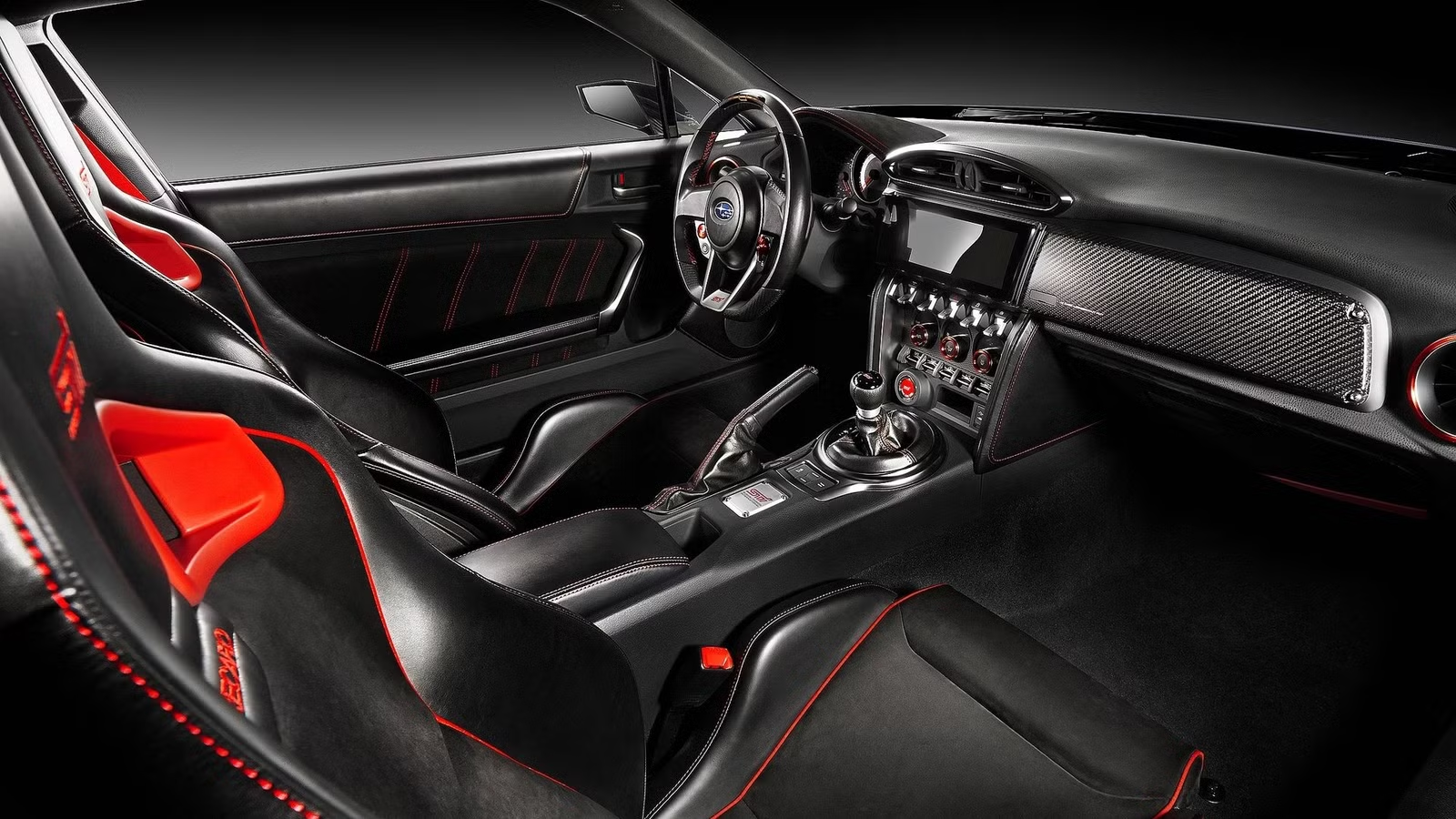
This year marks the end of the line for several long-running manual icons, including the Porsche 718 Boxster/Cayman, the Toyota GR Supra, and the BMW Z4. Enthusiasts are keenly hunting for the remaining three-pedal options in the new car market, and they know the window is closing. Today, only around two dozen models remain available with three pedals for 2026, down from nearly three dozen just five years ago in 2021.
While manuals only account for 1.7% of total new-vehicle sales, the Subaru BRZ boasts a 90% manual take rate, the WRX sits around 85%, while 83% of Porsche 911 GT3 Touring buyers choose the pedal-operated clutch even as elite hypercars like the Corvette ZR1 and Lamborghini Temerario go automatic-only.
So why are automakers killing the manual? Certifying two separate transmissions requires duplicating costly emissions and other testing, and manuals don’t integrate easily with modern hybrid architectures or advanced driver-assistance systems (ADAS). Also, mainstream buyers just don’t want them. Tightening fuel economy and emissions targets make it harder to meet modern standards with a primitive gearbox that can’t be precisely computer-controlled, even though it’s the clear choice for a dedicated faction.
Below, we’ll run through a list of the remaining manual-equipped models you can find on the new car market today, as well as a few nearly or recently departed models that might still be sitting on dealer lots. Where possible, we’ll show the take rate according to reporting from Motor1.com and consider how far from extinction each of the manual boxes below might be.
17
Acura Integra / Type S
Acura launched the Integra in the mid-80s with a manual as a core part of its identity from the get-go. The 2023 revival preserved that heritage, and today, the 6‑speed stick is available on the A-Spec with Tech Package, as well as the top-dog Type S. The base-model Integra comes automatic-only, pushing the price of the stick upmarket, for a take rate of 22% for 2025 (up from 19.8% in 2024), as reported by Motor1.
Acura keeps the manual alive because it anchors the nameplate’s enthusiast credibility in a new era, though Honda’s electrification roadmap threatens its long-term survival. Honda hasn’t announced discontinuation of the Integra’s manual, though it will pause production of manual-equipped variants in 2027. Taken with the automaker’s public comments about the rising cost of certifying multiple powertrains, it looks like manual-equipped Honda and Acura sports sedans might be in seriously precarious territory.
16
BMW Ms (M2, M3, M4)
BMW’s M cars have offered manuals since the 1980s, and the current G‑series generation represents the final chapter. Motor1 take rate data shows that 40% of M2 buyers, 50% of Z4 buyers, 50% of rear‑wheel‑drive M3 buyers, and 33% of rear‑wheel‑drive M4 buyers chose the manual.
When Competition and xDrive variants are included, the manual accounts for just 6–8% of total M3/M4 sales. BMW has confirmed that future M cars will lean heavily into electrification and automatic gearboxes, and with the Z4 and its available manual entering their final 2026 production run, these manual M cars are a few steps deeper into endangered species territory than they were a year ago.
15
Honda Civic Si / Type R
The Civic has offered a manual since its 1972 launch (1973 in North America), and the latest generation (2022 for the Si, 2023 for the Type R) continues the tradition. Both trims are manual‑only, for a take rate of 100 percent. Recent speculation suggested the Si might lose its manual due to certification costs, and Honda is pausing production of the Si alongside the Integra for 2027. Still, they’ve issued no discontinuation announcement. Electrification is coming for the broader Civic lineup, making the long‑term future of its spiced-up and highest-performing variants particularly uncertain.
14
Hyundai Elantra N
The Elantra N arrived in 2022 as Hyundai’s first true performance sedan, offering a 6‑speed manual alongside an 8‑speed DCT. Manual take rates have increased from 25% to 30%, as reported by Motor1, showing rising demand even as the segment shrinks. Earlier speculation suggested the manual might be short‑lived, but Hyundai has issued no official US‑market discontinuation bulletin. Keep a close eye on this one: for now, the manual is available, appreciated, and gaining traction – though the Elantra N is currently the only remaining manual Hyundai, and a new-generation Elantra is on the horizon.
13
Mazda MX‑5
The MX‑5 launched in 1989 with a manual as part of its very DNA. The current generation continues with a 6‑speed manual paired to the 2.0‑liter Skyactiv‑G engine. Take rates exceed 70% as reported by Motor1, making it one of the strongest manual performers in the industry. That’s no surprise given this car’s target audience. Mazda has hinted that the next MX‑5 may incorporate electrification, but hasn’t confirmed whether the manual will survive. For now, the MX‑5 remains one of the safest manuals left, at least until the end of the current generation.
12
Mazda3
The Mazda3 launched in 2004 with a manual option, but availability has shrunk dramatically. The current generation, launched in 2019, offers a 6‑speed manual only on the hatchback 2.5 S Premium trim grade paired to the 2.5‑liter naturally aspirated engine and front-wheel drive. Mazda didn’t report a manual take rate for this model, though Motor1 notes that most drivers choose the automatic, and that take rates have been slipping.
Mazda hasn’t confirmed discontinuation of the manual gearbox on this specific trim grade, its sole offering with three pedals in the Mazda3. Still, we wouldn’t be too surprised to see this gearbox disappear sooner rather than later, especially as the brand continues pushing upscale.
11
Nissan Z
The Z lineage dates back to 1969, and manuals have always been part of its DNA. The latest generation (2023) offers a 6‑speed manual paired to the 3.0‑liter twin‑turbo V6, with take rates around half as reported by Motor1 at the model’s launch. With initial orders satisfied, the take rate subsequently dropped to 38 percent, and has since climbed back towards 50 percent for non-Nismo models.
From the 2027 model year, you’ll be able to get a manual in Nismo models too, which are currently automatic only. That satisfies those after a three-pedal solution at the highest performance level. Though we don’t know what’s next for the Z, we do know that it’s just been through an update and refresh, and expect it to stick around for a few more years at least. Expanding manual momentum in this model line should prove strong enough to keep them on the Z’s options list until then – and hopefully beyond.
10
Porsche 911
The 911 debuted in 1964 with a manual, and the 992.2 refresh has reshaped three‑pedal availability. Standard Carrera and Carrera S models launched PDK‑only, but Porsche restored the manual for North America via the Carrera S MT Package, introduced for the 2027 model year and offered exclusively as a rear‑wheel‑drive Coupe and Cabriolet. It joins the Carrera T and GT3 / GT3 Touring as the only 6‑speed manual 911s. The AWD Carrera 4S remains PDK‑only.
Take rates for the GT3 Touring reach 83%, as reported by Motor1, while the Carrera T and Carrera S MT Package serve as the last non‑GT analog 911s. With rivals like the Corvette ZR1 and Lamborghini Temerario going automatic‑only, the GT3 stands as the final manual at the elite tier. We don’t see it going anywhere any time soon.
9
Subaru BRZ / Toyota GR86
The BRZ and GR86 launched in 2012 with manuals as their defining feature, and the second generation (2022) continues with a 6‑speed manual paired to a flat‑four. Take rates are astonishing: 90% for BRZ and around half for the GR86, as reported by Motor1. Strong demand should keep the manual transmission alive and well on this platform and beyond, though the same clock ticks for all manual transmissions, and these twins aren’t exempt.
8
Subaru WRX
The WRX debuted in the 1990s with a manual, and the latest generation (2022) continues with a 6‑speed manual paired to the 2.4‑liter turbo flat‑four. Take rates sit around 85%, as reported by Motor1, making it one of the strongest manual performers in the industry.
We don’t know what’s next for the WRX, but we do know that Subaru has recently been re-jiggering the lineup to the benefit of sales volumes. It’s likely Subaru will continue selling stick-shift WRXs for as long as it’s able, to the end of this generation and hopefully beyond. Subaru hasn’t confirmed a successor, but electrification is accelerating across the brand. All told, call the manual-equipped WRX “safe but vulnerable”.
