

The forthcoming Euro 7 emissions regulations are pushing many automakers to cook up new powertrains and retool their lineups. As far as engines go, naturally aspirated V6s are starting to disappear, with another configuration possibly joining them soon: the oddball 5-cylinder. The situation has already led Audi to mull the decision to kill its high-performance five-cylinder engine, despite the company helping popularize the layout in automobiles decades ago.
Let’s take a look at some of the brands responsible for putting the five-cylinder powerplant on the road before these engines disappear. Some of them even had their own twist on the idea.
8
Mercedes-Benz
1974-1991 OM617
The common misnomer is that Audi developed the five-cylinder engine before anyone else did. Not true. In 1974, Mercedes-Benz introduced the OM617 3.0-liter five-cylinder diesel engine, beating Audi’s gasoline-fueled five-pot to the market by two years. Mercedes’ success with the powerplant didn’t come from racing, as Audi’s did. Instead, the unit gained notoriety in other ways.
Owners reported getting fuel economy around 26 miles per gallon. In the late 1970s, the mileage was a refreshing sight in the midst of a fuel crisis. Over the years, the OM617 proved reliable enough to propel vehicles into high six-figure odometer readings. These attributes cemented the OM617’s place in Mercedes history.
Better still, Mercedes introduced the turbocharged OM617A in 1976. The company put a tuned version in the C-111 test car, and the vehicle managed to hit 156 mph. A road-going version powered the brand’s models until the early 1990s.
7
Honda
1989-1998 G-Series
After Mercedes-Benz and Audi started offering five-cylinder engines, Honda had the same idea and developed one for similar reasons. A four-cylinder engine can achieve great fuel economy but can only produce so much power, while a six-cylinder can deliver power but hurts economy with its weight and generally larger displacement. Honda’s answer was a compromise: a 188-horsepower 2.5-liter 5-cylinder engine that landed smack in the middle between the two engines. The unit debuted in North America in the 1992 Acura Vigor.
The Acura Vigor, as it’s known in the US, was the Honda Inspire in Japan. It was the first vehicle to feature the brand’s new G-Series engine in the FWD sedan. The engine was mounted longitudinally between the front fenders to improve weight distribution, with power sent to the front wheels via equal-length half-shafts to eliminate torque steer. This setup gave the Vigor and its replacement, the 1996 Acura TL, sleek proportions until it was redesigned after 1998, kicking out the G-Series for a 3.2-liter transverse-mounted V6.
6
Volkswagen
1997-2006 VR5
Volkswagen revolutionized compact internal combustion engines when it introduced the VR6. The letters in the alphanumeric moniker loosely translate to “shortened inline engine.” Made popular by the VR6, the layout consisted of two banks of cylinders with a narrow enough angle between them to allow for a single cylinder head. VW once made a short-lived, five-cylinder version called the VR5 that never made it to the US.
The first-generation VR5 engines used in the Golf, Passat, Bora (the foreign-market name for the Jetta), and New Beetle made 150 horsepower and 154 lb-ft of torque with one cylinder head, two camshafts, and two valves per cylinder. Later models received four valves per cylinder and kept the dual-cam setup, using rocker arms to depress the second set of valves. This punched out an extra 20 horsepower and 18 lb-ft of torque. Unfortunately, this ill-fated five-cylinder mustered no more oomph than the available turbocharged 1.8-liter four-cylinder on offer. By 2006, the engine was gone from the lineup.
5
Fiat
1996-2007 Pratola Serra Family C
The Fiat Coupé launched with a pair of four-cylinder engines in 1993, then added two more options: a 1.8-liter four-cylinder and a 2.0-liter inline-five. Its sheet metal, designed by Chris Bangle (that explains it), was the only thing objectionable once it got the new five-cylinder engine. Fiat had a world beater on its hands with the Coupé. The model could hit 60 MPH in about 6.0 seconds and topped out at 149 MPH (155 with the 6-speed gearbox in 1998), numbers befitting other affordable Italian sports cars of the time.
The five-cylinder engine was part of Fiat’s Pratola Serra Family C. A 2.4-liter version of the powerplant was in the Fiat Stilo Abarth hatchback. A handful of cars bore Fiat’s five-cylinder engines in both gasoline and diesel form, too, including two other Fiats, a small fleet of Alfa Romeos, and a few Lancias. The Family C range included a 2.0-liter naturally aspirated and turbocharged variant, good for 145 and 217 horsepower each, a 175-horsepower 2.4-liter gasoline variant, and a 2.4-liter turbodiesel that lasted three years after the rest of the Fiat-made five-cylinders faded from existence in 2007.
4
Land Rover
1998-2007 Td5
While Land Rover barely changed the Defender’s skin for 26 years, it added enough technology to breathe new life into the model’s old bones. Development of LR’s Td5 inline-five turbodiesel was near competition when BMW purchased the Rover Group. The new bosses oversaw the project but kept tight reins on it. The Td5 became LR’s last in-house-designed diesel engine while it was still part of the British conglomerate. The unit found a home in the Defender and the Discovery II in some markets from 1998 until 2007.
The inline-five made a name for itself in the Defender community as one of the more reliable diesel engines, even with its new ECU codenamed “Thunder.” It squeezed roughly 122 horsepower and 221 lb-ft of torque from its 2.5 liters of displacement, helped by dual chain-driven overhead cams and an electronic fuel management system. The system was clean enough for Euro 2 emissions without a catalytic converter. Many regard this era of Defender as one of the most robust, but preventative maintenance is crucial to keeping them roaming.
3
General Motors
2004-2012 Vortec 3500 & 3700
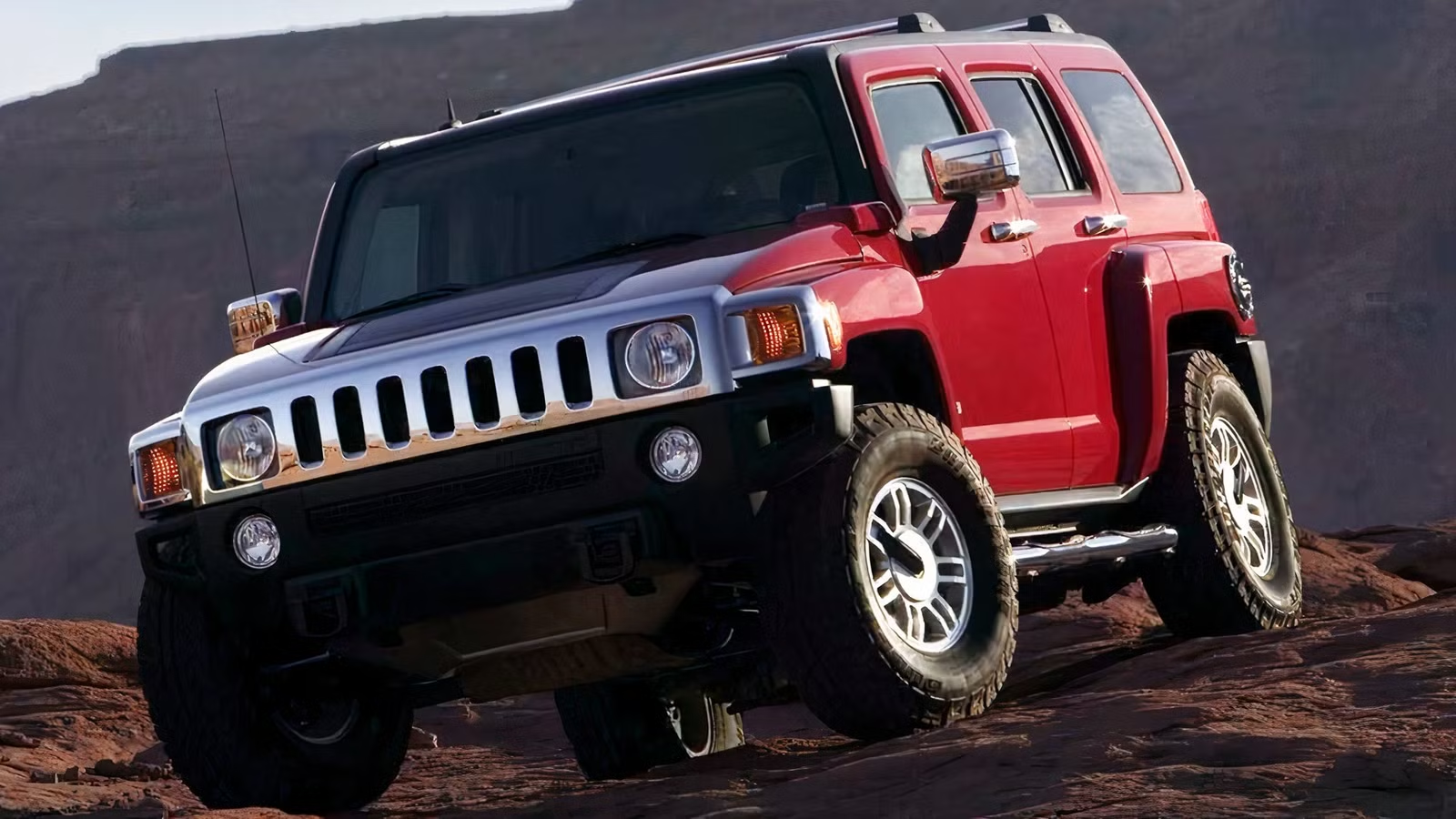
If the pub quiz category “five-cylinder American pickup trucks” would leave you stumped, you’re not the only one. It’s uncommon knowledge that General Motors built an inline five for its midsize trucks and SUVs. The Vortec 3500 and 3700 engines were some of the biggest gasoline-powered five-cylinder workhorses around. These units powered the Chevy Colorado, GMC Canyon, Hummer H3, and the Isuzu i-350 and i-370.
The 3.5-liter variant was available in trucks from 2004 until GM replaced it with the larger 3.7-liter version in 2007. The powerplant lived on until 2012, outlasting the Isuzu i-3700 and Hummer H3, which ended in 2008 and 2010, respectively, with the Colorado and Canyon leaving in 2012. When Chevy and GMC issued new variants of their small pickups in 2015, they came with four-cylinder and V6 powerplant options.
2
Volvo
1991-2016 Whiteblock 5-Cylinder
The Volvo five-cylinder has lived many lives. It had roots in the original 850 R, which effectively served as the company’s mascot for a decade. The Whiteblock family of modular engines formed the basis of 4-, 5-, and 6-cylinder mills, starting in the early 1990s with a 2.9-liter inline-6 used in the 960. Shortly thereafter, the 2.3-liter 5-cylinder arrived in the 850, where it produced upwards of 258 horsepower and 250 lb-ft. of torque.
Volvo took an 850-R Estate racing in the British Touring Car Championship, albeit unsuccessfully (the sedan version that replaced the wagon did far better, earning 11 wins from 1995 to 1996). Still, Volvo proved to the world that a company that wasn’t Audi, or even German for that matter, could build a 5-cylinder and take it racing. The 5-cylinder engines made their way throughout Volvo’s lineup, landing in everything from wagons to hatchbacks to convertibles. It even powered a few Fords during the Swedish automaker’s residency within the Blue Oval’s Premier Auto Group.
1
Audi
2009–2027 2.5 TFSI
Many Audis packed one of the brand’s numerous five-cylinder engines, and we hoped many more would follow. But we can’t have nice things for long, and Euro 7 is a staunch reminder of the purpose of life: smoke ‘em if you got ‘em. Bringing Audi’s story of building venerable odd-cylinder engines to a close is the turbocharged 2.5-liter TFSI version, the one built to pay homage to the original without living in its shadow. Audi put the powerplant in its TT RS, RS3, and RS Q3, and also sold it for use in everything from track cars to sports cars to crossovers made by KTM, Donkervoort, and Cupra.
Its final Audi-branded model is the RS3, slated for cancellation in Europe after this year and likely not returning elsewhere after 2027. The unit reigns supreme over all other five-cylinders used in production models by making nearly 400 hp. The original 2.1-liter turbocharged inline-five could hit 600 hp in full race trim for sprints over gravel, snow, and dirt throughout its Group B rallying days. There’s no more car befitting to see the end of the five-cylinder in an Audi than the RS3 – even if it’s not the original Porsche-built wagon that was among the machines that brought the five-cylinder front and center to performance cars.
Sources: Driving Line, Hemmings, Auto Evolution, Motor1, Arkonik, Classics World UK, Slashgear
