

Ever since the Bugatti Veyron arrived two decades ago, hypercar brands have relied on headline horsepower figures to move the needle. Electrification only pushed things into overdrive, with hypercars in recent years starting to chase 2,000 hp as even Tesla and GMC family haulers started putting out around 1,000 horses.
But there comes a point when simply adding more power doesn’t add to the driving experience. How many people can actually handle all the horsepower, let alone find a place to use it? It appears we’ve reached that point.Last year, we asked automakers to stop with the four-figure-horsepower cars, and this year they’ve responded by making cars that prioritize driver engagement over outright performance, with that approach now very much in vogue.
Five Monterey Debuts, All Under 1,000 hp – And All With A Manual
Hennessey Blackbird At 2026 Monterey Car WeekHennessey
With the Geneva Motor Show no longer running, Monterey Car Week has quickly become the place for hypercar makers to unveil their newest creations, giving them a chance to impress the public and potential buyers alike. But this year’s gathering, held in August on the Monterey Peninsula, California, revealed an interesting shift: several of the biggest debuts came with less than 1,000 hp.
That’s a notable change from last year, when the GMSV S1 LM was the only sub-1,000-hp star of the show. Even more telling, each of this year’s lower-powered standouts came with a manual transmission, highlighting that wealthy buyers are increasingly seeking an analog and unfiltered driving experience. We’ve rounded them up below.
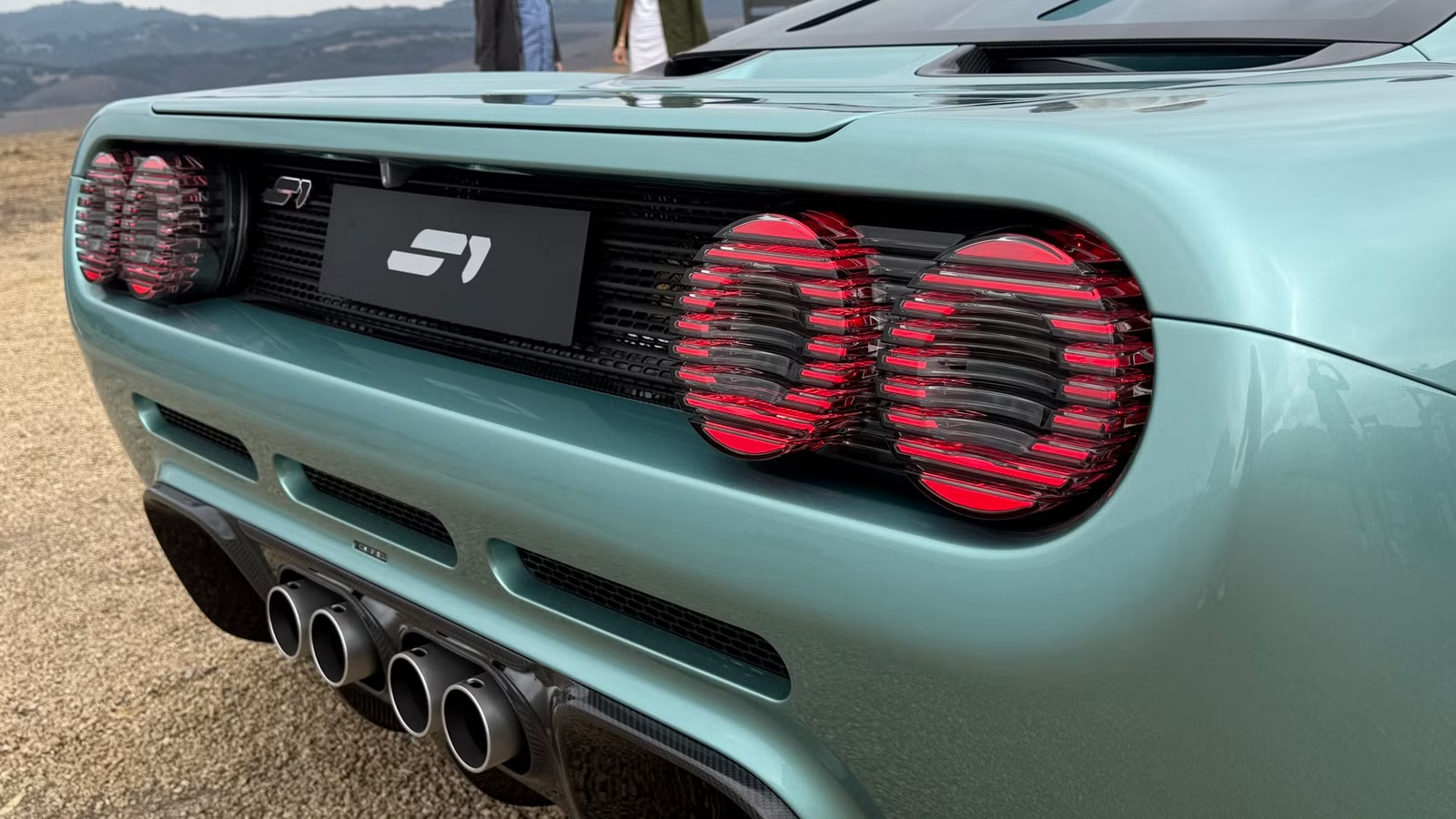
GMSV S1
Gordon Murray Specialty Vehicles S1 from the front three-quarter angleBrett T. Evans / CarBuzz / Valnet
Legendary car designer Gordon Murray understands how to elevate the driving experience. He did, after all, design one of the greatest driver’s cars ever built, the McLaren F1. In Monterey this year, he unveiled the S1, a car that can best be described as the F1 reimagined for the modern era. It pairs a naturally aspirated 4.2-liter V12 that revs past 12,000 rpm and generates 680 hp, all of which is channeled to the rear wheels via a six-speed manual. Just 64 will be built, matching the number of road-going versions of the F1, and naturally all build slots are already sold.
Hennessey Blackbird
Hennessey Blackbird At 2026 Monterey Car WeekHennessey
Hennessey is a company that has built its reputation on high-horsepower machines. However, when devising plans for a follow-up to its Venom F5 twin-turbo V8 hypercar, which in Evolution guise delivers 2,031 hp, Hennessey realized it couldn’t simply add more power. Not only would that upset owners who just paid millions for the still-new Venom F5, but it would also push the limits of what’s possible when it comes to a tire’s grip.
That’s why, in Monterey, Hennessey presented the Blackbird, a hypercar that skips the turbos for a more sensible 800–850-hp target and adopts a manual transmission. It’s proven popular, as all 71 build slots are sold.
McLaren McL 6GT
2028 McLaren McL 6GT Monterey DebutBrett T. Evans/CarBuzz/Valnet
McLaren pulled off arguably the biggest surprise in Monterey by unveiling the McL 6GT. The new hypercar is McLaren’s first manual road car since the F1 was launched more than three decades ago, and it is the realization of a vision for a road-going car that McLaren founder Bruce McLaren had in the 1960s, just before his untimely death. Full details are still under wraps, but we know it pairs a twin-turbo V8 with a six-speed manual transmission.
Ruf Ehra
Ruf EhraRuf
Ruf is a company that’s all about driver engagement, and it showed up in Monterey with the new Ehra, a wide-body sports car that draws heavily from the company’s SCR and CTR models. It may resemble the Porsche 911, but its body is made entirely of carbon fiber, while the chassis is Ruf’s own carbon-fiber monocoque. Power comes from a twin-turbo 3.6-liter flat-six generating 650 hp and driving all four wheels via a seven-speed manual transmission. The tuning is more about balanced performance, with Ruf positioning the Ehra as the ultimate grand tourer in its lineup.
Spyker C8 Preliator XXV
Spyker C8 Preliator XXV at Monterey Car WeekBrett T. Evans/CarBuzz/Valnet
Spyker has been out of the supercar scene for so long that you’ll be forgiven if you don’t quite remember it. But the Dutch marque made its return in Monterey with the new C8 Preliator XXV, a car that, like its predecessors, very much puts driver engagement ahead of outright numbers. Its 4.0-liter twin-turbo V8 produces 789 hp, but the real star is the six-speed manual transmission, whose exposed linkage runs down the center of the cabin, adding another layer of mechanical theater to the driving experience.
But what’s actually driving this shift? It turns out the answer has less to do with taste and more to do with physics – and money.
Why The Wealthy Are Starting To Demand Less Power
2011 Bugatti Veyron Super Sport action shot on the trackBugatti
Every car above shares one thing beyond a manual gearbox: their buyers actively chose less power. Here’s why that’s become the status move.
Going back to the original Veyron, when it landed with nearly 1,000 hp, the next-most-powerful car at the time, the Koenigsegg CC8S, had just 655 hp, a figure you’re more likely to associate with a high-performance luxury sedan or SUV today. The fact that the Veyron was also civil enough to drive every day made its arrival almost the automotive equivalent of the moon landing: a once-in-a-generation achievement.
However, improvements in powertrain and chassis technology over the years have resulted in high-horsepower hypercars becoming almost common, at least among those who can afford them. Don’t believe us? There were 11 cars with more than 1,000 hp launched in 2025, which, remarkably, was down four cars from the previous year. Suddenly, just having a lot of power wasn’t so special anymore.
2018GhostSquad-Keno-99/Koenigsegg CC8SKoenigsegg
Then there’s the reality of actually driving a car whose output rivals five or more family sedans combined. On a public road, you’re going to be nursing it almost all the time, meaning you’ll rarely get to exploit the full potential of the power plant. And when things go wrong, managing that much power takes genuine skill, something countless online videos make clear, particularly when the tires aren’t up to temperature.
And simply “taking it to a track” isn’t the refuge you might think it is, we’d argue, even assuming you have the time to get out there. Apart from long straights, which are far rarer on circuits than you might think, having more than 1,000 hp can become more of a hindrance than an ally when tackling challenging corners, where grip levels, chassis balance, and braking performance all come into play. And that’s before considering whether you’re even talented – or brave – enough to exploit all that power in the first place.
How Pagani, Porsche, And Gordon Murray Built The Template The Hypercar World Is Now Copying
2017 Pagani Huayra Roadster Exterior Finished In Exposed Blue Carbon FiberPagani
Not every hypercar maker followed Bugatti’s route of chasing ever-greater horsepower. Pagani, for one, has always understood that around 800 hp is more than enough when the rest of the car is right. A high-revving engine, manual gearbox, tactile controls, and lightweight chassis offer something no dyno sheet or 0–60 time can match. The driving experience itself becomes the priority, and that’s what makes a car memorable long after its acceleration figures or top speed have become ordinary.
Gordon Murray understood this when he devised the McLaren F1, and, after spending years away from the road-car world, he’s now back with GMA and its even more exclusive GMSV offshoot.
1996-2005 Porsche 911 GT3 (996)Porsche
Porsche has understood this, too, perhaps best exemplified by the 911 GT3. It isn’t the fastest 911, but when you rev its naturally aspirated flat-six to 9,000 rpm, execute the perfect shift with its manual ‘box, and toss it into a turn and steer out using the throttle, there’s almost nothing in motoring that’s more satisfying.
What Comes After The Horsepower Wars – And Why The Best Is Still Ahead
2028 McLaren McL 6GT Monterey DebutBrett T. Evans/CarBuzz/Valnet
To bring things full circle, even Bugatti’s chief, Mate Rimac, understands where the market is heading. He may have founded the EV technology giant Rimac, and built the 1,914-hp Nevera electric hypercar, yet he told CNBC in a recent interview that while most of the world will transition to EVs, the very top of the market wants emotional appeal above all else. In other words, when performance becomes easy to buy, craftsmanship, mechanical complexity, and driver engagement become the true differentiators.
As the hypercar world knocks on 2,000 hp and beyond, the limits of actually using that power are becoming harder to ignore, especially as these cars become more commonplace. Monterey shows the market is turning, with exotic brands shifting their focus from headline figures to the things that make driving genuinely rewarding—and that’s no bad thing.
Sources: CNBC
