

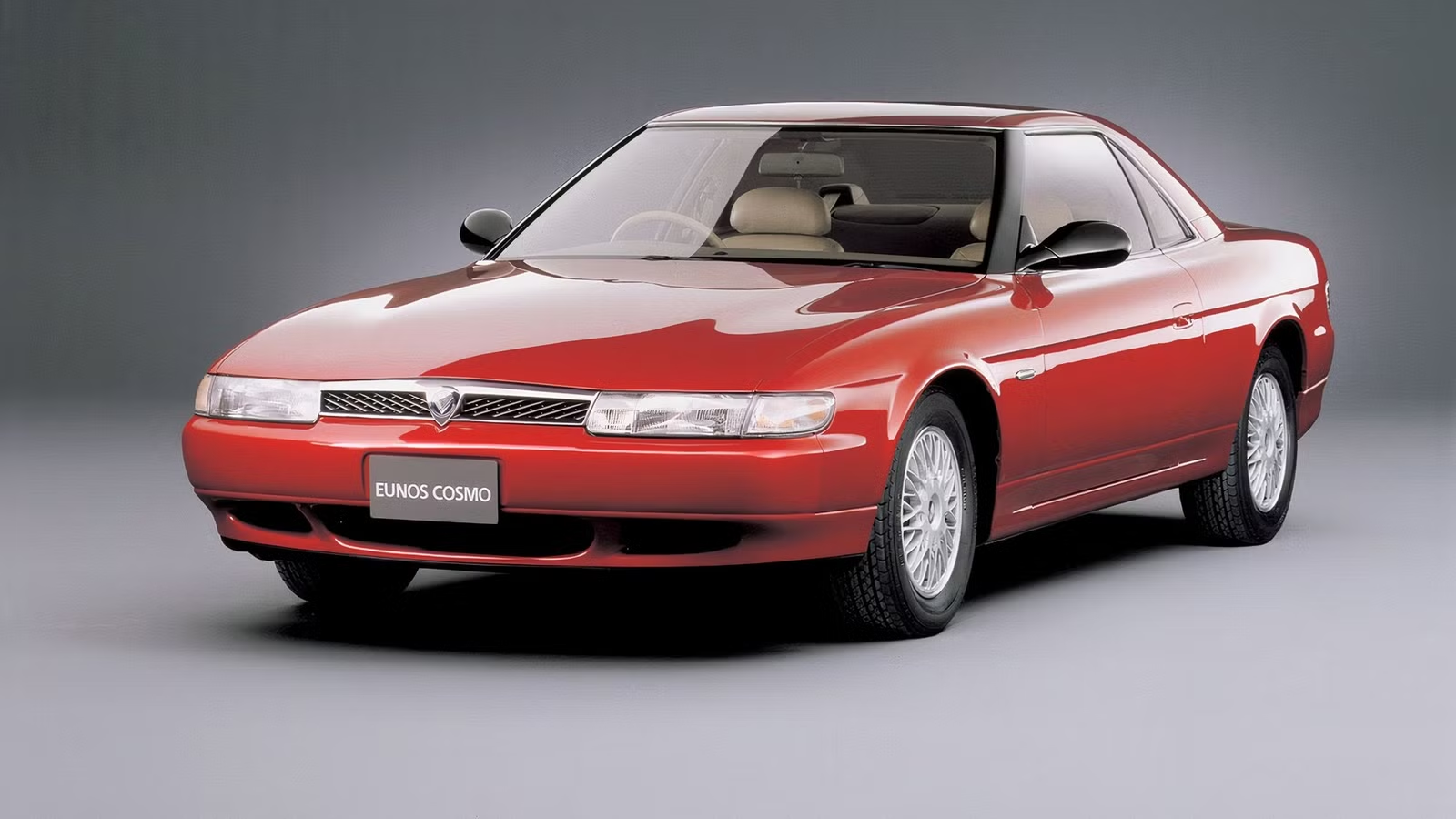
Tap an address into your phone or glance at your dashboard screen and a route appears in seconds — it feels completely unremarkable today. Yet built-in satellite navigation had to start somewhere, and the answer is a rotary-powered Japanese grand tourer that most people have never heard of. The Mazda Eunos Cosmo, which debuted in 1990, was the first production car to offer GPS navigation as we know it, and its influence quietly shaped a feature now found in virtually every new vehicle on the road.
Almost all small cars, luxury cars, pickup trucks, minivans, supercars, hypercars, and every type of vehicle that leaves the production line today are equipped — in some form or another — with a type of built-in satellite navigation system. The first model to ever have it as we know it today was the Mazda Eunos Cosmo, which debuted in 1990.
The Mazda Eunos Cosmo
The pioneer of the Eunos model range was introduced in 1967. Known as the Mazda Cosmo, it was a rotary-powered coupe with styling akin to the Jaguar E-Type. It was a gorgeous road car with a steel unibody and a plucky twin-rotor Wankel engine that would be reimagined for use in the Marathon de la Route, an 84-hour endurance race held at the Nürburgring between 1965 and 1971. Mazda entered two modified examples to test its mettle, with only one car crossing the finish line.
Engine
2.0-liter, twin-turbocharged, three-rotor
Horsepower
276 hp @ 6,500 rpm
Torque
296 lb-ft @ 3,000 rpm
0-60
6 seconds (est)
Top speed
155 mph
Four generations of this Mazda coupe were produced, with the JC-generation Eunos Cosmo being the final iteration of the model range. Debuting in 1990, it was a sultry two-seater that succeeded the original Cosmo. The Eunos Cosmo blended a luxurious, well-appointed interior with the inherent athleticism of a rotary-powered sports car, and it delivered convincingly on both fronts. One of its most significant features was the navigation system developed by Mazda and Mitsubishi Electric, called the Car Communication System (CCS). The CCS relied on satellites to calculate the vehicle’s location and could also be used to help track the car if stolen.
1990 Mazda Eunos Cosmo JC Red Front Angle Parked at WaterMazda
A screen was mounted centrally on the Cosmo’s dashboard. It displayed a 2D map and functioned similarly to the navigation systems found in modern vehicles, allowing a destination to be selected and a route to be plotted on a digital map. Models equipped with this system were offered only in certain trim levels and were exclusive to the Japanese market. This touchscreen display was relatively primitive compared to the systems available today.
The color touchscreen still used cathode-ray tube (CRT) technology — the same glass-tube displays found in older televisions — and allowed occupants to control the climate system and other infotainment functions. For context, the first touchscreen ever fitted to a production car was the 1986 Buick Riviera’s. While the Eunos Cosmo was undoubtedly the first production car to feature built-in satellite navigation integrated into an infotainment screen, it was not the first time any form of in-car navigation had been offered.
Technically, It Wasn’t The First
Mazda’s Eunos Cosmo was the first production car to feature a built-in GPS navigation system; however, manufacturers like Honda and Toyota had offered navigation systems years before. Honda was the first manufacturer to offer a commercially available navigation system. The Electro Gyrocator was a map-based navigation system offered in 1981 as an option on Honda’s vehicles. It relied on an inertial navigation system made up of a direction sensor, a driving distance sensor, a microcomputer, and related technologies to monitor heading and distance, enabling the system to calculate the vehicle’s position. A CRT display worked in tandem with a transparent map overlay. However, inertial navigation was inherently less accurate than GPS.
Toyota was another manufacturer that dabbled in early car navigation, and its contribution was a CD-ROM-based dead-reckoning navigation system in 1987 — also notable for being the first color navigation display. Dead reckoning is a navigation technique that uses known fixed positions to calculate distance and direction traveled. Interestingly, it was one of the techniques Amelia Earhart used when she flew solo across the Atlantic Ocean and on her final flight. Toyota’s system was introduced in the Toyota Crown Royal Saloon G and featured a color CRT display mounted on the dashboard.
Beyond automakers, companies like Etak — a US-based developer of vehicle navigation equipment, digital maps, and mapping software — debuted a navigation system in 1985 that is widely considered an ancestor of the modern GPS navigation systems we use today. One of its most distinctive features was the use of cassette tapes to store digital maps and portions of the Navigator’s operating system. These were cumbersome devices, though enormously significant in the evolution of vehicle navigation. Mapping a city the size of Los Angeles required four separate cassette tapes, and when a driver reached the edge of the mapped area, a new cassette had to be inserted. Even so, GPS navigation systems have come an extraordinary distance since then.
The Evolution Of GPS
Like most fields of technology, GPS navigation systems have evolved significantly over the decades, with the technology first appearing in cell phones in 1999. GPS was originally known as Navstar GPS, a satellite-based radio navigation system owned and operated by the US government. It was one of the global navigation satellite systems that provided geolocation data to GPS receivers. By 1993, a constellation of 24 GPS satellites had been established, and other major nations soon followed with their own systems, eventually resulting in more than 100 navigation satellites in orbit.
In 1998, Garmin introduced its first portable GPS navigation device for vehicles, which featured a black-and-white screen. By 2000, there was a clear need to expand and modernize the GPS satellite network, and new satellites were launched just five years later. Advances in aerospace have continuously driven improvements in GPS navigation. By 2010, the first GPS IIF satellites were launched, delivering better accuracy and security for both military and civilian applications worldwide. The final satellite in that series was launched in 2016, and its successor series, the GPS III, began launching in 2018. As the underlying satellite infrastructure has improved, in-car navigation systems have grown more accurate and more capable with each passing year.
Modern navigation systems calculate routes that factor in real-time traffic conditions, dramatically improving both efficiency and accuracy. The contrast with early systems is stark: where the Etak Navigator required cassette tapes and transparent map overlays to cover a single city, today’s systems provide seamless, real-time coverage of the entire globe with virtually no limitations.
Not A One-Trick Pony
Aside from being the pioneer of production cars with built-in navigation systems, the Mazda Eunos Cosmo also featured several other noteworthy elements that only elevated its appeal. The Eunos Cosmo featured frameless windows, which were available in four-door models at the time, but the Eunos Cosmo stood out because of its coupe body style. To meet safety regulations, the coupe needed a fixed B-pillar. Mazda also configured the Eunos Cosmo with a well-appointed cabin that featured LCD displays integrated into the dashboard alongside its GPS navigation system and touchscreen display.
One of the most significant aspects of the Mazda Eunos Cosmo was its engine. Mazda offered two engine options, both of which were Wankel rotary engines. The most powerful was the 20B-REW, a three-rotor unit paired with a sequential twin-turbocharger system — a genuinely uncommon configuration for any era. The added performance of this engine came at a price premium, with the top-spec Eunos Cosmo carrying an MSRP that exceeded that of a contemporary Chevrolet Corvette coupe.
The Mazda Eunos Cosmo was a striking car that pioneered built-in vehicle navigation, had sultry styling that aged like fine wine, offered a sumptuous interior, and featured enough power to contend with some of the most athletic Japanese nameplates available at the time.
Sources: Mazda.
