

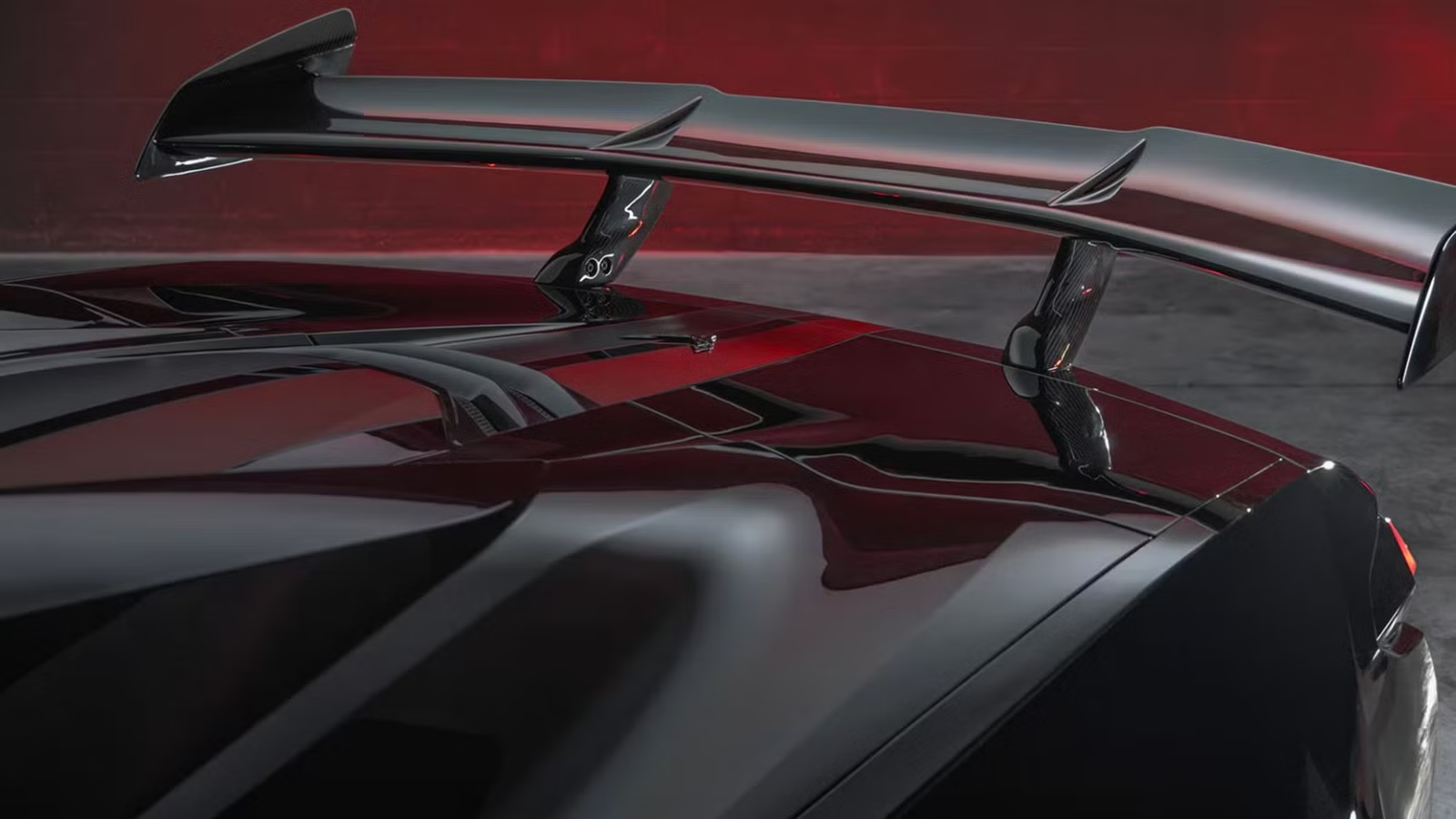
A sub-nine-second quarter-mile was once the kind of performance reserved for purpose-built drag cars, heavily modified street machines, and dedicated racing machinery. Today, however, a select group of showroom production cars can cross the same line straight from the factory, backed by the engineering, reliability, and warranties expected of road-going vehicles.
The technology behind this extraordinary acceleration is evolving at a remarkable pace, too. Some rely on immense electric motor output and all-wheel drive, while others extract astonishing performance from internal combustion engines, hybrid assistance and sophisticated traction management.
The Nine Second Quarter-Mile Has Become A New Performance Benchmark
Breaking the nine-second barrier in the quarter-mile is more than another step on the production car performance ladder. It marks a point where acceleration becomes difficult to comprehend, with cars covering 1,320 feet in less time than it takes many vehicles to reach 60 mph.
More importantly, the benchmark is meaningful because these are not stripped-out drag machines or modified street cars with aftermarket powertrains and race preparation. The rare production cars capable of such times leave the factory engineered to deliver their performance as sold, with road legal equipment and manufacturer support. The Dodge Challenger SRT Demon 170, for example, became the first factory production car to record an NHRA-certified sub-nine-second quarter-mile, completing the run in a blistering 8.91 seconds.
Chevrolet’s Latest Corvette Is Already Deep Into Hypercar Territory
The 2026 Chevrolet Corvette ZR1X takes the familiar Corvette formula into an entirely different performance bracket. At its heart is the twin-turbocharged 5.5-liter LT7 V8, producing 1,064 hp and 828 lb-ft of torque, while a front-axle electric motor adds another 186 hp and 145 lb-ft. Together, the hybrid powertrain produces a staggering 1,250 hp, with the electric motor also giving the Corvette all-wheel-drive traction.
That combination has produced numbers that would have sounded absurd for a Corvette not long ago. Chevrolet’s validation testing saw the ZR1X accelerate from 0 to 60 mph in 1.68 seconds and complete the quarter-mile in 8.675 seconds at 159 mph, with both figures recorded on the same run. The test was conducted on a prepared drag strip using pump gas, standard Michelin Pilot Sport 4S tires, and the production street-legal engine calibration.
The Rimac Nevera Made Eight-Second Runs Look Almost Normal
The Rimac Nevera helped redefine what could be expected from a production car when it recorded an independently verified 8.582-second quarter-mile at Famoso Raceway in 2021. That run was particularly significant because it was achieved on standard Michelin Pilot Sport 4S tires, demonstrating that this was not simply a stripped-out record car wearing production bodywork.
Underneath, four independent electric motors produced 1,914 hp, while Rimac’s All-Wheel Torque Vectoring 2 system continuously monitored grip at each wheel and adjusted power delivery to minimize wheelspin. Having said that, wheelspin can always be an option. This gives the Nevera an advantage at the most critical moment of any drag run: the launch. Instead of waiting for a gearbox to shift or an engine to build boost, its electric motors can deliver their force immediately, with individual wheel control helping turn that instant response into relentless acceleration.
The Pininfarina Battista Proved The Nevera Wasn’t A One-Off
The Rimac was not the only electric car in this segment. The Pininfarina Battista quickly demonstrated that the Nevera’s extraordinary quarter mile pace was not an isolated achievement. Its four electric motors combine to produce 1,900 hp, giving the Italian hypercar the hardware to compete in a performance category that had previously been almost unimaginable for a road car. In February 2023, the Battista recorded an 8.55-second quarter mile, reaching 168.7 mph in the process, narrowly improving on the Nevera’s previously established production car benchmark.
It also recorded a 4.75-second 0-to-100 mph time, underlining how brutally its performance builds beyond the initial launch. The significance went beyond one record: another road-going EV had demonstrated that eight-second quarter-mile runs could be engineered into a production hypercar.
The Demon 170 Took The Old School Route To Eight Seconds
2023 Dodge Challenger SRT Demon 170 drag stripStellantis
The Dodge Challenger SRT Demon 170 proved that the eight-second club was not exclusively an electric playground. Its 6.2-liter supercharged HEMI V8 produces up to 1,025 hp and 945 lb-ft of torque when running on E85, with the powertrain specifically calibrated to exploit the higher ethanol content.
That output is sent exclusively to the rear wheels, making its 8.91-second quarter-mile particularly remarkable. Dodge engineered the final Challenger around straight-line performance, giving it a TransBrake 2.0 launch system, drag-focused suspension tuning, and lightweight components to maximize acceleration.
TheDemon 170 could also liftits front wheels during hard launches, illustrating just how aggressively its rear-wheel-drive layout could deploy its combustion power. Rather than relying on four electric motors and instant torque, it showed that a traditional V8, when combined with specialized factory engineering, could still break into this extraordinary performance territory.
The Lucid Air Sapphire Shows This Performance Doesn’t Require A Supercar
The Lucid Air Sapphire is perhaps the least obvious member of this ultra-quick group because it wears the shape of a luxury four-door rather than an exotic two-seater. Yet beneath its understated bodywork is a three-motor electric powertrain producing 1,234 hp and 1,430 lb-ft of torque.
Lucid quotes a 1.89-second 0-to-60 mph time and an 8.95-second quarter-mile at 158 mph, putting its straight-line performance firmly into hypercar territory. More remarkable is that this pace comes without sacrificing the basic practicality expected of a luxury sedan. It has five seats, a sizeable cabin, and a 427-mile EPA-estimated range, making the Sapphire an unusual demonstration of how extreme acceleration is no longer confined to cars designed solely around performance.
The ZR1X Changes What We Should Expect From A Warrantied Hypercar
The real significance of the Corvette ZR1X is not simply that Chevrolet has built a 1,250 hp car. It is that this level of performance is being integrated into a production vehicle with the engineering, durability and manufacturer support expected from a mainstream automaker.
Chevrolet developed the electrified powertrain to deliver repeated bursts of performance, with the battery pack surviving the company’s 24-hour track-durability test. That matters when a car is expected to function as more than a single-purpose drag machine. The result is a road-legal Corvette capable of a claimed sub-nine-second quarter-mile, while remaining a factory-engineered vehicle rather than a tuner special.
That changes the meaning of the eight-second club. Extreme acceleration is no longer automatically the domain of multimillion-dollar hypercars or modified drag cars. Increasingly, it can be ordered from a manufacturer and driven home.
Sources: Chevrolet, Lucid Motors, Rimac, Dodge
