

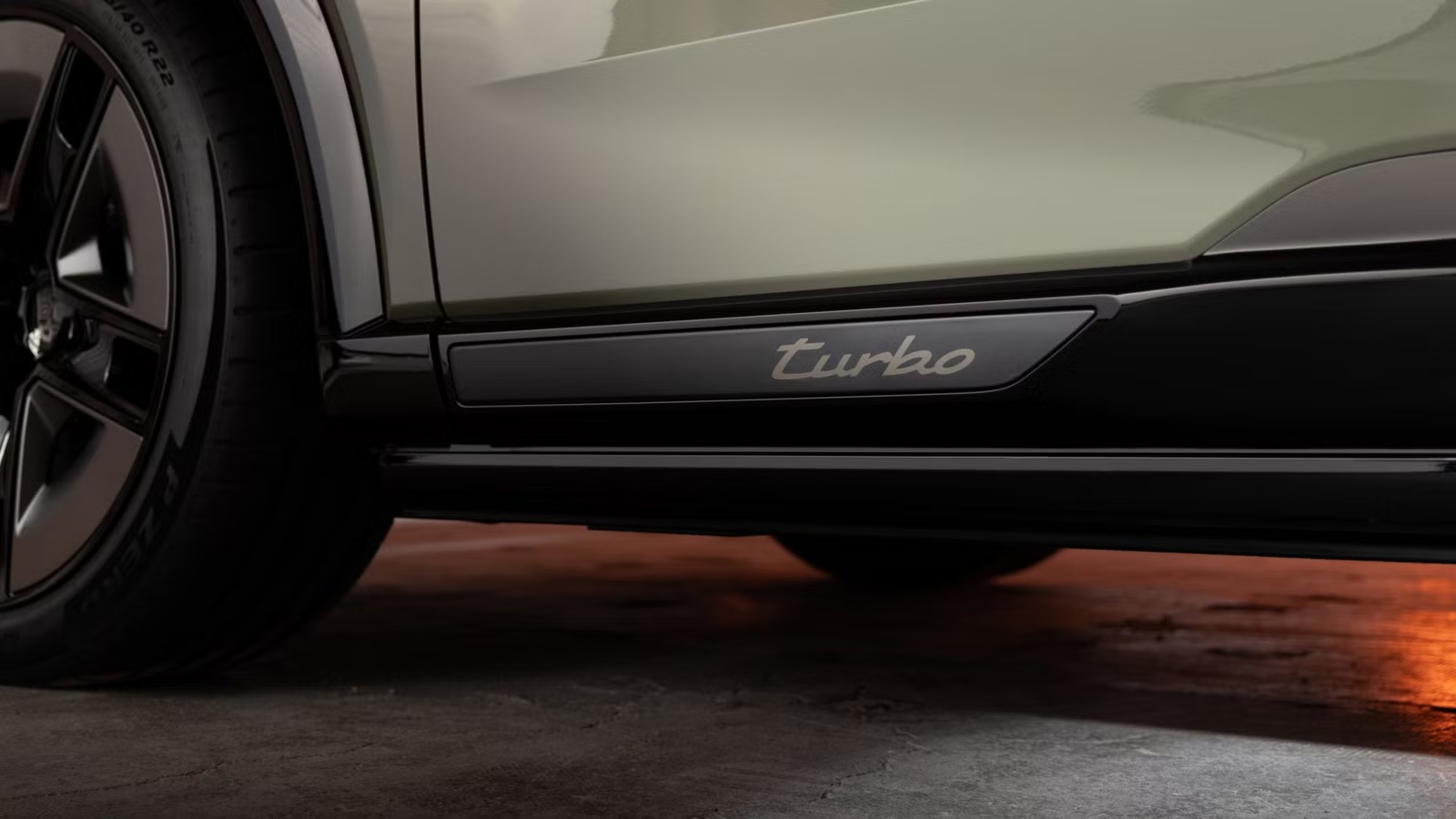
The Bugatti Veyron produces 1,001 horses from an 8.0-liter quad-turbo W16 engine, it clears 60 mph in just 2.4 seconds, and it can cost you more than three million bucks. That’s all well and good, but the Lucid Gravity GT-S beats it by nearly 70 hp, and the new Porsche Cayenne Turbo Electric blows them both out of the water by another 70 points.
We’re not talking about high-end supercars here, we’re talking about family vehicles. Premium family vehicles, sure, but family vehicles nonetheless. When they said electrification would democratize horsepower, they weren’t fooling.
The Lucid Gravity Delivers Up To 1,070 HP
2026 Lucid Gravity GT-SLucid
Go to Lucid dot com, and you’ll find the website proudly boasting of its “2026 World Luxury Car of the Year” award, promising seating for up to seven adults, and 120 cubic feet of available storage space. We’re talking about one of the most powerful mass-produced cars ever built, and they’re leading with the same points you would use to advertise a Subaru.
Running down the available trims.
Trim
Power
0-60
MSRP
Touring
560 hp
4.0 Seconds
$79,900
Grand Touring
828 hp
3.4 Seconds
$98,900
GT-S
1,070 hp
3.1 Seconds
$125,900
You don’t even have to upgrade all the way to the GT-S for face-melting horsepower. At 560 hp, the entry-level Lucid Gravity is already outrunning iconic performance models like the 503-hp BMW M4 Competition, and the 500-hp Ford Mustang Dark Horse. The Grand Touring takes us into supercar territory without even breaking six figures on the price tag, promising more horses than an 815-hp Mustang GTD, or an 800-hp Ferrari 812 Superfast.
Lucid’s aim with the Gravity’s higher trims is to deliver a true large family SUV that just happens to be incredibly powerful. It may be more powerful than a supercar, but the driving experience is intended to feel manageable.
To that end, the GT-S packs the Dynamic Handling Package as a standard feature, with rear-wheel steering, three-chamber adaptive air suspension, and “enhanced agility, stability, and ride comfort.” You may have four-digit horsepower on tap, but that’s no reason for your passengers to ride white-knuckled for the whole trip, right?
The 1,139-HP Cayenne Electric Turbo Is Just Plain Ridiculous
2026 Porsche Cayenne S Coupe ElectricPorsche
The 2026 Porsche Cayenne starts at a more or less reasonable 435 hp, clearing 60 mph in 4.5 seconds. Solid, but not really a headline story. The top trim is another story, producing 1,139 hp, and proving that street legality clearly doesn’t have anything to do with engine power.
Trim
Power
0-60
MSRP
Electric
435 hp
4.5 Seconds
$109,00
Electric S
657 hp
3.6 Seconds
$126,300
Electric Turbo
1,139 hp
2.4 Seconds
$163,000
The Electric Turbo hits its top power output with Launch Control, which maxes out the hp and squeezes 1,106 lb-ft of torque out of the electric powertrain to achieve its face-melting takeoffs.
Actual power potential is more like 844-hp when you’re cruising, which is still a lot. The Gravity GT-S keeps its 1,070 on tap at all times, but, in practice, you’re unlikely to notice the difference in most highway scenarios. You’re never going to be struggling to pass someone in an 844-horse monster and think “if only I had 20% more oomph!“
When we reviewed the latest version of the Cayenne Electric, we actually recommended the standard dual-motor Electric model as the one to buy, with the leftover money going toward upgrades like the head-up display and premium audio.
The base model delivers standard adaptive air suspension, you have available rear-axle steering, and, at 435 hp, you’ve already got more power than you’re likely to need in a family car. Everything we love about this car is right there in the Electric trim. Not that you’re going to let us talk you out of it once you’ve got your heart set on a 1,139-hp super-SUV, but that’s our take, nonetheless.
Do These SUVs Actually Make Sense As Family Cars?
2026 Lucid Gravity GT-SLucid
There are a few ways of looking at the prospect of a 1,000-hp family SUV. One argument would be that you never really need that much power for taking the kids to school and picking up groceries, so why not go with the entry-level models, which are already plenty powerful and fun to drive?
Another argument has it that there’s no point in buying a car like this if you’re not buying into four-digit horsepower, so you might as well get the fastest thing they sell. The most sensible take? Buying a Honda CR-V for the weekdays and a Porsche 911 for the weekends will probably make you happier than trying to split the difference with a Cayenne Electric.
But “sensible” is a flexible term when we’re talking 1,000-hp SUVs. So the only question to really consider at this point is whether they actually make good family cars.
Neither SUV Leaves You Wanting For Space
2026 Porsche Cayenne Electric configurable roofPorsche
The Cayenne Electric and the Lucid Gravity are fairly close in many interior dimensions for the first two rows. The biggest differences all come down to the fact that the Gravity offers up to seven seats across three rows. That difference means that the Gravity offers more than twice as much cargo space with all the seats folded, and the ability to carry a couple of extra passengers.
Porsche Cayenne Electric
Lucid Gravity
Seating
5
5-7
Maximum Cargo Space
56.1 Cu. Ft.
120 Cu. Ft.
Headroom Front/Rear
41.1/38.7 Inches
42/41 Inches
Leg Room
41.6/38 Inches
40.9/42.6 Inches
You’re probably not going to be making this buying decision based on half an inch of elbow room, but these specs should illustrate that you’re not sacrificing space for power in either of these vehicles. They’re as roomy as you need a family car to be.
The Lucid Gravity Is Maybe Too Techy
2026 Lucid Gravity GT-SLucid
Both models are all-electric, and fairly high-tech, but Porsche has never really been a gadgety brand. You’ve got a curved OLED driver display stretching 14.25 inches from corner to corner, standard 10-speaker sound, and an optional passenger screen.
Lucid is more tech-first, with a 34-inch floating display, standard head-up display, and a touch-based Pilot Panel system for operating features like windshield wipers and defrosters. That last point is going to be polarizing, and by polarizing we mean nobody wants to use a touchscreen to handle basic functions for which we already had buttons and switches.
But, screen-based-everything seems to go with the territory when buying from an EV brand. They’d probably get rid of steering wheels if they could find a way to do it.
Nobody Needs A Six-Figure Family Car, But…
2026 Porsche Cayenne Turbo Coupe ElectricPorsche
It’s difficult to recommend any car in this price range as a family vehicle, for the simple fact that kids and pets are messy. Wiping spilled ice cream off of a cheap cloth seat is no big deal, but the Gravity is decked out in Nappa leather. The Cayenne Electric uses a high-end RaceTex micro-fiber with optional Alcantara leather packages. We’d scarcely trust ourselves, let alone a family of five, to eat a fast-food order in here.
If you can afford a $163,000 electric performance SUV for your family, you can afford a mid-range SUV and a premium coupe or performance sedan. We’d rather drive the kids to school in a Subaru Forester, and take the supercharged Mustang Dark Horse to the track on the weekend. But we can debate the usefulness of the super-SUV segment some other day. If this is the kind of car you’re after, you could be happy with either of these vehicles.
That said, the Porsche clearly offers a better driver experience, simply because Porsche isn’t taking part in the touchscreen-everything trend, meaning that the Cayenne relies on physical controls for basic stuff like windshield wipers. Meanwhile, the Gravity GT-S offers two extra seats and twice the cargo space, making it the more comfortable ride for road trips and big families.
In short, they’re both excellent family cars, and the choice may simply come down to the size of your family. Beyond that, it’s just a question of how much power, and how much luxury, you need in a family car.
Sources: Porsche, Lucid.
