

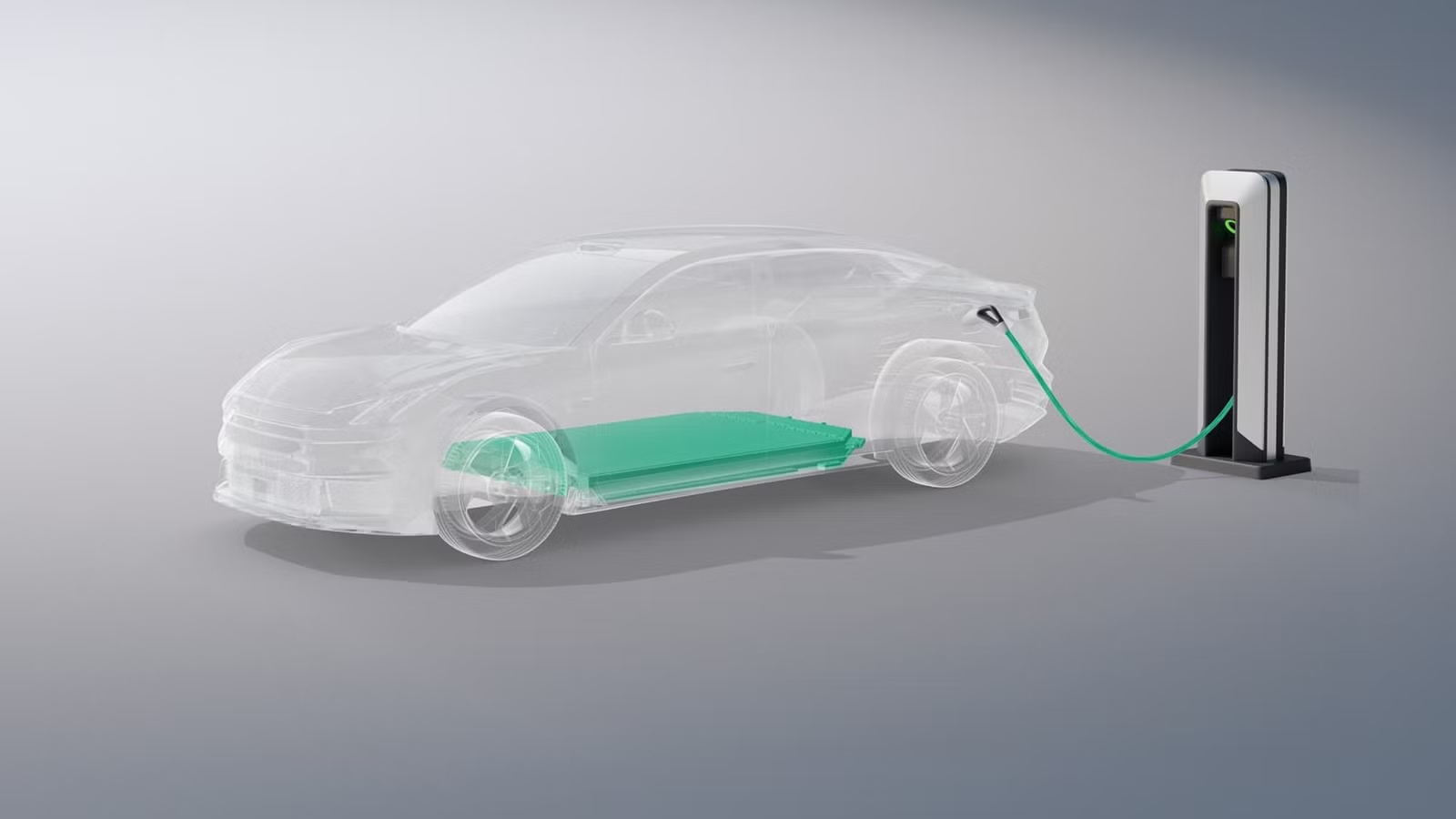
Battery technology has advanced considerably in the last year or more, to help alleviate some of the charging hassles that remain a thorn in the EV industry’s side. Range anxiety doesn’t trigger the kind of palpitations that it once did in America, especially given the capability and speed of some current US charging systems. However, the state of play in the US is under the microscope again due to rapid advancements in China. Geely has been able to demonstrate a technology in a production EV that makes “fast” US charging rates look suddenly rather ordinary.
Geely Shows That A Car Can Actually Take More Than 1,000 kW
Lynk & Co. 10 Series EV side viewLynk & Co.
Geely is currently championing a new 900 V LFP battery in the Lynk & Co. 10 Series EV. From a charging point of view, it only takes 4 minutes and 22 seconds to reach 70% and 8 minutes and 42 seconds to reach 97%, but the most impressive number involves the actual delivery. According to validation testing supervised by the China Automotive Technology and Research Center (CATARC), Geely’s battery was able to accept a peak of 1,093 kW from the vehicle side. And that’s more than four times the maximum 250 kW supercharging rate that US owners expect from a Tesla Model 3 Performance.
Still, it’s always important to look at huge charging numbers and claims in context, especially when the output rating of a charging station and the amount of power that the EV can actually take are not the same thing. In the Lynk & Co. demonstration, Geely used Zeekr V4 megawatt charging hardware, a 1.2 MW charging system with a single-gun peak power of 1300 kW and a peak current of 1300 A.
The 1,093-kW headline figure is the peak input that testers reportedly measured at the vehicle during subsequent CATARC-supervised validation testing. And that’s a far more useful number when comparing battery capabilities. After all, a 1.3 MW charger is only really a game changer if the vehicle that a driver connects to can make meaningful use of its output.
Geely tested its system on the Lynk & Co. 10 model, an electric sedan with a 95 kWh, 900 V LFP battery. And this shows that the battery in question was not something sitting on a test bench waiting for a future vehicle program. After all, the 10-series EV came into production during 2026, so these achievements could have much bigger implications for what EV buyers around the world should expect next.
Five Minutes To 80% Matters More Than The Four-Digit Peak
Lynk & Co. 95-kWh Aegis Golden Brick batteryLynk & Co.
As impressive as a peak charging rate can be, there’s still a lot of meaning in the detail further down. If the battery only touches that peak charging rate briefly before tapering off sharply, the owner may still have to wait a considerable amount of time for a useful amount of energy. But this is where the Lynk & Co. charging curve comes into focus. The demonstration showed that the battery could reach 70% from a 10% starting point in 4 minutes, 22 seconds, 80% at 5 minutes, 32 seconds, and 97% in 8 minutes, 42 seconds. Crucially, charging power remained above 500 kW beyond an 80% state of charge, and it was still above 300 kW as the battery came to 97%.
Geely has been particularly good at thermal management, and it’s used dual-sided three-dimensional liquid cooling to deal with the enormous amount of energy-related heat. This meant that during the high-power validation testing, reported peak cell temperatures capped out at around 64°C, below China’s regulatory limit of 65°C. This heat management may help explain the new battery technology’s efficient operation.
Still, it’s important to remember that not every vehicle owner will be able to reproduce 80% at 5:32 in every roadside charging interaction. Factory demonstrations will typically set up near-perfect environmental battery and charger conditions for optimal performance. Factors like ambient conditions, charger availability, battery temperature, and state of charge all affect a driver in everyday use, but none of this makes the engineering less important. Such staged conditions still establish what the vehicle and battery architecture are able to do when the rest of the charging system is capable of proper supply. And overall, these breakthroughs suggest that it is possible to get a very useful highway charge in about the same amount of time that it takes to buy a Starbucks.
BYD Proves This Is Becoming A Charging Arms Race
BYD’s second-generation FLASH Charging systemBYD
While Geely was congratulating itself in Shenzhen, rival BYD had already been chasing similar goals in Hangzhou. About a month before Geely, on March 5, 2026, BYD unveiled its second-generation Blade Battery and FLASH charging technology. It claimed 10 to 70% charging in 5 minutes and 10 to 97% in 9 minutes, and that’s remarkably close to the figures that Geely released following its own demonstration. These separate claims show that two enormous Chinese automotive groups are measuring their charging advantage over one another in mere seconds.
Importantly, BYD’s flash charging stations can supply up to 1,500 kW through one connector. However, that’s a charger-side infrastructure rating and not a claim that every Blade Battery 2.0 vehicle can accept 1.5 MW at its battery. Instead, BYD describes the 1,500-kW figure as the maximum output of the flash charger.
Extreme Charging Doesn’t Automatically Mean A Disposable Battery
Geely’s 900V electrical architectureGeely
It’s reasonable to ask what might happen to a vehicle’s battery after years of relatively aggressive charging, and Geely feels that it has a serious answer to that question. After all, the company has made longevity part of its Golden Brick battery story right from the beginning. In its 2025 Environmental, Social, and Governance report, Geely claims that its Aegis Golden Brick battery cell has a cycle life of more than 4,500 cycles. Geely believes that’s enough for a generation of battery cells to serve the equivalent life of multiple vehicles, or as much as one million km or roughly 620,000 miles of use.
Of course, that is a manufacturer-rated cell life claim and there is no evidence that a battery can complete 4,500 consecutive charges at 1,093 kW. Also, much will depend on real-world issues like temperature, depth of discharge, charging habits, calendar aging, and the individual battery management system.
Meanwhile, BYD is also working on longevity and overall battery safety. It conducted a nail penetration safety test after 500 fast-charge cycles of its Blade battery 2.0 without any thermal runaway, smoke, or fire. So, it seems clear that longevity and durability are part of the development approach for these Chinese automakers, and they’re not simply pursuing short-term publicity with eye-catching charging records.
Even America’s Mainstream 350-kW EVs Look Slow Beside This
2024 Chevrolet Silverado EV WT chargingChevrolet
China’s breakthroughs make the contrast with the US market very stark. And while Tesla has always been one of the industry leaders, its headline is the 250-kW maximum supercharging rate for the US market Model 3 Performance. Even one of America’s quickest-charging EVs, which is the 350-kW Chevrolet Silverado EV, is far below Geely’s measured peak.
Many mainstream American EVs are much slower. For example, the Ford Mustang Mach-E traditionally tops out around 150 kW, while Chevrolet’s current 2026 Blazer EV reports 150 kW charging for the 85-kWh LT and RS, and 190 kW for the larger battery EV SS. So, while 350 kW is extremely fast by today’s mainstream American standards, Geely’s measured peak is still more than three times higher.
Before drivers can become too enthusiastic about these new battery breakthroughs, there is an elephant in the room involving infrastructure. After all, the Lynk & Co. result depends on Zeekr’s megawatt-class charging equipment and the Geely self-built Chinese network only has 2,103 charging stations and 10,212 charging piles, including 1,216 ultra-fast stations and 5,468 ultra-fast charging points.
In the US there’s an even bigger problem, as a battery capable of taking a megawatt certainly can’t produce a five-minute charge from a 150 kW or 250 kW station. So, if EV owners are to benefit from this type of new battery technology, it’ll require new high-capacity electrical connections and enough grid infrastructure so that multiple cars can take advantage simultaneously.
This latest Lynk & Co. 10 Series EV story sets new benchmarks and could, in the future, trigger a major breakthrough. After all, when EV charging time starts to equate with the convenience of filling a gasoline tank, much of the opposition to EVs themselves may start to fall away. In the meantime, five-minute charging still requires rare and extremely powerful infrastructure, and real-world owners would be unlikely to duplicate a factory demonstration on a regular basis anyway.
It’s too early to say whether the battery-related side of the EV problem is starting to melt away. But the more pressing problem is that much of that progress is being made many miles away in China, which once again seems to be outpacing the USA.
Sources: Geely, BYD, Zeekr, Tesla, Ford, Chevrolet.
