

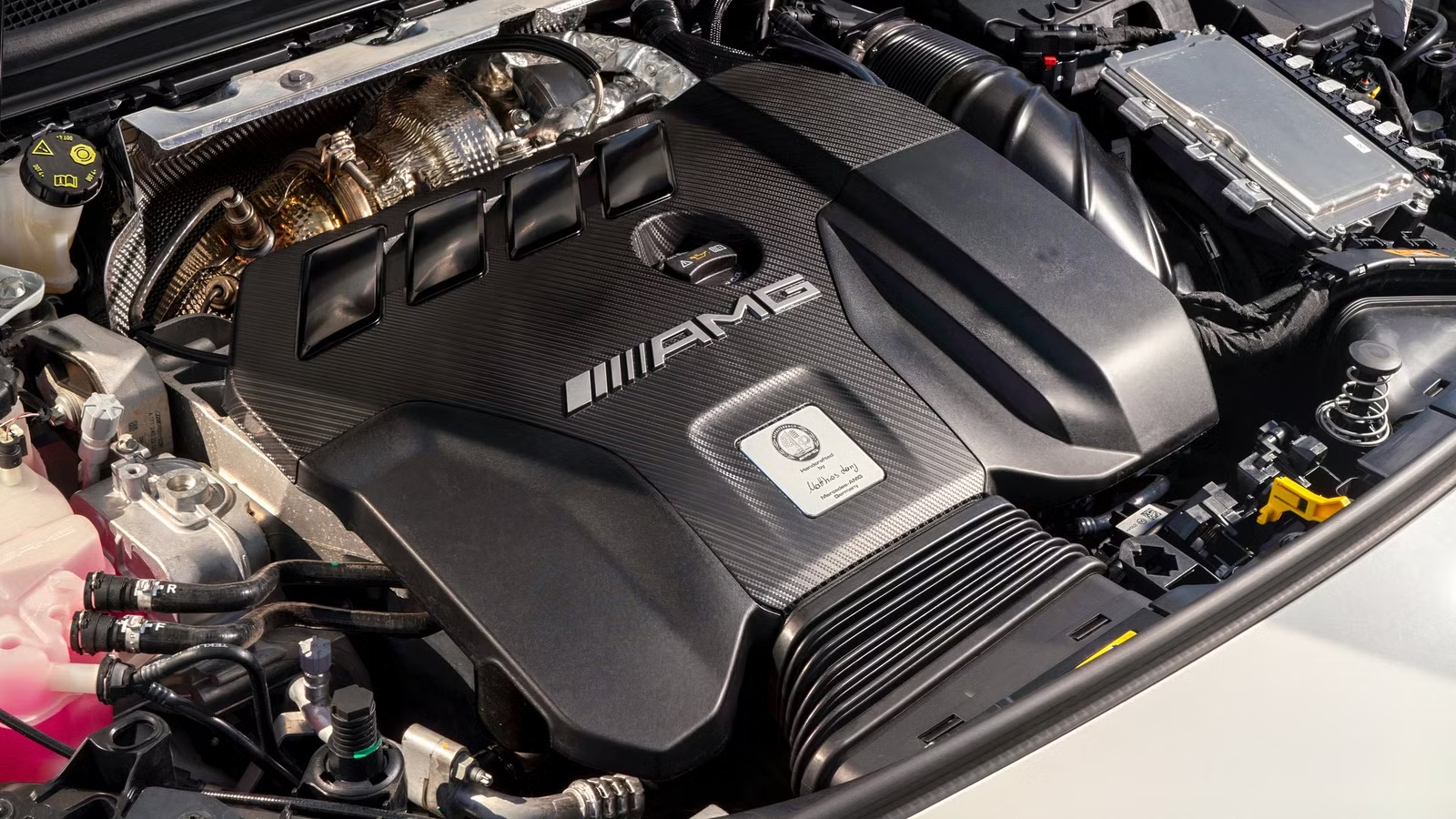
As engine technology gets better and more reliable, automakers are constantly experimenting. The use of turbochargers, direct injection, and more efficient cooling has meant engines have been able to sustain incredible performance without the need for big displacement or high emissions. People might think that Mercedes-Benz has fallen behind on their engineering ethos since the 1980s, but their M139 engine in the performance C-Class proves otherwise.
This tiny four-cylinder engine runs rings around most six or eight-cylinder units on sale today, and when paired to Mercedes’ F1-derived hybrid system, it makes insane power. But the company’s investment in this powertrain hasn’t paid off, especially in the eyes of enthusiasts, meaning they’re killing it off for a very simple reason.
A Four Pot With Unbelievable Figures
Mercedes-Benz M139 Engine on a standMercedes-Benz
There are engines, and then there are engines. We’re too used to manufacturers abandoning their combustion engine R&D to focus on electric powertrains, so it’s always admirable to see genuinely impressive new thinking about what a small displacement engine can do. The M139 power plant is the world’s most powerful production four-cylinder engine, making an unbelievable 469 horsepower in its most potent form. Torque is also super impressive at 401 lb-ft.
“With the M 139, we have demonstrated the engine expertise of Mercedes-AMG. Not only is the output per liter unrivaled for a turbocharged engine, the high level of efficiency also demonstrates that the internal combustion engine still has further potential,”
– Tobias Moers, Former Mercedes-AMG Chairman
It’s built under the ‘one man, one engine’ philosophy that AMG is famous for. The overall design is based on the M260, and succeeds the M133 unit used in previous-generation CLA 45 models and GLA 45 SUVs. First came the M139, which produced an already-impressive 416 hp, but it’s the M139L that’s found in the current Mercedes-AMG C63 that’s the most powerful form. Mercedes used its Formula One team’s expertise to build this engine, and that’s how it thought it would take the fight to BMW. Unfortunately, it didn’t work out that way.
How Does It Achieve This Ludicrous Power?
Mercedes M139/M139L Engine Technical Specs
Displacement
1,991 cc
Cylinder arrangement
Inline-4
Valves
16
Compression Ratio
9.0:1
Bore x stroke
83 mm x 93 mm
Maximum power
469 hp at 6,750 rpm
Maximum torque
402 lb-ft at 5,000–5,500 rpm
Maximum engine speed
7,200 rpm
Forced induction type
Electric 400V twin-scroll turbocharger
Engine Weight
353.8 lbs
A lot of tech is integrated into this engine to let it produce all this power. Firstly, the engine has been strengthened to contain all this power comfortably. The pistons are made from forged aluminum, the crankshaft is forged steel, and the engine has a closed-deck design that’s popular in racing. These elements allow a low weight (relative to its strength), and a higher peak combustion pressure of 2,300 psi. Compression ratio sits at 9.0:1, which is more than the 8.6:1 of its M133 predecessor.
The M139L, which is a longitudinal version of the transverse M139, is the one used in high-performance models. This engine family is the first time that Mercedes has used both port and direct injection in a four cylinder, and this system helps increase efficiency and performance at the top end of the rev range. The fuel injection nozzles in the chamber have been angled and repositioned slightly compared to the M133, which allows for bigger exhaust valves.
“We kept waiting for the four-cylinder engine to run out of steam, but it never happened. We’ve driven many fast performance cars before, but the C63’s linear acceleration made us feel physically ill, it’s that savage.”
– Jared Rosenholtz, Former Editor-at-Large, CarBuzz
To cool the powertrain, there is an electric water pump that is only used when high performance is needed. The engine is also able to keep the head and block at different heat levels, which can reduce friction in the crankcase yet cool the cylinder heads to allow for more efficient ignition timing. The cylinders also make use of ‘nanoslide’ technology from Formula One, which reduces friction inside the engine. This is also the first engine from Mercedes to use roller bearings on turbocharger components, reducing turbo lag.
Add Electric Power And It’s Even More Of A Monster
2025 Mercedes-AMG C 63 S E Performance Fender BadgeMercedes-Benz
Mercedes C 63 S Technical Specs
Electric motor type
Permanently excited synchronous motor
Battery capacity
6.1 kWh (4.8 kWh usable)
Battery weight
196 lbs
Electric motor output
203 hp
236 lb-ft
Combined system output
671 hp
752 lb-ft
Number of electric motors
One on rear axle
There is a limit to the four-cylinder’s power, though, and if you’re expecting to fight the likes of BMW M and Audi’s RS models, you have to bring back up. The M139L engine in the C63 S is backed up by an electric motor on the rear axle, which pushes total power up to 671 horses and torque up to an insane 752 lb-ft. Combining this with the electric twin-scroll turbocharger means that when you put your foot down, the power delivery is instant.
Power is nothing without control, though. The battery cooling technology is what allows this high-performance powertrain to continuously perform under load, consisting of 3.7 gallons of coolant that keeps the entire system at about 114 degrees Fahrenheit. The liquid is passed through a radiator at the front of the vehicle using an electric pump. Seriously impressive tech from the world of F1, but is it enough to keep enthusiasts interested?
Over-Engineering Is Mercedes’ Selling Point
2025 Mercedes-AMG C 63 S E Performance Charging Close-UpMercedes-Benz
If we think about Mercedes-Benz’s history, we think of clever engineering, new inventions, and a general feeling of doing things better than everyone else. Of course, Karl Benz invented the car, but in terms of modern inventions, we can thank Mercedes for the crumple zone, anti-lock braking system, and even the supercharger. But with this technology now available in some of the cheapest cars on the market, and many previously-premium features becoming affordable, Mercedes has started to become overshadowed by rivals.
Now with a successful Formula One team to show off their engineering might, the Stuttgart-based manufacturer wanted to show that its road cars get the same treatment. F1 currently uses a tiny 1.4L four-cylinder engine paired to a hybrid system making around 800 – 1,000 horsepower, and the engines use impressive tech to achieve this power. If they could bring this technology to the road with how popular Formula One is now, surely it’d have success on its hands? Right? Wrong.
Why Is Mercedes Killing The AMG Four Cylinder?
2024 Mercedes-AMG C63 S E Performance side view of the tailgateMercedes
Ironically, with the automotive world downsizing to fit around new regulations, Mercedes-Benz’s official reason for killing the M139 four-cylinder is Euro 7 emissions. Apparently, updating the engine to meet these rules will take more than Mercedes says is viable, but we think there’s another reason. Many automakers will have seen these rules coming for years, so the company is probably also killing this impressive motor due to the general outcry from enthusiasts.
If this engine and car were released into a vacuum, no one would bat an eye — the engine is impressive, fast, and easy to live with thanks to the efficiency of hybrid powertrains. But the problem is the C63’s history. The thunderous 6.2L V8 may have been raucous in terms of theater, but it was also what fans loved about the performance-focused C-Class. Pair that with bigger engines in rivals like the BMW M3, Alfa Romeo Quadrifolglio, or even the Cadillac CT4-V Blackwing, and it feels a bit too overcomplicated.
“The M3, and the CT5-V Blackwing to a greater extent, embrace the whimsical elements of performance: silly exhaust sounds, a manual transmission, and rear-wheel-drive. It might be too nerdy for its own good.”
– Jared Rosenholtz, Former Editor-at-Large, CarBuzz
Next up, we’re expecting to a see a return to form. There may not be a direct C63 replacement, but the 3.0L inline-six turbocharged engine is expected for an all-new C 53. This engine is already used in the GLC 53, and produces 443 horsepower. Interestingly, even with how impressive the hybrid systems are in new Mercedes cars, the C 53 may not have any additional electrons helping push the power up. Could this be the start of Mercedes realizing enjoyment is more important than outright pace?
Sources: Mercedes-Benz, Motor1, Enginelabs.
