

Car features have always been transitional, right? We used hand-cranked windows for a century, but when was the last time you saw a vehicle with them? Dashboard-mounted 8-track players gave way to cassette tape decks, then CD players, and eventually led to modern touchscreen displays. The features that actually stick around are few and far between.
The year 1976 was pivotal for cars. It was a real necessity-is-the-mother-of-invention era, seeing as we were in the midst of an Oil Crisis, giving birth to some critical features we still use today.
1976 Aston Martin Lagonda
The World’s First Digital Dashboard
View of the 1976 Aston Martin Lagonda interiorAston Martin
Digital dashboards are a feature we take for granted now. They’re becoming ubiquitous throughout every automotive segment, from high-end luxury cars to even some dirt-cheap budget models. When this tech debuted in the 1976 Aston Martin Lagonda, it wasn’t just state-of-the-art; it looked downright futuristic.
And yet, the 1976 Lagonda’s display may seem relatively primitive when compared to modern dashboards, looking more like a digital clock/radio than a modern screen-based instrument cluster using advanced OLED displays.
Early Digital Displays Simply Did Not Work
View of the 1976 Aston Martin Lagonda front 3/4Aston Martin
It looked very cool, but Aston Martin spent a fortune repairing this system under warranty when it kept failing to work as intended. Early cars used an LED-based display solution, and later models switched to Cathode Ray Tube (CRT)-based screens, which proved even less reliable.
Digital gauge clusters became a fad in the 1980s, including appearances in the Chevrolet Corvette and the Nissan 300ZX. By the 1990s, most automakers had given up on the dream of video-gamey displays. You can thank Tesla for popularizing modern one-screen digital gauges with the 2012 Model S. By this point, we were carrying supercomputers in our pockets, and building them into the dashboard was trivial. Aston Martin was simply 36 years ahead of the curve on this one.
1976 Volvo 240: The World’s First Lambda Sensor
Volvo 240 sedanVolvo
The lambda sensor was first developed in the late 1960s and made its mainstream debut in the 1976 Volvo 240. This oxygen sensor sits in the exhaust pipe, measuring unburned oxygen in a car’s exhaust by comparing it with the surrounding air. This information is then fed to the engine control unit, which adjusts the air-fuel ratio on the fly for clean, efficient combustion.
Just When The World Needed It The Most
No Gas at Gas Station During 1973 Oil CrisisNational Archives
From 1971 to 1976, gas prices rose from $0.36 per gallon to $0.61 per gallon, nearly doubling over just five years. By the end of the decade, people were paying $1.25 per gallon. In newer cars, lambda sensors account for up to 20% of improved fuel efficiency.
Modern lambda sensors still work essentially the same way they did 50 years ago. The ECU systems may be a little more sophisticated, but the basic components of fuel management are, in many ways, still the same.
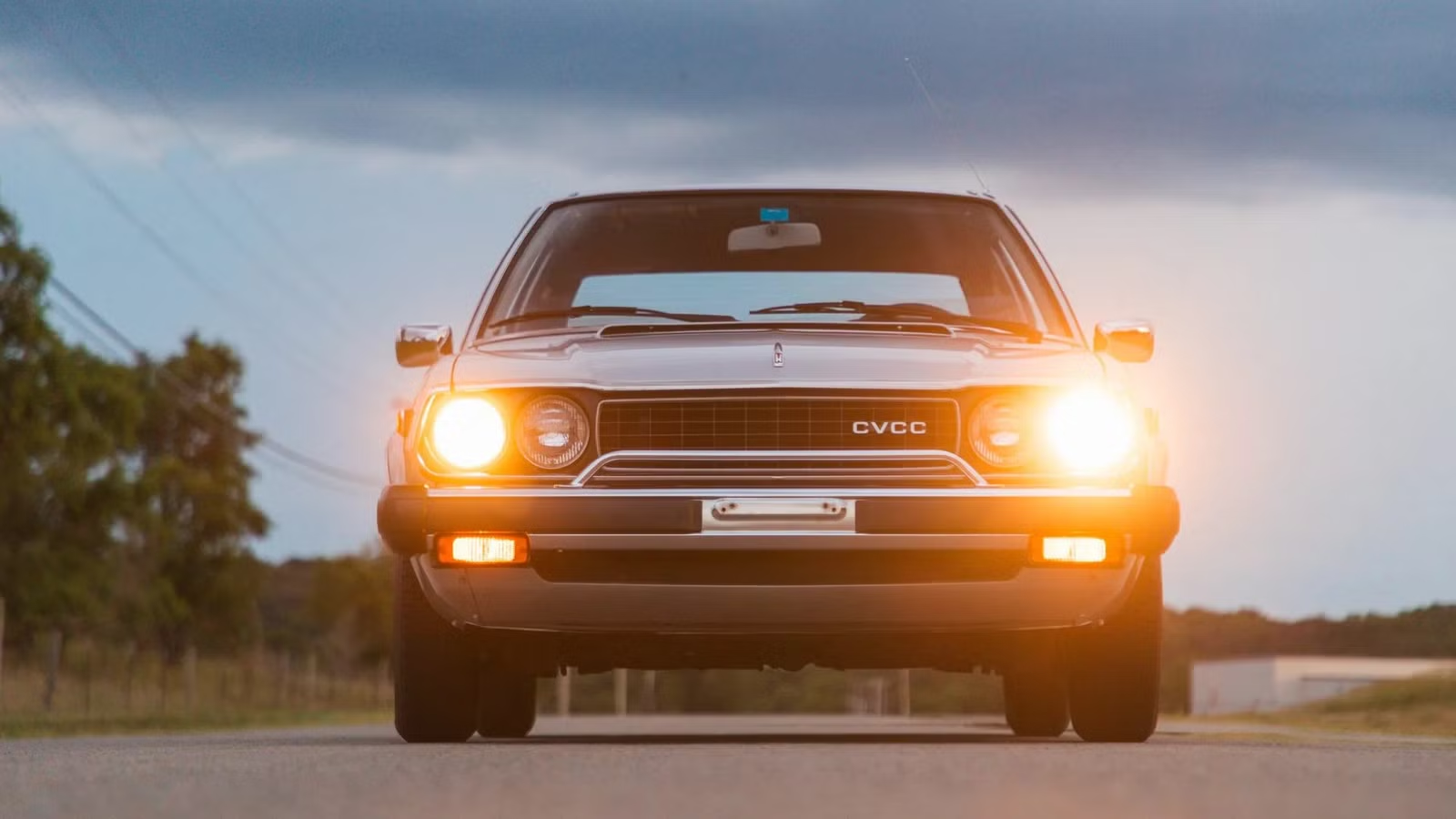
1976 Honda Accord: Honda Invents The Modern Compact
1976 Honda AccordHonda
You can’t really credit anyone with “inventing” the compact car. Making your car a little smaller than someone else’s isn’t really an innovation on its own. But the 1976 Honda Accord is widely regarded as the first compact car as we know it today. That is, a small, front-engine, front-wheel drive hatchback with an exceptionally fuel-efficient engine. The Accord managed to meet increasingly strict emissions standards without the need for a catalytic converter.
The 1976 Accord is still incredibly fuel-efficient, averaging up to 44 miles per gallon on the highway in modern tests. It wasn’t the most powerful car on the market, producing just 68 horsepower from its 1.6-liter 4-cylinder engine and taking around 14 seconds to hit 60 mph. Still, with gas prices spiraling out of control, Americans were more than happy to buy around 18,000 Accords in that first year, and nearly 76,000 units the next. In 2025, it sold 150,196 Accords in the US.
The Malaise-Era Accord Came With Engine Tech That Wouldn’t Last
1976 Honda AccordBring a Trailer
Honda’s secret ingredient was the Compound Vortex Controlled Combustion (CVCC) engine. A CVCC engine features a secondary intake valve that feeds the prechamber, while the main intake valve fills the combustion chamber with an efficient but hard-to-ignite lean air/fuel mix. The spark plug ignites the prechamber, and the resulting flame ignites the lean mixture in the cylinder.
The CVCC engine went the way of the dodo in the mid-1980s. Honda’s solution was innovative, but it ultimately couldn’t keep up with more sophisticated fuel-injection systems.
1976 Chrysler Cordoba: Chrysler Introduces Lean-Burn Computer Systems
1976 Chrysler CordobaBring a Trailer
It’s unclear which 1976 Chrysler was actually the first to come packed with Lean-Burn, Chrysler’s computerized ignition-timing system, as it was incorporated into the 400-cubic-inch (6.6-liter) V8 available in several models. But Road & Track tested the Chrysler Cordoba and found it matched a 360 Dodge Charger’s 0-60 time, despite being heavier and more fuel-efficient than the Charger. So we’re giving the Cordoba the point for introducing the world to the technology.
Lean-Burn Is Outdated, But Computerized Ignition Timing Lives On
1976 Chrysler CordobaBring a Trailer
The Lean-Burn system is no longer in use. Still, these Chrysler V8s are widely credited with putting the industry onto computerized ignition timing, with sensors monitoring things like engine temperature and throttle position and making instantaneous adjustments to improve performance and fuel economy.
Around the same time, General Motors partnered with Motorola to develop the MC6800 microprocessor, which made its way into the 1978 Cadillac Seville and further set the stage for modern cars packed with thousands of little computers, sensors, and processors.
Great Ideas Don’t Have An Expiration Date
The 1898 Lohner-Porsche P1, Ferdinand Porsche’s first electric car.Porsche
Some of the technology we’ve highlighted here has changed considerably over the years. The Lean-Burn system and the CVCC engine, for instance, may not technically be in use anymore, but they both pushed a new way of thinking about fuel economy.
You can imagine what sort of technology we’re pushing today that will still be in use in 50 years. We have no doubt that hybridized engines could be the norm at some point. If you can add an extra 40 hp or so without burning any extra fuel, why not? The success of the hybrid Toyota RAV4 and the Camry only goes to prove that point.
Bad Ideas Tend To Fade Away Quickly
Tesla Cybertruck has been crash-tested by the NHTSA, earning 5 starsTesla/YouTube
On the other hand, in-vehicle screen technology seems to have plateaued. You can build your screens bigger, you can add a screen to the passenger side, but at a certain point it just becomes obtrusive, rather than helpful. As JD Power’s Tech Experience Index proves year after year, drivers typically only welcome technology when it’s more or less invisible. That is, something that helps in the background, rather than something that pulls our attention off the road.
For that matter, we don’t know anyone who likes gesture-based controls, where you have to wave your hands like a maniac to change the radio station, like in the BMW 7 Series. We like buttons. We don’t want to adjust the air-conditioner by doing jazz hands. Flush door handles, as cool as they are, seem to be more trouble than they’re worth, too, being just one more part that can break.
Fake engine noises and simulated gear shifts may eventually be a thing of the past, as well, though new solutions to driver feedback in electric cars may echo these features. Then again, save icons in a lot of software still look like floppy discs, so we could be wrong on this one.
Then there are ideas like Aston Martin’s digital dashboard, which seem inevitable, but the time isn’t quite right. We have no doubt the whole world will be driving electric vehicles one day, but for now and into the near future, we expect the segment to remain relatively niche while infrastructure support catches up to drivers’ needs.
Sources: Honda, Aston Martin, Chrysler, GM, Volvo, Hemmings, FleetRabbit.
