

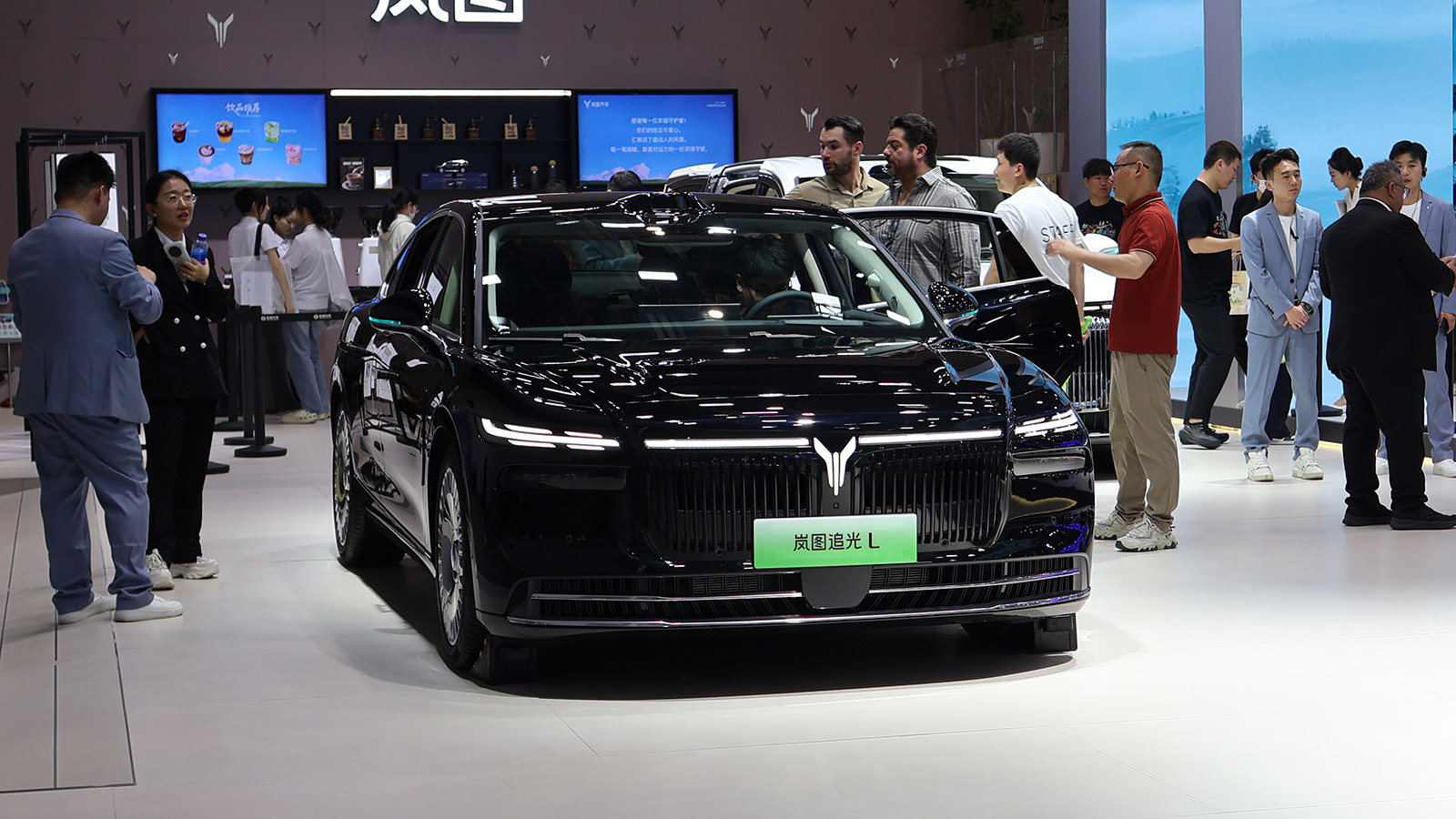
A Voyah Passion L on display at the Beijing Auto Show in April 2026. Credit: CnEVPost.
- The new guidelines call on automakers to avoid frequent, steep overseas price changes and respect local dealers’ pricing autonomy.
- The guidelines cover marketing, quality, employment and data security, addressing compliance risks as China’s automotive supply chain expands overseas.
China has issued guidelines on overseas competition in the automotive industry, focusing on automakers’ pricing, promotions and brand marketing in international markets.
China’s Ministry of Commerce, Ministry of Industry and Information Technology, and State Administration for Market Regulation jointly issued the guidelines, according to a notice posted Tuesday on the commerce ministry’s website.
The document comprises 4 chapters and 20 articles, providing a reference for Chinese automotive companies’ market competition and business operations overseas.
It serves as general guidance, and companies must still comply with the laws and policies of host countries and international organizations.
The guidelines call on companies to adopt pricing strategies based on costs and international market supply and demand, without disrupting market competition through improper means.
When setting suggested retail prices overseas, automakers should establish clear price tiers for different vehicle configurations and avoid frequent, steep price changes that could harm consumers’ interests and brand image.
Companies should also respect the pricing autonomy of local dealers and agents and clearly define the terms of sales incentives.
Product prices, discounts, gifts and auto-financing offers must also be transparent and comply with local business practices.
When conducting brand promotions overseas, automakers must disclose information truthfully and completely and refrain from false advertising that deceives or misleads consumers.
The requirements indicate that Chinese regulators are incorporating price volatility and aggressive promotions — long-standing features of the domestic auto market — into the risk-management framework for automakers’ international operations.
The guidelines also extend their focus to overseas production and localized operations. Companies are expected to strengthen workplace safety, quality management, after-sales services, labor protections and intellectual property safeguards.
For connected-car and autonomous-driving businesses, companies must ensure that the collection, use, protection and cross-border transfer of data comply with applicable rules while safeguarding consumers’ personal information.
Companies should also assess political, economic and industry risks in host countries and avoid exporting products that do not meet the needs of local markets or operating environments.
The commerce ministry said the guidelines were introduced against the backdrop of Chinese companies having invested in automotive manufacturing in more than 80 countries and regions. China exported 8.32 million vehicles to more than 200 countries and regions in 2025.
Exports continue to grow rapidly. China exported about 5.18 million passenger vehicles in the first 7 months of 2026, including roughly 2.77 million new energy vehicles (NEVs), up about 129% from a year earlier, according to data from the China Passenger Car Association (CPCA).
Passenger NEV exports alone reached 540,000 units in July, surging 147.8% year-on-year and accounting for 58.8% of China’s total passenger-vehicle exports.
The rapid expansion is also prompting Chinese automakers to move beyond product exports toward building overseas factories, supply chains and service networks. Taxation, employment, environmental protection and data localization have consequently become more prominent operating risks.
The commerce ministry said the new guidelines are intended to help automakers, component suppliers and service networks expand overseas in a coordinated manner, supporting the Chinese auto industry’s shift from product exports to the internationalization of its broader supply chain.
China will conduct nationwide inspections of intelligent connected vehicle safety, R&D and production capabilities, and product conformity.
