

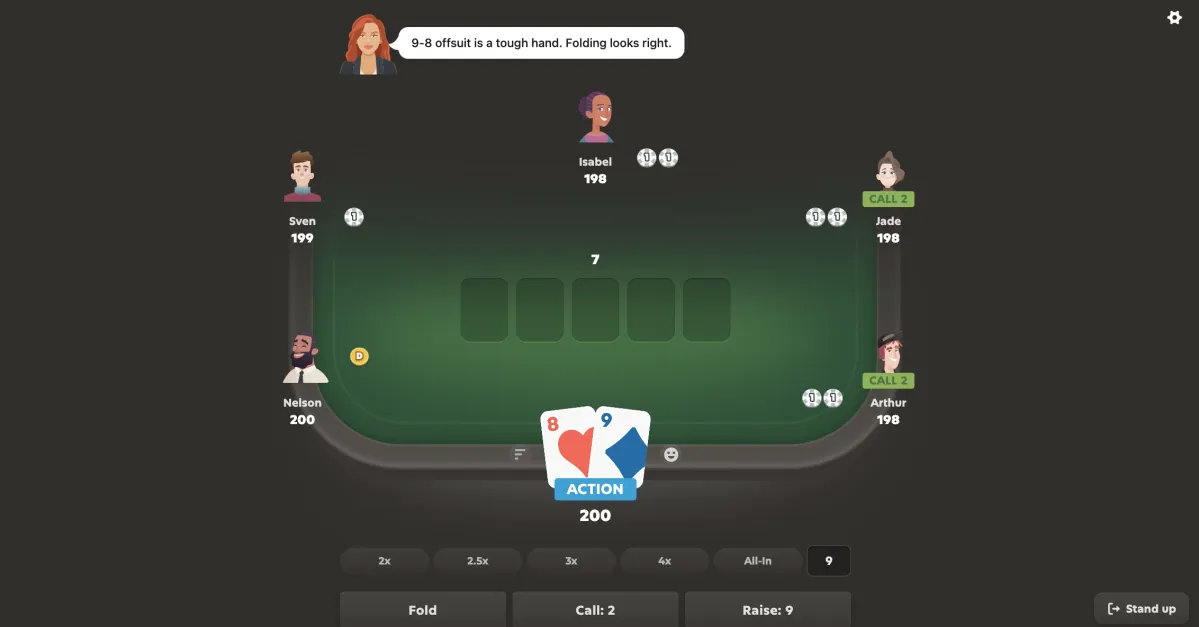
Chess.com has done one thing, and one thing very well, for almost 20 years, but now it’s going beyond its domain name. The biggest name in online chess quietly launched its first companion site in beta back in May: Gambit, a free online poker website where players can learn the game without risking any real money. Now Gambit’s ready to really get the ball rolling with its first livestreamed event and collaborations with content creators, and Chess.com is planning to branch out into even more games from here.
Chess.com’s chief growth officer, Albert Cheng, told The Verge the company chose poker for its first companion site because, like chess, it has learning and social elements on top of just playing the game. He also promised there will never be real-money gambling on Gambit, saying, “Real money is the problem we built Gambit to get away from, the whole industry makes money when beginners lose. We’d rather build a place where people can actually learn.”
Gambit will look familiar to anyone who’s used Chess.com. It borrows the same design style and includes similar play modes, like bot matches, games with friends, tournaments, a review mode for studying your past games, and a learning mode. Gambit even includes Chess.com’s bot characters, with matching skill levels — I immediately recognized “Martin,” the lowest skill level bot from Chess.com, who is also the lowest skill level bot on Gambit.
PreviousNext
1/2Gambit includes interactive lessons to learn poker. Image: Gambit
Chess.com also developed its own Elo-style rating system for Gambit. Cheng explained in an interview with The Verge that the rating system serves as the main motivator for players to improve: “You’re not gambling your own hard-earned money necessarily, so the stakes are lower from that standpoint, but you need something to counterbalance it that you care about, and that keeps the ecosystem in play, and keeps the poker that’s on Gambit reasonably high-quality.”
The rating system is also the backbone of Gambit’s paid subscription for access to premium learning features, following the same model Chess.com uses. “Our primary business model of Chess.com is a subscription, but most people play Chess.com for free,” Cheng said. “They subscribe to get unlimited access to review their games and to get unlimited puzzles, lessons, et cetera.” A reliable rating system allows players to track their improvement, potentially motivating them to pay for those premium features.
PreviousNext
1/2Players can study their past games in Gambit’s review mode. Image: Gambit
Rating systems are also at the heart of Chess’s next move. Chess.com is now looking to expand into even more classic games, including go, backgammon, and mahjong. Like Gambit, Chess.com is developing Elo-style rating systems for these games, as well. Cheng didn’t say when the new sites will launch but that “development is moving quite rapidly” on them, using the same playbook he used for Gambit.
AI is a key reason Chess.com was finally able to expand into other games after nearly 20 years, according to Cheng. He and one other employee took Gambit from prototype to launch within a year, partly with help from AI, mainly for coding tasks. “I think the biggest advantage that it’s provided is essentially being able to read our existing codebase and our design system and apply consistent patterns to how we develop Chess.com over to a different platform and do so quickly,” Cheng said.
He went on to add that there were also a lot of areas where AI struggles, such as brand and feature design. “I think that’s the best ultimate use of AI is that ultimately it’s going to be a blend, right?” Cheng said, adding, “Just because code is easier to write doesn’t mean that you just let it run on its own, but it certainly is a superpower in getting things off the ground.” Cheng also said the version of Gambit that’s live at the time of writing has “zero or close to zero” AI-created assets, which were used in early prototypes.
According to Cheng, without help from AI, getting another site up and running would have required a bigger team or “would have been a lot more disruptive to the status quo of building and growing Chess.” Now that a “small, scrappy” team can get a new platform off the ground much faster, it’s opened the door for Chess.com to dip into more games, starting with poker.
As Chess.com plans its next move, Cheng says they’re focusing on games with “both that classic durability plus the community around it,” like chess. Now that Gambit has launched, Cheng’s leaning into the community and social side of the platform more, following Chess.com’s lead, and getting content creators more involved. On August 31st at 12PM ET / 9AM PT, Gambit’s livestreaming its Gambit Cup for the first time on Twitch and YouTube with Chess.com co-founder Danny Rensch and chess content creator Alexandra Botez.
Follow topics and authors from this story to see more like this in your personalized homepage feed and to receive email updates.
- EntertainmentClose
Entertainment
Posts from this topic will be added to your daily email digest and your homepage feed.
FollowFollow
See All Entertainment
- GamingClose
Gaming
Posts from this topic will be added to your daily email digest and your homepage feed.
FollowFollow
See All Gaming
- NewsClose
News
Posts from this topic will be added to your daily email digest and your homepage feed.
FollowFollow
See All News
- TechClose
Tech
Posts from this topic will be added to your daily email digest and your homepage feed.
FollowFollow
See All Tech
- WebClose
Web
Posts from this topic will be added to your daily email digest and your homepage feed.
FollowFollow
See All Web
