

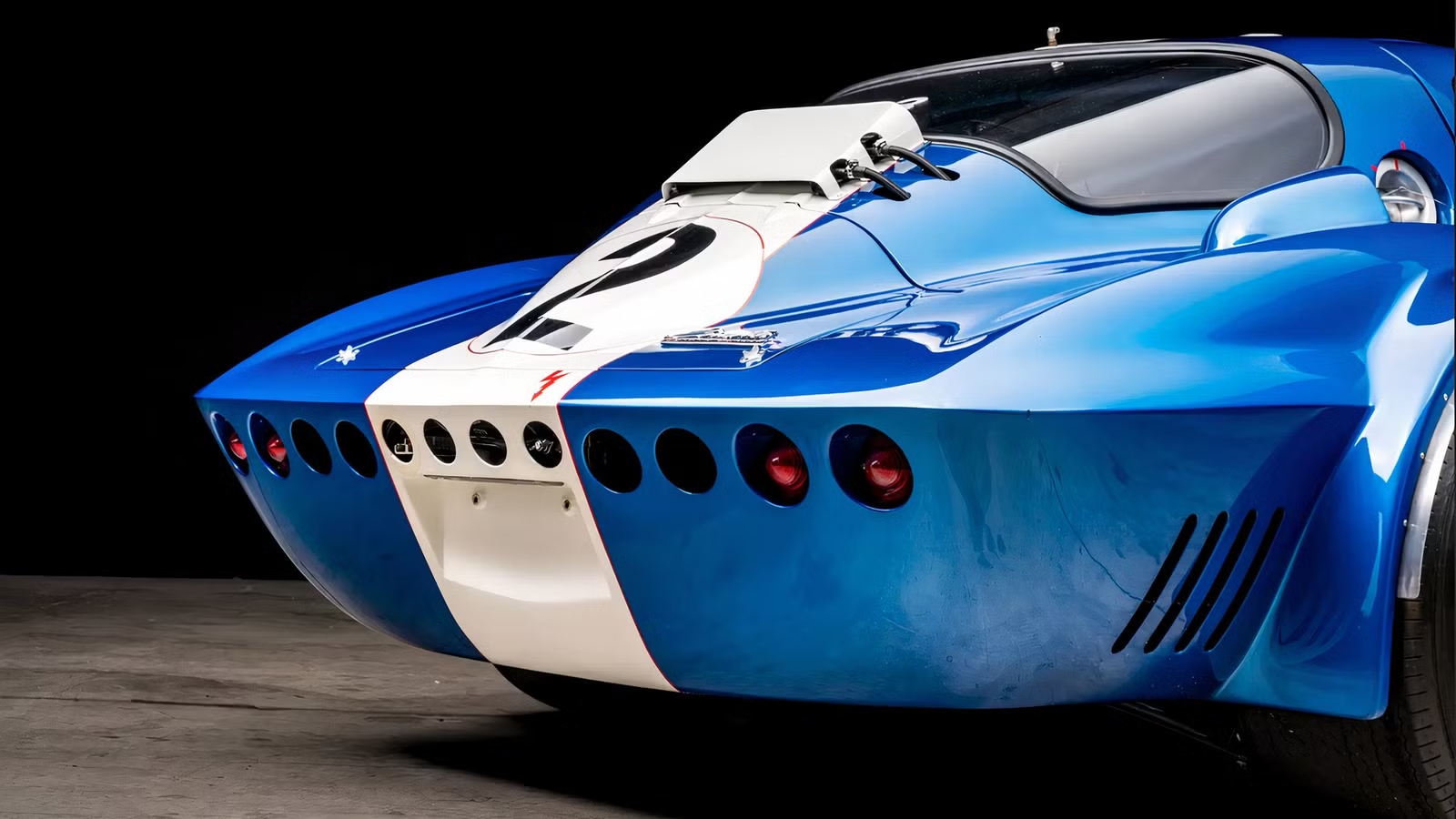
The asking price for a 1963 Corvette Coupe was $4,257 when new, and 10,594 units were produced that year, so why on earth did this striking blue-and-white example just sell for more than a Bugatti? As it happens, this is no ordinary Corvette, and its wild eight-figure auction result is perfectly justifiable.
America’s Sports Car Shatters Records At Monterey Car Week
The appeal of Chevrolet Corvettes has always been that they offer accessible performance at price points we mere mortals can tolerate, unlike their European counterparts. Well, that’s certainly not the case for this 1963 Corvette Grand Sport, as it netted an $18.705 million result when selling at auction during Monterey Car Week 2026.
At such a price, this Corvette isn’t simply more expensive than a Bugatti, it’s actually more expensive than any auction-sold Bugatti. The most expensive Bugatti ever sold at auction is the 1934 Type 59 Sports, which commanded a sum of $12.7 million in 2020, while the priciest modern effort was a 2025 Bugatti Mistral which fetched $8.8 million, also at Monterey Car Week 2026.
Sure, $18.705 million is a ludicrous cost, but this is a ludicrous car after all, and an opportunity that’s seldom offered.
One Of Three: How GM’s Secret Racing Program Created The Rarest Corvette Ever Built
1963 Chevrolet Corvette Grand SportRM Sotheby’s
All C2 Corvettes are cool, and relatively speaking, they are all fairly expensive too, but this 1963 Grand Sport is the holy grail of Corvettes, and it takes things to an entirely different level. Let’s start by going over the engineering and technical specifications packed into this particular Corvette.
While standard models tipped the scales at roughly 3,200 lbs, the ultra-exclusive Grand Sport Coupes instead sat closer to 1,900 lbs. To help shed a load of weight, they were equipped with feather-light fiberglass bodies, which boasted broad fenders capable of swallowing the Halibrand magnesium knock-off wheels. These bodies provided that iconic Grand Sport silhouette, complete with fixed headlamps and sweeping, aerodynamic lines.
Beneath the skin, the Grand Sport’s technical advancements are just as interesting. Gone is the standard car’s frame; in its place, a super-thin, lightweight tubular structure, and literally everything that could be lightened has been. Door handles, carburetor mounts, plexiglass windows — absolutely no stone went unturned by the weight-crazed engineers behind this particular project.
Various engines made their way into this Grand Sport, but during an intense 23-year restoration, a freshly built and all-aluminum 377ci V8 made its way back under the hood. Rather than chasing lofty outputs for the sake of it, this 377 has been finished as per original Grand Sport specifications, a recipe that provides in excess of 600 horses and 600 lb-ft of torque. Mated to it is a close-ratio manual transmission, with power, of course, being sent exclusively to the (suitably fat) rear tires.
1963 Chevrolet Corvette Grand SportRM Sotheby’s
So it’s clearly a mean racing machine, but what’s a racer without some real pedigree? Fortunately, chassis 003 here has that in spades. Upon its list of accolades sit SCCA victories, a second-in-class finish at Sebring 1964, a podium-in-class result the following year, placement in the 1963 Bahamas Speed Week, and many more such results spanning from 1963 through 1965.
After some years of limited use in anger post-1965, 003 was placed into long-term storage in 1969. While it might seem a shame for such a venerable racing machine to sit going unused, that’s exactly what allowed it to stay preserved in such wonderful and original condition for so long. In 2003, 003 passed into the care of a California owner who then painstakingly restored and refreshed this immensely important American racing car into the finished article displayed and sold at Monterey Car Week by RM Sotheby’s earlier this August.
Here’s Why This $18.7 million Corvette Is Worth Every Penny
1963 Chevrolet Corvette Grand SportRM Sotheby’s
First off, the restoration carried out on this car is absolutely first-class. Secondly, it was in remarkably solid and original condition when acquired in 2003, with the tubular frame, fiberglass body, dashboard, and even seats totally original to the car. Many such cars of the era were driven and crashed until they couldn’t be pieced together into a single vehicle any longer, so the fact that this extremely competitive racer remained in such wonderfully preserved condition for so long is something of a small miracle.
Cars are only original once, and when it comes to something as important, exclusive, and as valuable as this, originality (and therefore authenticity) is often the most prized and valuable aspect of the car.
Why Being One-Of-Three Beats One-Of-36 On A Historic Racing Grid
This Grand Sport hasn’t been restored as a shiny showpiece; rather, it’s been reinstated once more as the fire-breathing racer it was always intended to be. And so it seems only fitting that it should race once more in the upper echelons of historic motorsport, alongside sporting E-Types, Shelby Daytona Coupes, and 250 GTOs.
1963 Ferrari 250 GTO two racingWikimedia Commons
What the lucky new owner has purchased here then isn’t just a Corvette, it’s a ticket into that ultra-exclusive world of racing. Here, scarcity matters. Ferrari produced a grand total of 36 250 GTOs, Jaguar made a total of 17 E-Types across low-drag, lightweight, and semi-lightweight guises, and Carroll Shelby produced six Daytona Coupes. In comparison, five Grand Sports are exceedingly rare, and only three were coupes. So, when it comes to squeezing onto highbrow grids at events such as Goodwood’s Revival, being one-of-three is undoubtedly going to play into the Grand Sport owner’s hands. Who wants just another GTO in the lineup?
That same ruling goes for the most prestigious of concours fields, too. It certainly wouldn’t be out of the question for a car of this caliber to appear on the lawns of Pebble Beach and Salon Privé. Awards given on the lawns and prizes won on the track will only work to further boost the Corvette’s appeal, so it’s well-worth the new owner’s time campaigning the Grand Sport over the coming years.
Here’s How To Net One Of Your Very Own For A Fraction Of The Price
Superformance Chevrolet Corvette Grand SportSuperformance
Having an original is always worthwhile, so before buyers write off the $18 million purchase, they should double-check behind the couch cushions and smash that old piggy bank, just to be sure. Should they still come up short, all is not lost, for Superformance will build them an officially licensed replica for absolute pocket change, with prices beginning at just $220,000. At roughly 1.18% of the cost our original example here commands, that’s pretty decent value for money.
For that sum, buyers receive the same fear-inducing silhouette, along with a long list of track-geared goodies, like Wilwood brakes, an independent suspension setup, and a limited-slip differential. Buyers also get to choose the method of motivation too, whether that be a reliable LS3 in a sensible state of tune, a supercharged LS9, a custom-built old-school 427, or anything in-between.
Other Monterey Car Week Auction Results Show The Collector Market Is Alive And Well
Even with the history and scarcity placed into context, over $18 million for a Corvette is a remarkable result, but that’s just what auctions during Monterey Car Week tend to bring. Here’s a quick look at five other results from this year’s action which prove beyond any shadow of a doubt that the very top-tier of car collecting is still in very fine health:
1989 Porsche 959 Sport: The Porsche That Quietly Doubled Its Market Value Overnight
The Porsche 959 was a technical masterpiece that rivaled the F40 in period, and the Sport was the one to have. Only 29 were made, and collector interest in the marque is clearly building. This 1989 example sold for $7 million, around double what most public sales have achieved in recent years.
2023 Ferrari Daytona SP3: A “Stupid” Result Or The New Normal?
In the words of collector-car dealer Tom Hartley Junior, this result was “nothing short of stupid”. The figure it managed on the day was $17.8 million, so only just shy of what our Corvette achieved. Ferrari made 600 of these, and just three years ago they were selling new for approximately $2.25 million. A wild one-off result or an indicator of things to come?
1999 Ferrari 550 Maranello: How A Low-Mileage Manual Tripled Its Expected Value
The very best Maranellos tend to trade hands for between $300,000–$500,000, with very few making it into that bracket. In fact, most typically sell for closer to $200,000, so for an example – even a low-mileage manual like this – to fetch $610,000 is a remarkable feat. It also demonstrates that collector cars don’t have to be one-of-a-kind or important racing machines to command strong prices.
1996 McLaren F1 GTR: A New Record For The Most Expensive British Car Ever Sold
McLaren F1s will always be the auction stars that need no introduction. This GTR set a new record for the marque, bringing $34.6 million. While the ’63 Grand Sport became the most expensive Corvette of all time, this GTR became the most expensive British-built car, showing just how high the ceiling is for McLaren’s tremendous F1.
2026 Ferrari Luce: 40x Its Estimate, But Does A Charity Sale Count?
With a hammer-price of $40 million, this Luce shocked everyone, beating its pre-auction estimate around 40 times over. It was, of course, a charity auction, which makes it something of a special case rather than a true market indicator.
Sources: RM Sotheby’s.
