

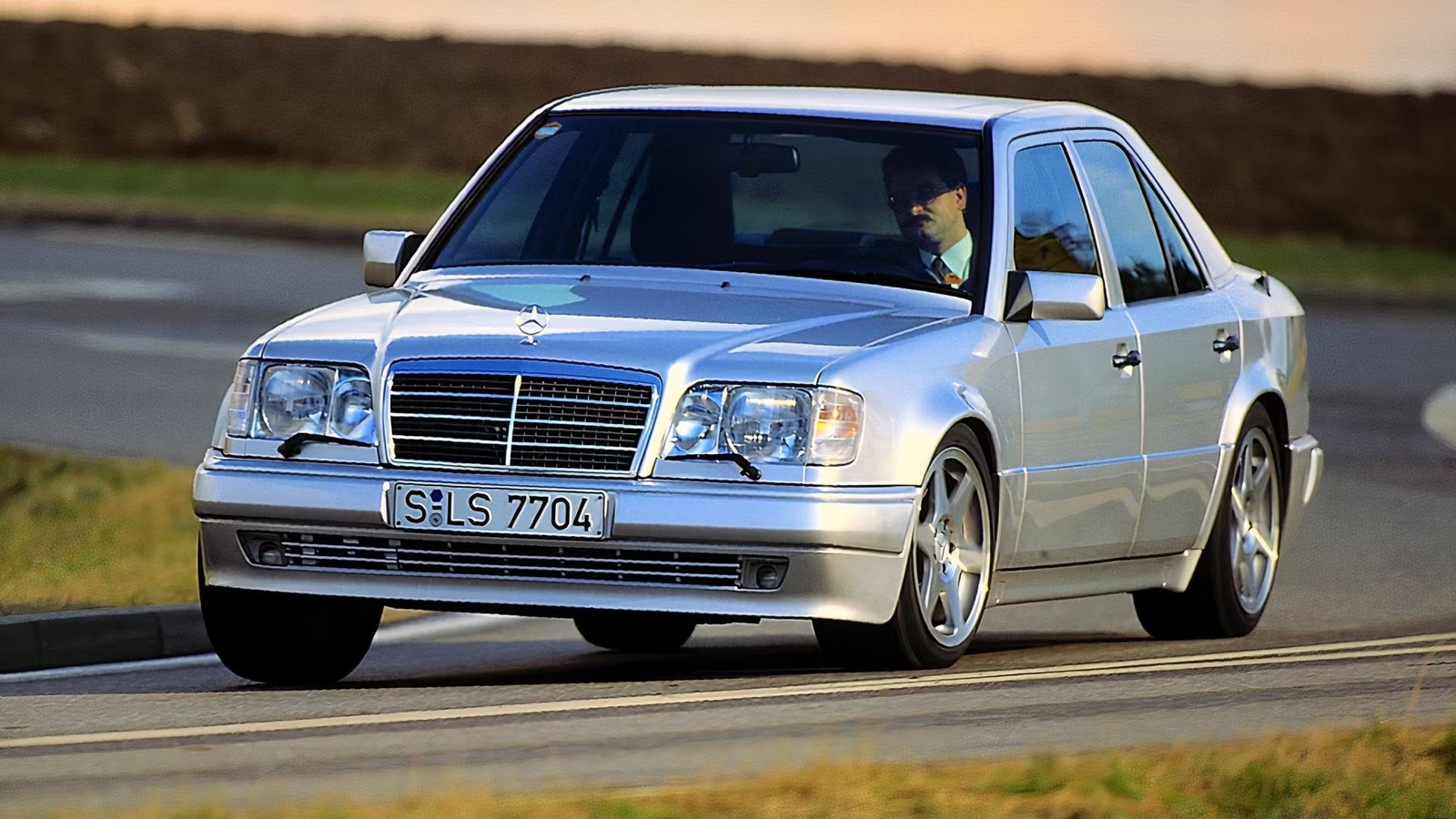
If you think about “luxury cars,” concepts like “expensive repair bills” and “heaps of maintenance” may come to mind. Vehicles on the high-end market are not exactly known for being bulletproof. However, there are exceptions to every rule, and the family of vehicles from the Mercedes-Benz W124 model series is definitely one of them.
An ancestor of what we now know as the E-Class, the iconic W124 was in production for a decade and has distinguished itself as one of Mercedes’ most reliable and iconic cars from the end of the 20th century. Here was how it became a symbol of timeless, dependable luxury motoring.
The W124: A Legendary Model In Mercedes’ History
Black 1992 Mercedes Benz W124 convertible front endMercedes-Benz
The name W124 refers to an entire range of cars produced from 1985 through 1997, belonging to the model family that eventually became known as the E-Class. However, each member of the lineup actually had its own alphanumerical code: W124 specifically referred to the sedan, while the coupe was C124, the wagon was S124, and the convertible was A124. The lineup also included a few more left-field body styles: F124 for a rolling chassis, and V124 for a limousine (along with a long-wheelbase version dubbed VF124).
The W124 is the product of a rapid evolution in automotive technology. Mercedes-Benz had to work hard to keep up with competitors. It produced the cutting-edge W124 to stay ahead of the curve, packing the model with advanced engineering and tech for the era. The result was a complete package of comfort and reliability: a luxury car that has endured throughout the decades, with plenty of examples still on the road today.
1990 Mercedes-Benz E-Class Coupe W124 side angle while parkedMercedes-Benz
Power came from a wide range of engines, which included both gas-powered (four-cylinder, inline-six, and V8) and diesel (four-cylinder, inline-five, and inline-six) units. The many options included the famously stout M104 gasoline-fueled inline-six. Depending on the engine choice, market, and model year, the transmission options included four- and five-speed automatics, as well as four- and five-speed manuals.
In 1993, the W124 sedan became the first generation of the new E-Class. Five more generations followed; the current E-Class arrived for the 2024 model year, with four body styles available, including a long-wheelbase version primarily sold in China and not offered in the US.
What Made The W124 So Reliable And Popular?
White 1988 Mercedes Benz W124 wagon front endMercedes-Benz
Although the W124 was a success from the start, it also became known over the years for its impressive reliability. Many examples of the W124 are still on the road today, a testament to the quality of Mercedes’ engineering and manufacturing.
The reason why the W124 has endured through the decades largely has to do with the amount of effort the German automaker put into the development of the model: Mercedes did not overlook a single detail. The W124 was created specifically with American drivers’ lifestyle in mind, which is why it became such a successful and durable vehicle in the US.
Both the engines and the transmissions offered with the W124 were renowned for their reliability, which is why several examples of the model have reached over a million miles over the decades. Another factor that made the W124 popular was its suspension. Mercedes paired independent front struts with a five-link independent rear suspension, which made the ride comfortable and improved handling. The wagon version offered a self-leveling rear suspension, which improved cargo-carrying capability without sacrificing ride quality.
1986 Mercedes-Benz 300E (W124) badgeBring a Trailer
For the car’s bodywork and chassis, Mercedes used robust zinc-coated steel panels with advanced rust protection, creating a vehicle that was both light and resilient. The car’s interior was packed with high-quality cloth, leather, and vinyl. The W124 was also ahead of its time on the braking front, with some models coming standard with ABS years before competitors.
Mercedes’ design choices made the W124 perform well in terms of safety and fuel efficiency, both of which were rapidly becoming bigger priorities for drivers. Mercedes took a crucial leap forward in safety by using digital crash-test data during development for the first time in the company’s history.
Lasting Into The Present Day: Buying And Maintaining A W124 Today
Mercedes-Benz E-Class Cabriolet W124 high angle in red while drivingMercedes-Benz
While the W124 has become somewhat of a cult classic, it is still pretty accessible to the average person. Sedans in decent condition are readily available for around $10,000, and wagons average around $14,000. However, there are some notable outliers. Models from famous Mercedes tuners such as AMG and Brabus can sell for over $100,000. A particularly pristine 1987 Mercedes-Benz 6.0 AMG Hammer with 29,000 miles sold for $695,000 in 2026.
One key factor in the W124’s exceptional long-term reliability is the support Mercedes-Benz offers. Component availability is a major issue for anyone trying to maintain a classic car; the brand’s parts supply service solves it, offering over 5,800 replacement components for the W124. This dramatically cuts the time owners spend searching for new parts; it also prevents existing cars from being used as donors, keeping more W124s on the road.
1994 – 1995 Mercedes-Benz E-Class Sedan W124 (1st Gen) Front View DrivingMercedes-Benz
While the W124 definitely has an advantage in reliability compared to other classics, that doesn’t mean it is completely free of problems. If you decide to add one to your garage, there are a couple of problem areas to watch for to keep your car in top shape. Degrading wiring insulation, climate control issues, and wear and tear on the suspension bushings are all common pain points for the W124, so make sure you stay on top of these to keep enjoying your car for as long as possible. The absolute newest examples of these vehicles are around 30 years old, and parts need to be replaced over time.
How W124 Reliability Was Combined With Performance: The 500E And The Hammer
Front quarter shot of the 1987 AMG Hammer sedanBroad Arrow Auctions
Among the many models in the W124 lineup were also some high-performance versions, two of which became particularly well-known among Mercedes fans and automotive enthusiasts in general. We’re talking about the 500E/E500 and the AMG “Hammer.” Both take the standard W124 sedan and add plenty of performance-oriented modifications.
The Hammer arrived first, being introduced in 1986 and remaining on sale until 1993. At the time, AMG was still an independent firm, founded by two former Mercedes engineers. Thanks in part to the Hammer’s success, AMG began working with Mercedes full-time a few years later. By 2005, the automaker fully owned the tuner.
The process that transformed a standard W124 into a Hammer involved an engine swap (with three different V8s available), as well as the addition of a limited-slip differential, an upgraded suspension and exhaust system, and a widebody kit. Depending on the selected powerplant, output ranged from 355 hp to 385 hp.
The interior was upgraded to make it more premium. A set of Pirelli tires was fitted as well. Thanks to its modifications, the Hammer reached 60 mph in around five seconds, on par with several supercars of its era.
1991 Mercedes-Benz 500E front 3/4 movingMercedes-Benz
A few years later, in 1990, Mercedes introduced the 500E. This W124 variant was on the market for five years and resulted from a joint effort between Mercedes and Porsche. Porsche’s expertise played a pivotal role in fitting a 5.0-liter V8 engine (which Mercedes had previously used in the SL-Class) into the W124. It made 322 horsepower and 354 pound-feet of torque, letting the sedan hit 60 mph in around 5.5 seconds.
The result was a rare, powerful, and fast model that remains beloved by classic car collectors today. Every 500E (or E500, as it was referred to after the 1993 facelift) was built by hand over 18 days. The cars were transported between Porsche and Mercedes facilities, with each team completing a part of the assembly process.
Sources: Mercedes-Benz
