

Not every great sports car is appreciated the moment it arrives. Some become instant icons, while others spend years living in the shadow of more popular rivals before enthusiasts finally recognize just how influential they really were. Throughout automotive history, a handful of sports cars introduced ideas that seemed radical at the time. Looking back today, it’s remarkable how many of these cars helped shape the performance machines we take for granted.
From the Honda NSX forcing Ferrari to rethink what a supercar could be to the Lexus LFA proving that engineering passion sometimes matters more than sales figures, each of these models pushed the industry forward in its own way. They may not all have been commercial successes, but they shared one thing in common: they predicted the future long before everyone else saw it.
1967 Toyota 2000GT
Japan’s First True Exotic Sports Car
Side shot of 1967 Toyota 2000GT in red parked in barnBring A Trailer
Long before the Supra, GT-R, or NSX became household names, there was the Toyota 2000GT. Introduced in 1967, it shattered perceptions of what Japanese manufacturers were capable of, proving they could build a world-class sports car rather than a practical vehicle. Developed in partnership with Yamaha, the 2000GT featured a front-mid-engine layout, independent suspension at all four corners, four-wheel disc brakes, and a 2.0-liter inline-six producing 148 horsepower and 129 pound-feet of torque. Those figures may seem modest today, but the car’s balance and sophistication rivaled many European sports cars of the era.
Low-angle front 3/4 shot of 1967 Toyota 2000GT in red parkedBring A Trailer
Its influence reached far beyond sales numbers. The 2000GT established Japan as a serious player in the performance car world and laid the groundwork for icons like the Nissan Z, Mazda RX-7, and Toyota Supra. As Road & Track once described it, the 2000GT was “one of the world’s truly great sports cars,” high praise for a machine that arrived decades before Japanese performance cars earned global respect.
- Japan’s first true exotic sports car
- Developed jointly with Yamaha
- Approximately 350 examples were built
1968 Ferrari Dino
The Ferrari That Broke Tradition
1971 Ferrari Dino side shot parkedNathaniel Ehinger | Top Speed
When the Ferrari Dino debuted in 1968, it challenged everything buyers associated with the Prancing Horse. Instead of Ferrari’s signature V12, the Dino arrived with a smaller 2.4-liter naturally aspirated V6, producing 195 horsepower and 166 pound-feet of torque. For some purists, that alone was enough to question whether it deserved the Ferrari name.
1971 Ferrari Dino Rear ShotBring A Trailer
History, however, proved otherwise. More importantly, the Dino placed its engine behind the driver, introducing Ferrari buyers to a mid-engine layout that offered sharper balance and handling than the company’s traditional front-engined grand tourers. It became the blueprint for nearly every modern Ferrari supercar that followed. Hagerty has called the Dino “one of the sweetest-driving Ferraris ever built.”
- Ferrari’s first mid-engined road car
- Used a naturally aspirated V6 instead of a V12
- One of Ferrari’s most beautiful designs
1973 Lancia Stratos
The Rally Car That Changed Performance Design
Lancia Stratos front 3/4TopSpeed | Garret Donahue
The Lancia Stratos wasn’t designed to be a road car that happened to go rallying—it was engineered from the outset to dominate the World Rally Championship. In doing so, it rewrote the blueprint for performance cars. Power came from Ferrari’s 2.4-liter Dino V6, producing 190 horsepower and 166 pound-feet of torque in road-going form. Combined with a short wheelbase, lightweight construction, and a mid-engine layout, the Stratos delivered agility on virtually any surface. It was uncompromising, purpose-built, and unlike anything else on the road.
Lancia Stratos rear 3/4 shot parked in garageTopSpeed | Garret Donahue
Its success spoke for itself. The Stratos won three consecutive World Rally Championship manufacturers’ titles between 1974 and 1976, proving that designing a car around a specific performance goal could outperform more conventional rivals. Motor Sport Magazine described it as “the first rally car built with only one purpose in mind: to win.” More than 50 years later, its influence can still be seen in everything from rally homologation specials to today’s track-focused performance cars.
- Purpose-built World Rally Championship homologation car
- Ferrari Dino-derived V6 engine
- Won three consecutive WRC manufacturers’ titles
1976 Renault Alpine A310
Lightweight Thinking Before The Industry Cared
1985 Renault Alpine A310 V-6Renault Group
Long before lightweight sports cars became fashionable again, the Alpine A310 proved that horsepower wasn’t the only path to driving enjoyment. Instead of chasing ever-larger engines, Alpine focused on keeping weight low, the chassis balanced, and the driver fully immersed in the experience.
1978 Alpine A310 Rear ShotBring A Trailer
Early models were powered by a 1.6-liter inline-four producing 125 horsepower and 110 pound-feet of torque, while later V6 versions raised output to around 150 horsepower. Even then, the A310 wasn’t built to dominate on paper. Its fiberglass body, rear-engine layout, and agile handling made it feel far more capable than the numbers suggested. Evo praised the Alpine’s delicate steering and playful balance, qualities that remain at the heart of today’s Alpine A110. Decades later, the A310 still feels like a blueprint for the lightweight driver’s car.
- Lightweight fiberglass body
- Rear-engine layout for excellent balance
- Inspired the philosophy behind today’s Alpine A110
1976 Porsche 924
The Porsche Purists Initially Hated
Front three-quarters shot of a 1987 Porsche 924 SMecum Auctions
When the Porsche 924 arrived in 1976, it was met with skepticism. It abandoned the brand’s traditional rear-engine formula in favor of a front-engine, water-cooled layout, prompting many enthusiasts to question whether it was a “real” Porsche. Powered by a 2.0-liter inline-four producing 125 horsepower and 121 pound-feet of torque, the 924 was never about straight-line speed. Instead, Porsche focused on balance, using a rear transaxle layout to achieve near-perfect weight distribution and a chassis that rewarded precision over brute force.
1976 Porsche 924 rear 3/4 shotBring a Trailer
Initially overshadowed by the 911, the 924 has since earned the respect it deserved. Hagerty praised its “wonderful balance” and noted that its rear-transaxle layout gives it handling that still feels special today. In many ways, the 924 laid the foundation for the front-engine Porsches that followed—and its focus on balance over outright power is a philosophy the Cayman would later perfect.
- Front-engine, rear-transaxle layout
- Nearly perfect weight distribution
- Laid the groundwork for later transaxle Porsches
1980 Alfa Romeo GTV6
It Proved Balance Could Beat Brute Force
1986 Alfa Romeo GTV6 Driving shotBring A Trailer
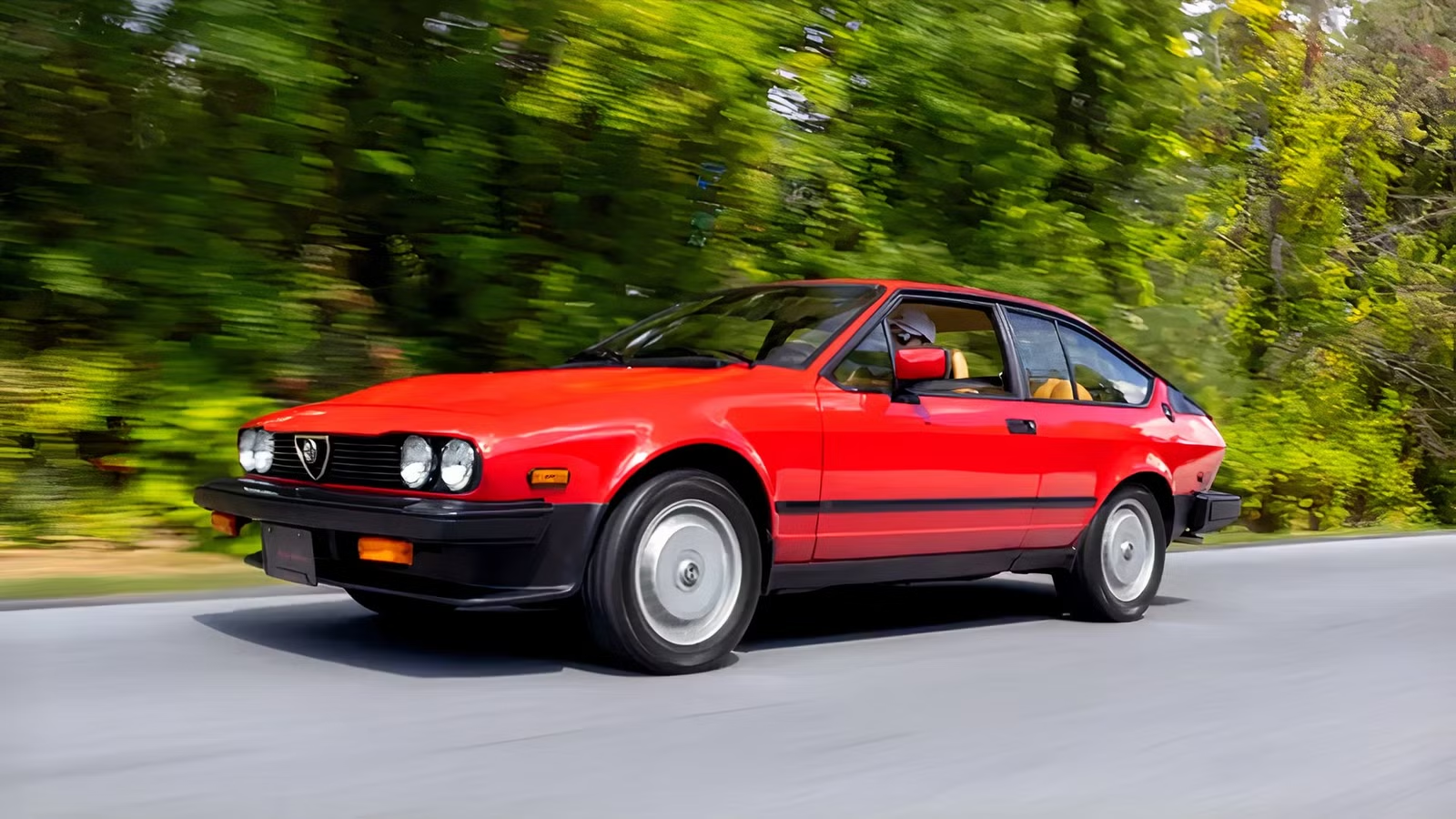
The Alfa Romeo GTV6 arrived at a time when performance cars were becoming obsessed with horsepower. Alfa Romeo took a different approach, focusing on balance, steering feel, and driver involvement instead of chasing numbers. Under the hood sat a charismatic 2.5-liter Busso V6, producing 154 horsepower and 157 pound-feet of torque.
1986 Alfa Romeo GTV6 Rear ShotBring A Trailer
While those figures were modest, the GTV6’s near-perfect weight distribution, rear transaxle layout, and beautifully communicative steering made it one of the most rewarding sports cars of its era. It wasn’t about how fast you could go in a straight line—it was about how connected you felt through every corner. As Hagerty noted, the GTV6 remains “one of the greatest driver’s cars of its era,” a reputation earned not through brute force, but through delivering an experience that enthusiasts still celebrate decades later.
- Powered by the legendary Busso V6
- Rear transaxle improved chassis balance
- Won the European Touring Car Championship
1990 Honda NSX
The Supercar That Changed Everything
Front 3/4 shot of 1991 Honda NSX in black parkedBring A Trailer
The Honda NSX arrived in 1990. The NSX became the world’s first production car to use an all-aluminum monocoque chassis, which made it lighter than many of its rivals while delivering exceptional rigidity. Powered by a naturally aspirated 3.0-liter V6 with Honda’s VTEC technology, the NSX produced 270 horsepower and 210 pound-feet of torque. It wasn’t the most powerful exotic on the market, but it was one of the most rewarding to drive. As Car and Driver noted, the NSX was “so pleasing to operate—even just running errands—that all-out speed doesn’t matter much,” highlighting just how approachable and enjoyable it was in everyday driving.
Rear 3/4 shot of 1991 Honda NSX in black parkedBring A Trailer
With Ayrton Senna helping hone the chassis, the NSX rewrote the supercar rulebook. It forced Ferrari to rethink build quality, reliability, and everyday usability, proving that performance didn’t have to come with compromise. More than three decades later, its influence is still impossible to ignore.
- First production car with an all-aluminum monocoque chassis
- Naturally aspirated 3.0-liter VTEC V6 producing 270 horsepower
- Ayrton Senna helped fine-tune the chassis during development
1991 Mitsubishi 3000GT VR-4
Packed With Technology Before It Was Normal
3/4 top view of 1991 Mitsubishi 3000GT VR-4Bring a Trailer
When the Mitsubishi 3000GT VR-4 debuted in 1991, it felt like a glimpse into the future. While most sports cars relied on raw power and driver skill, Mitsubishi packed the VR-4 with technology that wouldn’t become commonplace for years. Its 3.0-liter twin-turbocharged V6 produced 300 horsepower and 307 pound-feet of torque, but the headline wasn’t just the engine.
1991 Mitsubishi 3000GT VR4 SideMitsubishi
Many critics focused on the VR-4’s weight, but that overlooked what Mitsubishi had achieved. It went toe-to-toe with icons like the Toyota Supra Mk4, Nissan 300ZX Twin Turbo, and Mazda RX-7, while showcasing technologies that would later become commonplace. As Road & Track noted, the VR-4 was “too far ahead of its time,” blending all-wheel drive, four-wheel steering, adaptive suspension, and active aerodynamics into one remarkably capable package. At the time, very few production cars offered anything close. More than three decades later, the industry has finally caught up.
- 3.0-liter twin-turbocharged V6 with 300 horsepower
- Featured AWD, four-wheel steering, and active aerodynamics
- Rivaled the Toyota Supra, Mazda RX-7, and Nissan 300ZX
1995 Nissan Skyline GT-R R33
Technology Turned Into Performance
A black R33 Nissan GT-R basking in the sunBring-a-Trailer
Overshadowed by the R32 that came before it and the R34 Skylines that followed, the R33 GT-R rarely gets the recognition it deserves. Yet it was one of the most advanced performance cars of the 1990s and proved that technology could be just as important as horsepower. At its heart was Nissan’s legendary 2.6-liter twin-turbocharged RB26DETT inline-six, producing the officially quoted 276 horsepower and 271 pound-feet of torque—although many believe the real output was considerably higher.
Front right shot of a white Nissan Skyline GT-R V-Spec (R33) parked in a parking lotBring A Trailer
Paired with the sophisticated ATTESA E-TS all-wheel-drive system and Super-HICAS four-wheel steering, the GT-R delivered staggering grip and confidence that few rivals could match. The R33 became the first production car to lap the Nürburgring Nordschleife in under eight minutes. MotorTrend praised its confidence-inspiring handling and everyday usability, proving that sophisticated electronics could make a performance car faster without sacrificing driver engagement.
- RB26DETT twin-turbocharged inline-six
- First production car to lap the Nürburgring in under eight minutes
- ATTESA E-TS AWD and Super-HICAS four-wheel steering
2010 Lexus LFA
The Supercar People Underestimated
Rear 3/4 view of a 2012 Lexus LFA on trackLexus
When the Lexus LFA debuted in 2010, many questioned whether it was worth its staggering $375,000 price tag. After all, why spend Ferrari money on a Lexus? Yet with hindsight, it’s clear the LFA wasn’t overpriced—it was misunderstood. At its heart sat one of the greatest engines ever built: a 4.8-liter naturally aspirated V10 producing 552 horsepower and 354 pound-feet of torque. Co-developed with Yamaha, the engine revved to 9,000 rpm so quickly that Lexus had to fit a digital tachometer because an analogue gauge couldn’t keep up. The carbon-fiber-reinforced polymer chassis further demonstrated just how serious Lexus was about building a world-class supercar.
White 2012 Lexus LFA on a track.Lexus
Time has been incredibly kind to the LFA. Top Gear famously described its V10 as “the best engine in the world,” praising its breathtaking soundtrack and razor-sharp throttle response. Today, pristine examples regularly command well over $1 million, making the LFA one of the most sought-after modern supercars. More importantly, it proved that true engineering brilliance isn’t always appreciated immediately—sometimes the world simply needs time to catch up.
- Carbon-fiber-reinforced polymer chassis
- Yamaha-developed 4.8-liter V10 revving to 9,000 rpm
- Limited to just 500 examples worldwide
In essence, these sports cars weren’t simply ahead of their time—they helped shape the performance cars we drive today. Looking back, their greatest achievement wasn’t sales success, but proving that the future often arrives long before the world is ready for it.
Sources: OEMs, Hagerty
