

The fact that manual gearboxes have been cast away by manufacturers isn’t exactly a secret, with fewer drivers’ machines than ever coming packing one of the easiest ways to increase driving engagement. Slicker and easier-to-use automatics became the popular choice, leading exotic manufacturers like Lamborghini to start putting most of their attention towards designing cars specifically for such units. Before it did though, it gave the manual a fine send-off from its flagship range.
Lamborghini Saw Automatics As The Future
Lamborghini Aventador S LP 740-4 CabinCollecting Cars
During the 2000s, equipping a high-end performance car with a rapid-fire automatic transmission became much more than simply a design trend. Not only did they help increase performance by quickening shift times, but they also made these ultra-rapid cars much easier to drive for non-professional drivers. They helped rid the pilot of the difficulty of trying to nail their gear changes with a manual clutch, but they also ensured the car would remain better balanced thanks to the slick and blink-and-you-miss-it downshifts.
Ferrari was the first to really nail it with its F1 gearbox in the late 1990s and early 2000s, while Porsche had improved its Tiptronic unit consistently since its 1989 introduction. Now under the stewardship of Audi, Lamborghini elected to get in on the act in the early 2000s, with its Murciélago and new Gallardo models both being graced with the six-speed automated and single-clutch E-Gear unit. It proved a bit of a hit, and before long, most customers were speccing their expensive supercars with it.
As a result, Lamborghini decided to only offer the Murciélago’s successor, the Aventador, with a seven-speed auto gearbox, and ditch the manual altogether. That made the Murciélago LP-670 SV the final V12 model from the storied Italian manufacturer to roll out of Bologna with a manual, bringing the end of a spectacular era for the beloved brand. As goodbyes go, the SV was a pretty damn good one.
The LP670-4 SV Was The Most Extreme Version Of The Murciélago
2010 Lamborghini Murcielago LP670-4 SVAlex Penfold / RM Sotheby’s
With the new Aventador on the horizon, Lamborghini wanted to give the aging Murciélago a glorious send-off. It did this by tasking its engineers with developing the most hardcore variant yet, a car that would only be built in limited numbers. Like its predecessors, the LP670 would be offered with either the six-speed manual or six-speed automated manual option, though the latter would likely be the more popular choice. Lamborghini’s prior hot-Murciélago effort, the LP640, ended up selling just 88 examples with the manual transmission equipped, from a total run of 1,675, and the uptake for the six-speed LP670 which followed was even smaller still.
2010 Lamborghini Murcielago LP670-4 SVAlex Penfold / RM Sotheby’s
The 6.5-liter V12 from the LP640 was retained, though it was gifted an upgraded intake setup and revised timing to increase peak output from 641 horsepower to 661 hp, making it the most powerful Murciélago ever built. Beyond that, the LP670 SV also got widened air intakes at the front to help enhance brake cooling, ensuring it could pound around the world’s most demanding racetracks for longer before the brake pedal started to get concerningly long. To this end, a powerful carbon ceramic braking setup was included as standard with all SVs.
The Revised Murciélago Was Much Lighter
2010 Lamborghini Murcielago LP670-4 SVAlex Penfold / RM Sotheby’s
The Super Veloce package went further than just an upgraded engine and brake cooling ducts. Lambo produced much of the car’s body, cabin, and chassis from lightweight carbon fiber, while also developing a new exhaust system to help shed the car of more crucial pounds. In the end, the manufacturer’s efforts resulted in a car that tipped the scales at 220 pounds lighter than the LP640, despite the more aggressive aerodynamic package the car was lavished with.
Lambo introduced a larger front splitter and carbon fiber rear wing, as well as a complex rear diffuser, to help increase downforce at high speed. This allowed for greater cornering speeds, but also enhanced stability compared to standard versions of the Murciélago. The SV even lost most of the luxuries, such as a radio, that the normal car had in pursuit of lightness and agility, though these could at least be added back via the options list.
2010 Lamborghini Murcielago LP670-4 SVAlex Penfold / RM Sotheby’s
The result was a Murciélago that could sprint to 60 mph in just 3.2 seconds, but could also carry this kind of performance through the bends and through the most demanding braking zones as well. It didn’t just look more aggressive than the base Murciélago; it behaved like it too.
It Would Also Become The Rarest Of Lambo’s Last V12 Manual Supercars
2010 Lamborghini Murcielago LP670-4 SVAlex Penfold / RM Sotheby’s
Being the special final hurrah for the Murciélago, Lambo initially communicated that just 350 examples of the LP670-4 SV would be produced, easily making it the most exclusive variant of the supercar. In the end, primarily due to the financial challenges brought on by the 2008 global financial crisis, just 186 cars would ultimately be completed. The thing is, the vast majority of these came with the automated transmission, and it’s thought that only five cars were equipped with the full manual. The number could be as high as seven, though this is unconfirmed due to the cars being tough to pin down.
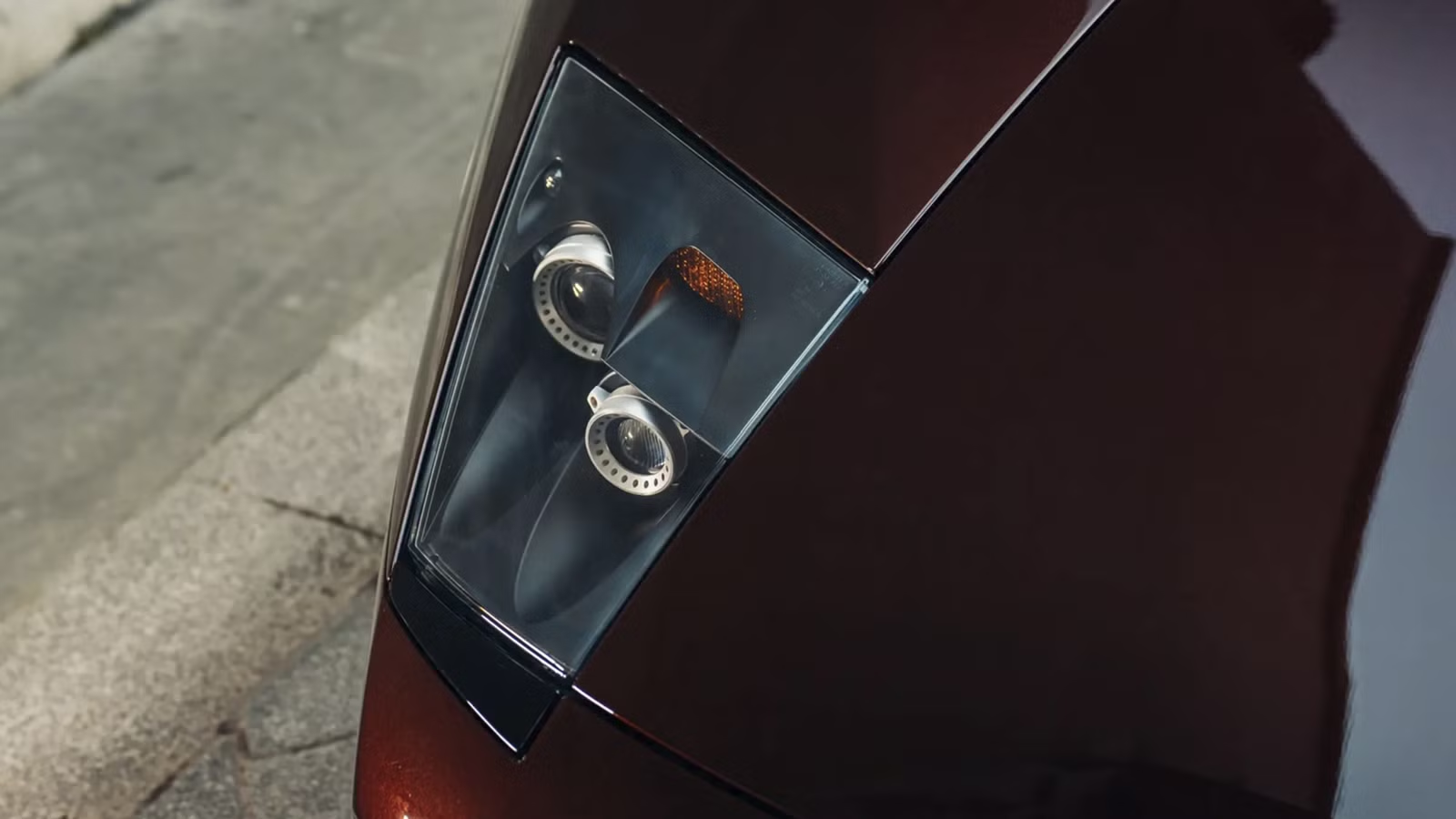
They don’t come up for sale often due to being locked away in the lairs of their collector owners, but when they do, they’re expected to fetch an absolute fortune. We’ll find out soon enough though, as a beautiful example finished in Ad Personam Marrone Eklipsis, or a posh brown to you and us, is set to go under the hammer in late August 2026 through RM Sotheby’s. Fascinatingly, this car is the last of the five known manual LP670-4 SV’s to be built, which therefore makes it the last ever manual V12 Lambo.
This only adds to its desirability, and therefore, its likely selling price. Other examples of such cars haven’t come up for public sale, so it’s difficult to know exactly how much they fetch. Automated manual LP670s tend to secure around $900,000 in good condition, though ultra-low-mileage cars in concours shape can sell for as much as $1.2 million. Given how rare manual vehicles are, when combined with the rising desirability of manual cars as collector’s items, Hagerty’s Valuation Tool estimates that a good one should sell for 35% more, or $1.2 million at the lower end. When in mint condition, $1.6 million could be achieved.
2010 Lamborghini Murcielago LP670-4 SVAlex Penfold / RM Sotheby’s
That said, seeing as an auto machine, which granted came in a one-of-one paint scheme, managed to secure over $3.1 million through RM Sotheby’s recently, we wouldn’t be surprised to see the LP670 eclipse the $2 million mark. Seeing as Hagerty’s values ballooned by around 40% across the board across the last year, expect such examples to only get more valuable going forward.
The Final Manual Lambo Died A Few Years Later
2004-2008 Lamborghini Gallardo Black Interior Center Console Manual Gated ShifterLamborghini
While the final V12-powered Lamborghini was produced in 2010, you could still secure yourself a manual transmission in a car with the Raging Bull gracing it for a few more years. The entry-level Gallardo came packing a shouty naturally aspirated 5.2-liter V10 engine, which nicely complemented its bigger V12 siblings. Like the Murciélago, it came with a useful all-wheel drive system to help boost traction and aid stability, though it was smaller and lighter.
Sadly for manual lovers though, Lambo was hell-bent on moving its entire range towards slicker automatic transmissions and away from the trusty manual. That’s why when the Gallardo’s replacement, the Huracan, arrived in 2014, the manual was nowhere to be seen. Purists were kept happy due to the awesome V10 being kept in service, though the end of the Gallardo also meant the end of the manual Lamborghini in its entirety.
Lambo has refrained from equipping a manual in any car since then, even when building limited-production specials that you’d expect to hark back to the company’s earlier history. Still, such vehicles featuring a manual are becoming a more popular approach in more recent years, so there is always the chance for Lamborghini to change its mind and resurrect this glorious combination. We, for one, would relish such a machine.
Sources: Hagerty Valuation Tool, Lamborghini, RM Sotheby’s
