

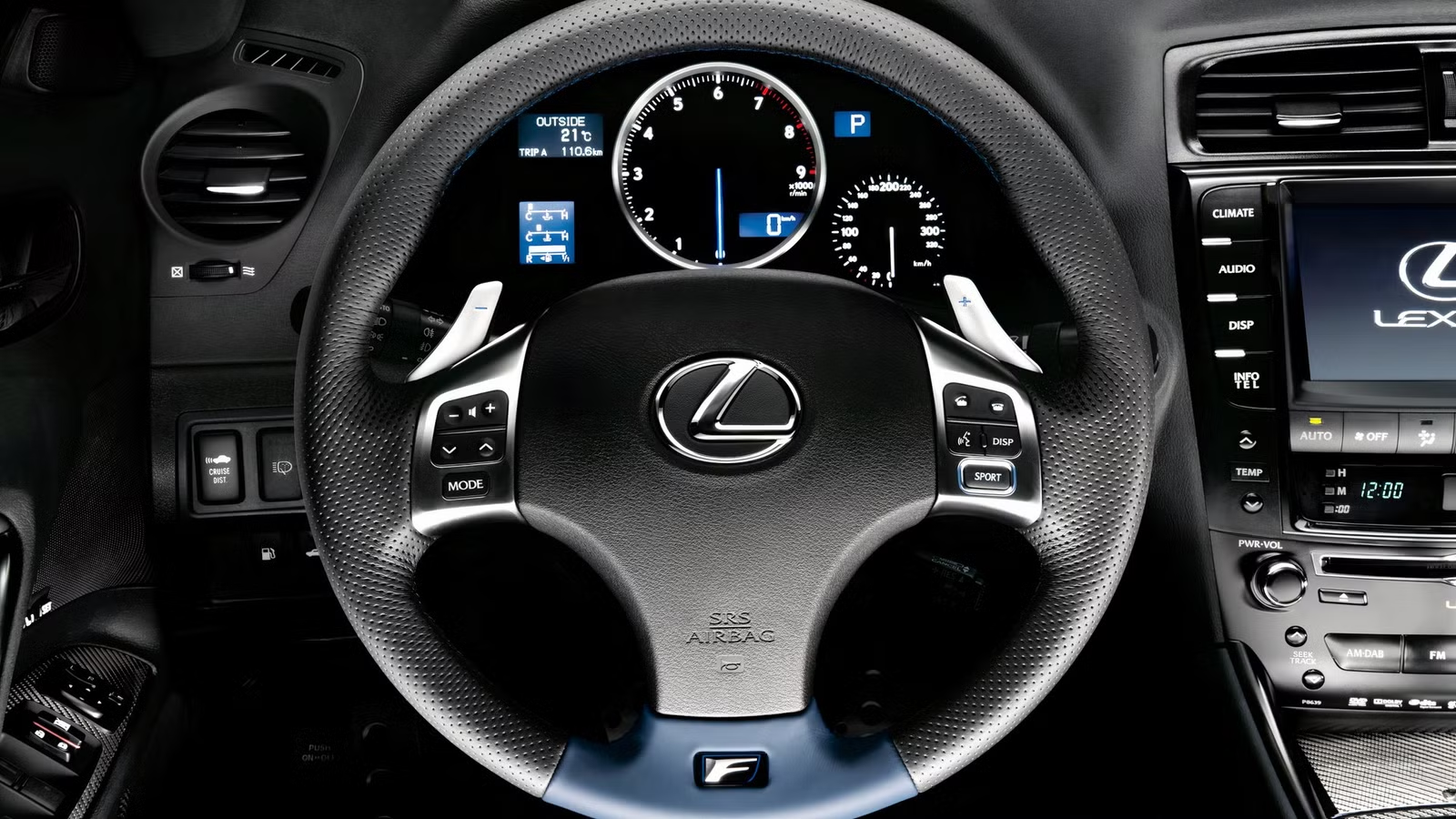
Grab a Kleenex to dry your eyes because the Lexus naturally aspirated V8 is dead. When I heard the news, I began sobbing quietly. The mighty 2UR-GSE engine debuted in the Lexus IS F as an evolution of Toyota’s UR‑series powerplant family, and it was one of the last naturally aspirated performance engines on the market.
Once you’re ready to move past the loss of the 5.0-liter V8, known by the engine code 2UR-GSE, you may find yourself interested in grabbing a second-hand copy to own a piece of the now-concluded Lexus V8 era. If so, you’d better move quickly, because prices are already rising, and fans are scrambling to snap them up. Read on for a closer look at what you need to know if you’re planning to preserve a little piece of your own 2UR-GSE history.
Pour One Out For One Of The Greats
2011 Lexus IS 350 F SportLexus
The 2UR-GSE crossed over peacefully to the highway in the sky earlier this month, with the end of Lexus LC 500 production. Born in Japan in 2008 to power the Lexus IS F, the 2UR‑GSE grew into a symbol of potent Japanese performance through its Yamaha‑tuned, overbuilt, high‑revving, and blessedly analog demeanor in a world of increasingly turbocharged and hybrid-powered competitors. Throughout its life, the 2UR-GSE powered some of Lexus’s most dazzling cars: the IS F, RC F, GS F, and ultimately the LC 500, which became its final resting place.
After its 2008 launch in the IS F, 2015 brought the second act of Lexus’s five-point-oh, when the two-door RC F refined the V8’s hardware and software to add power and brought the latest high-tech chassis enhancements for even higher performance. In 2016, the engine powered the larger GS F, and it ultimately retired to the LC 500 in 2017.
A free-breathing unit that could rev to the moon, this powerplant leaves a legacy of durability, character, and motorsport-proven design that influenced years of success. With its passing, Lexus closes the chapter on naturally aspirated performance, and enthusiasts worldwide mourn not just an engine, but the end of a philosophy built around shaping combustion into a crafted response, sound, and soul. Perhaps thanks in part to the work with Yamaha, the 2UR-GSE made a noise tuned like a musical instrument. It should be remembered with fondness, not sadness.
Values Are Already Swelling
2009 Lexus IS F front 3/4Bring A Trailer
As of 2025, the growing popularity of used Lexus ‘F’ models reportedly had them holding value better than German sport sedans. This was partly because competitors require fairly intensive ongoing maintenance and repairs to keep them ticking. These costs are well understood in the marketplace and fairly predictable, making them easy to factor into your purchase decision if you’d rather have something German. Still, sticking with the Japanese option generally raises far fewer concerns about potentially pricey upkeep.
As CarBuzz reported earlier in 2026, this reliability angle is helping support rising prices for exclusive, naturally aspirated performance sedans like the IS F. Since 2019, it has risen in value by about 10%.
“As more and more sedans – internal combustion and otherwise – get discontinued, expect both the Lexus IS F and BMW M3 to continue to appreciate in value. Although buying a car for investment purposes is almost always a bad idea, if you’re going to have some fun behind the wheel anyway, it’d be nice to have something to show for it when it comes time to trade in.”
Online sales results show that the average 2007-2014 Lexus IS F has increased in value by more than $1,500 in the last three months. The model’s depreciation curve has flattened out and actually shows a slight reversal. That’s an early sign that interest in the now-discontinued engine may be driving up demand (and pricing) in the used market.
Data from CarGurus shows used Lexus prices up nearly 10% year over year overall, with sales prices for the IS lineup as a whole up 13% this year, though the IS F isn’t called out as its own sub-model.
Other elements of the collector’s classic recipe are present in the IS F. It features an end-of-an-era performance engine in a trim level that’s in relatively low supply. The IS nameplate is still around, but there’s no sign of a V8 going under the hood again after the discontinuation of the IS 500 in 2025.
Remember, the IS F isn’t the only way to access that 5-liter V8. Looking at the two-door RC F alternative, even more price growth is apparent: towards the end of 2025, average sale prices were around $32,000. Eight months later, in July 2026, the average price for this model had climbed to over $48,000. Cut the supply of a loved performance car (or engine) while interest is still simmering, and demand (and pricing along with it) can spike as a result. This is what we’re seeing here.
“Little could be more exciting than the pure exhaust roar of a set of pipes that don’t exhale through a snail-shell, especially when those exhausts live on a seductively tuned V8 engine. That could be why two of the last naturally aspirated sports sedans ever – the E90 BMW M3 and Lexus IS F – are increasing in value. The V8s in these four-doors combine exotic noises and a thrilling redline for a driving experience that’s almost impossible to recreate today.”
– CarBuzz
When I reviewed the IS-F in 2008, I found it interesting that one of the loudest sedans in the performance sedan scene that year came from a manufacturer known for making some of the quietest. Most impressively, that test drive revealed an angry V8 engine that kept much of the eerie smoothness of the near-silent 4.6-liter unit it’s based on. In the punched-out 5.0-liter version, a tasteful but ever-present exhaust drone tells drivers a lot is going on under the hood. Still, it’s not a rev-monster like a BMW M3 or Audi RS4, more ‘Harley’ than ‘Street Bike’ when it comes to sound effects and revs.
What You’re Paying Right Now
2008 Lexus IS F close-up rear angle in blueLexus
As of this writing, IS F shoppers can expect to pay around $25,000 for a starter model, with higher-mileage examples from early production in 2008 or 2009 often at 150,000 miles or more. Extreme high-mileage outliers included one example with 250k miles for just $12,000.
2014 Lexus IS F Manufacturer Specifications
Engine Type
V8, 90-degree; aluminum block and heads
Engine Designation
2UR-GSE
Valvetrain
DOHC, 32-valve; Intake VVT‑iE, Exhaust VVT‑i
Displacement
5.0 Liters
Bore × Stroke
3.70 in × 3.52 in
Compression Ratio
11.8:1
Horsepower
416 hp @ 6,600 rpm
Torque
371 lb‑ft @ 5,200 rpm
Redline
6,800 rpm
Fuel System
SFI D‑4 direct injection + secondary port injectors
Fuel Requirement
91‑octane premium unleaded
Emission Certification
ULEV II
0–60 mph Acceleration
4.6 sec (manufacturer result)
Top Speed
170 mph (electronically limited)
Quarter‑Mile Time
13.0 sec (manufacturer result)
EPA Fuel Economy
16 / 23 / 18 mpg (city / highway / combined)
Coefficient of Drag
0.30 Cd
Moderate-to-high-mileage units from 2008 to 2011 cluster widely between $25,000 and $35,000, often with 85,000 to 130,000 miles on their odometers. From the high-thirties to the mid-$40,000s, look for plenty of sub-85,000-mile units from 2011 or 2012. If you’ve got $45,000 to $60,000 to spend on your IS F experience, you’ve got access to most of the lowest-mileage, final-run copies on the scene. Note that the 2011+ models command a premium because of a facelift, suspension revisions, and cosmetic tweaks over earlier cars. Stick to a 2010 or older unit if you need to save a few bucks.
Key Pros And Cons
Lexus IS F 5.0L NA 2UR-GSE V8 Engine and TransmissionLexus
There are a few key reasons to consider a used IS F, and a few good reasons not to. If this will be your first performance car, remember that it’s not a Corolla designed to go 100,000 miles on oil changes and maybe an air filter or two. To keep your IS F ticking and healthy, maintenance and care are more aggressive, which makes upkeep pricier. If you can’t resist the temptation to stuff your foot to the firewall at every opportunity (good luck), then expect a particularly hefty gas bill, too.
2008-2010 Lexus IS F Red Front ViewLexus
Oil and fluids may cost more than you’re used to and likely require more frequent changes. As the IS F ages, some parts may fail because of age, not necessarily just use and mileage. RepairPal data suggests owners average an annual repair cost of $531, with the priciest issues including parking brake cable replacement (up to $1,156), sunroof motor replacement ($2,329), and air conditioning trouble that could require a new expansion valve for about $1,500.
Also, you need to run high-performance tires and brake parts on your IS F, and you’ll likely be replacing them more often than you’re used to. Take good care of the brakes, all fluids, and the tires, and the IS F can reward you with a track-day experience that’s built to thrill while standing up to the heat. When you’ve finished stretching the V8’s legs at high speed on a closed course, you can cruise back home in comfort and relative quiet, too. Point is, whether you’re looking to commute, tour, drift, or head to the track for some lapping, the IS F is ready for action. This flexibility is a major pro.
Still, note that a newer alternative for the same money could provide shoppers with access to a more advanced array of safety and connectivity features not available in the IS F. Ultimately, this is an emotional purchase that’s less about the spreadsheet and dollar figures, and more about your willingness to keep a little but important piece of performance motoring history around for as long as possible.
Sources: Lexus, Classic.com, CarGurus.com, Yamaha, Auto123.com, LexusEnthusiast.com
