

Geopolitical shocks around the world have some EV advocates rubbing their hands with glee. They’re imagining how skyrocketing gasoline costs could push people further toward electrification as they try to remove the threat posed by oil prices from their lives. And people do seem to be rushing toward EVs in many parts of the world, where global electric car sales were up 35% from the first to the second quarter of 2026.
The picture is not so clear in the US, where battery electric sales fell almost 24% during the first half. In America, it seems, people are looking at electrification in a different light.
The Second Quarter EV Rebound Was Real
2024 – 2026 Chevrolet Equinox EV 1st Gen SUV charging portChevrolet
Global electric car advocates didn’t have much to celebrate at the end of March 2026, as first-quarter volume was down approximately 8% year-over-year due to weaker demand in both China and the US. However, things would start improving in the second quarter and global electric car sales were actually up 35% compared to those sluggish first three months. The second quarter’s volume was also 4% higher than a year earlier, despite a roughly 5% decline in the wider global car market during the first half.
As part of this second-quarter improvement, 50 countries went on to set quarterly electric car sales records. These included India, Brazil, Australia, South Korea, and Vietnam, all of which doubled electric car sales between March and June compared with the same period the preceding year. Looking at the first half of the year in its entirety, records show that more than 90 countries recorded year-over-year growth.
Such was the strength of the second-quarter performance that it virtually erased the global EV market’s first-quarter deficit. First-half electric car sales ended up only slightly below the equivalent 2025 period, with EVs representing around 24% of all new cars sold globally. From a big-picture perspective, the International Energy Agency (IEA) expects electric cars to represent 29% of global sales for 2026 as a whole.
Of course, it’s important to remember that, in IEA terms, the electric car category includes both battery electric vehicles and plug-in hybrids but not conventional non-plug-in hybrids like the Toyota RAV4 Hybrid. This can sometimes muddy the waters when it comes to looking at actual growth statistics, as, after all, most would consider the Toyota RAV4 Hybrid to be part of the broader electrification initiative.
A lot of this interest in EVs is connected to significant tensions in the Middle East and the raw oil connection. Brent Crude was recording almost $118 per barrel at the end of the first quarter as disruptions through the Strait of Hormuz choked off international petroleum flows. And that market has tended to behave like a yo-yo since then, due to political and other issues and seems likely to remain highly volatile.
In early August 2026, Brent was trading at just under $80 as the markets were assessing Iran-Oman negotiations around the Strait of Hormuz, with the possibility of more reliable shipping through the strait. But the second-quarter EV rebound may have been a response to the headline $120-per-barrel figure and a sign that car buyers were seriously assessing the overall state of play.
America Was Moving In The Opposite Direction
2016 Toyota RAV4 Hybrid rearToyota
While global figures point to a strong increase in EV adoption, figures in the US were rather different. Kelley Blue Book suggests that Americans bought 247,226 BEVs during the second quarter of 2026, and while that was a 14.7% sequential improvement over the first quarter, it was still 20.5% lower than in Q2 2025. In terms of US new vehicle sales, BEVs accounted for only 5.8%.
When looking at the entire first half of 2026, US EV sales fell by 144,761 vehicles compared to 2025, a drop of 23.8%. Most of the damage happened in the first quarter, when US EV sales were down 27.3% year-over-year. However, the contraction narrowed to 20.5% in Q2, so the market may be stabilizing but not exactly recovering in the conventional sense. This is even more apparent when you consider that second-quarter demand was more than one-fifth below its year-earlier level.
While BEVs were not exactly the flavor of the month in the US, hybrid electric vehicles were moving in the opposite direction. One estimate suggests that US hybrid sales increased approximately 9% during the first half of 2026, even as the overall new vehicle market shrank by roughly 2.2%. Elevated gas prices would certainly have helped, but there was also an increasing number of hybrid SUVs and pickups coming into the marketplace. Underneath all these figures seems to be a trend where Americans are increasingly distinguishing between BEVs and hybrids and not treating all electrified powertrains as one solution.
The Global Boom Includes Cars Not Available In America
2026 BYD Dolphin Mini EVBYD
While an increasing number of people may be inclined to swap out a gas guzzler for something electric, the oil shock alone may not always be enough to make them act. After all, the overall price of a new vehicle certainly comes into the picture, and this may explain why the same oil shock can produce different buying behavior in different countries.
This is where Chinese automakers like BYD come into the picture. The IEA estimates that production costs for Chinese OEMs are roughly 35% lower than those of manufacturers in other advanced economies, and that, of course, translates into lower sticker prices. And those lower purchase costs help explain why Chinese EV exports are up more than 120% year-over-year during the first half of 2026, which is starting to transform markets in many countries. EVs now represent approximately 45% of Chinese car exports, and this boom in exports for Chinese manufacturers is fully compensating for lower electric car sales at home.
American consumers are largely insulated from that Chinese revolution. Section 301 tariffs in the US imposed 100% surcharges on Chinese electric vehicles in 2024, and that’s on top of separate 25% Section 232 auto tariffs and the normal import duty. This helps to prevent low-cost Chinese EVs from competing directly in the US market, so American buyers don’t have as much choice as their counterparts in some overseas countries. So, when it comes to electric vehicles, those Americans are looking at comparatively expensive domestic or allied market EVs against an enormous supply of used hybrids.
A Used 2022 Toyota RAV4 Hybrid XLE Can Still Beat The Equinox EV Up Front
2022 Toyota RAV4 HybridToyota
Specifications
2022 Toyota RAV4 Hybrid XLE
2026 Chevrolet Equinox EV LT 1
Engine
2.5-liter gasoline-electric hybrid
Single-motor battery-electric
Transmission
eCVT
Single-speed reduction gear
Drivetrain
Electronic AWD
Front-wheel drive
Power
219 hp
not published
Torque
220 lb-ft
243 lb-ft
EPA combined efficiency
40 mpg
108 MPG-e
Representative price
$29,896
$36,795 including dest.
To get a better picture of what US shoppers are facing, it’s interesting to make a budget-based comparison between a new 2026 Chevrolet Equinox EV LT 1 and a used 2022 Toyota RAV4 Hybrid XLE. The used Toyota is currently around $30,840 according to the CarBuzz Marketplace, and gets consumers a vehicle that returns 40 mpg combined and comes with electronic all-wheel drive. The front-wheel drive Equinox EV LT 1 has a starting price of $36,795 including destination, an EPA-estimated range of 319 miles, and is rated at 108 MPG-e combined.
Back-of-the-envelope math using those exact figures makes the Chevrolet $5,955 more expensive than the representative used Toyota, before taking into account taxes, financing, dealer charges, incentives, or home charging installation. And when it comes to consumption, the 40 mpg RAV4 would, at an average of around 12,000 miles per year, consume roughly 300 gallons. At an indicated national gas average cost of $4.09 per gallon, its annual fuel cost would therefore be approximately $1,227.
Meanwhile, the Equinox’s 108 MPG-e rating would consume around 3,744 kWh of power over the same distance. Using a national residential electricity average of 18.44 cents per kWh, home charging would cost around $690 per year, so the Chevrolet would save approximately $537 per year on energy.
With those figures on the spreadsheet, it’s possible to conclude that it would take around 11 years to recover the $5,955 purchase price difference on energy savings alone. And that result could change dramatically for a driver who’s dependent on paid public charging. Using an AAA figure of 42 cents per kWh as a national public charging average, Equinox charging would cost approximately $1,573 for those 12,000 miles, roughly $346 more than the cost of fueling the RAV4 at $4.09 per gallon.
Of course, other factors come into the picture from an ownership cost comparison. The Chevrolet is new and comes with full factory warranty coverage, and it ought to require less routine powertrain maintenance. Factors like insurance, depreciation, financing, electricity plans, and local incentives could all alter the outcome.
But when looking at the decision to buy, it’s possible to see why some American consumers still choose a hybrid despite that expensive gasoline. The home charging side of the picture may make the Equinox cheaper to power, but its energy cost advantage will certainly not arrive immediately. And public charging could eliminate that energy saving altogether.
Hybrids Have Become America’s Fuel Shock Hedge
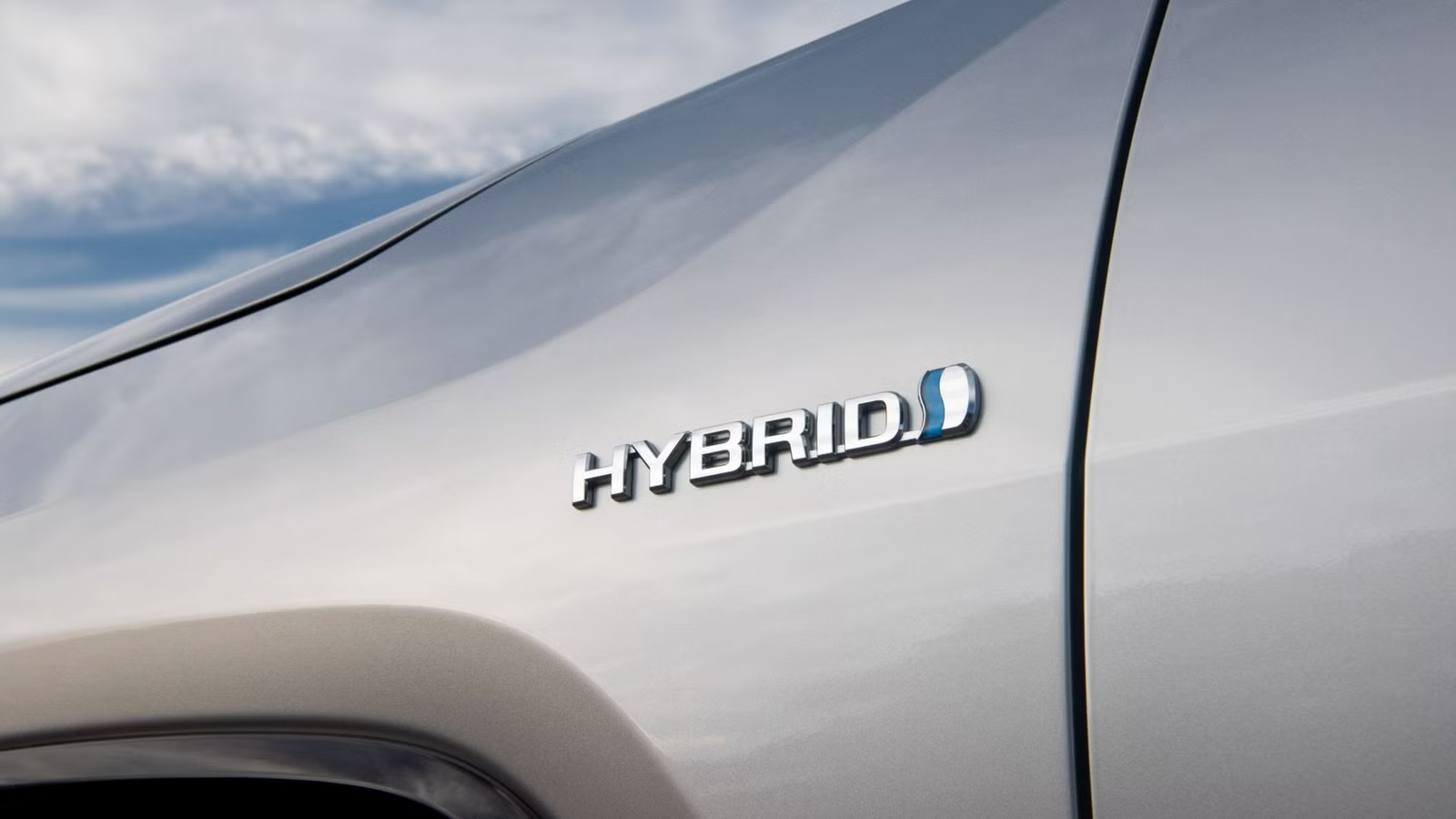
2025 Toyota RAV4 Plug-in Hybrid exterior detail shot of the PHEV BadgeToyota
Government actions have also served to slow adoption of BEVs in the US. After all, the federal Clean Vehicle Credit of up to $7,500 expired in the fall of 2025 and that choked off a lot of demand. This meant that America entered the subsequent energy crisis with not only fewer federal incentives but limited access to low-cost Chinese EVs and significant uncertainty around charging and resale values. Against that backdrop, hybrids offered an immediate alternative without asking owners to plan charging stops, install equipment, or depend on public infrastructure.
A consumer survey by the Pew Research Center found that 44% of Americans would seriously think about buying a hybrid, versus 32% considering an EV, but that split is not necessarily explained by gas prices alone. After all, American drivers face a very different scenario from that of some of their counterparts in other countries. They have to think about different vehicle prices, incentives, tariffs, charging costs, and used car choices. And when it’s time to make a decision about their next car, the answer is often produced by a spreadsheet.
Sources: Toyota, Chevrolet, Pew Research Center, IEA, Kelley Blue Book, U.S. Energy Information Administration, AAA, US Trade Representative, Cox Automotive.
