

The contrast between old-school toughness and modern refinement has never been clearer than when comparing two of Mopar’s most popular and widely used V8s. The 2026 Ram 1500 and the massively powerful Jeep Wrangler 392 both showcase the brute power and smart efficiency of the late model Hemi V8.
However, many enthusiasts still prefer the straightforward simplicity of the older 5.9-liter Magnum V8. The Magnum, with its basic architecture and strong low-end torque, represents an era when engines were built for longevity and ease of repair or modification. Far from the overly complex and technological advancements of a modern engine, is the Magnum good enough to surpass the mighty Hemi?
If your vehicle is experiencing any of the problems listed below, it is advisable to have it inspected by a trained technician for an accurate diagnosis and repair.
5.9 Magnum vs 5.7 Hemi
The Birth Of The 5.9-Liter Magnum Engine
1994-2001 Dodge Ram 1500Dodge
The Magnum line of engines was a workhorse for Chrysler/Dodge, with the 3.9-liter V6 and the 5.2-liter V8 being released in 1992. The larger 5.9-liter Magnum V8 was released for the 1993 model year, with a big 8.0-liter V10 being made available for the 1994 model year. The Magnum engine is an updated version of the long-standing LA engines that were used from 1964 to 1991. Core LA engines included 273, 318, 340 and 360 cubic-inch V8 engines.
For the 1992 model year, Chrysler introduced an updated and revised version of the LA engine called the Magnum. Although the Magnum engines, for the most part, shared the same size as the older LA engines, almost no parts are interchangeable. In fact, the only parts that were left unchanged were the connecting rods. Key changes were made to guarantee that the new Magnum would deliver more power and a better ownership experience.
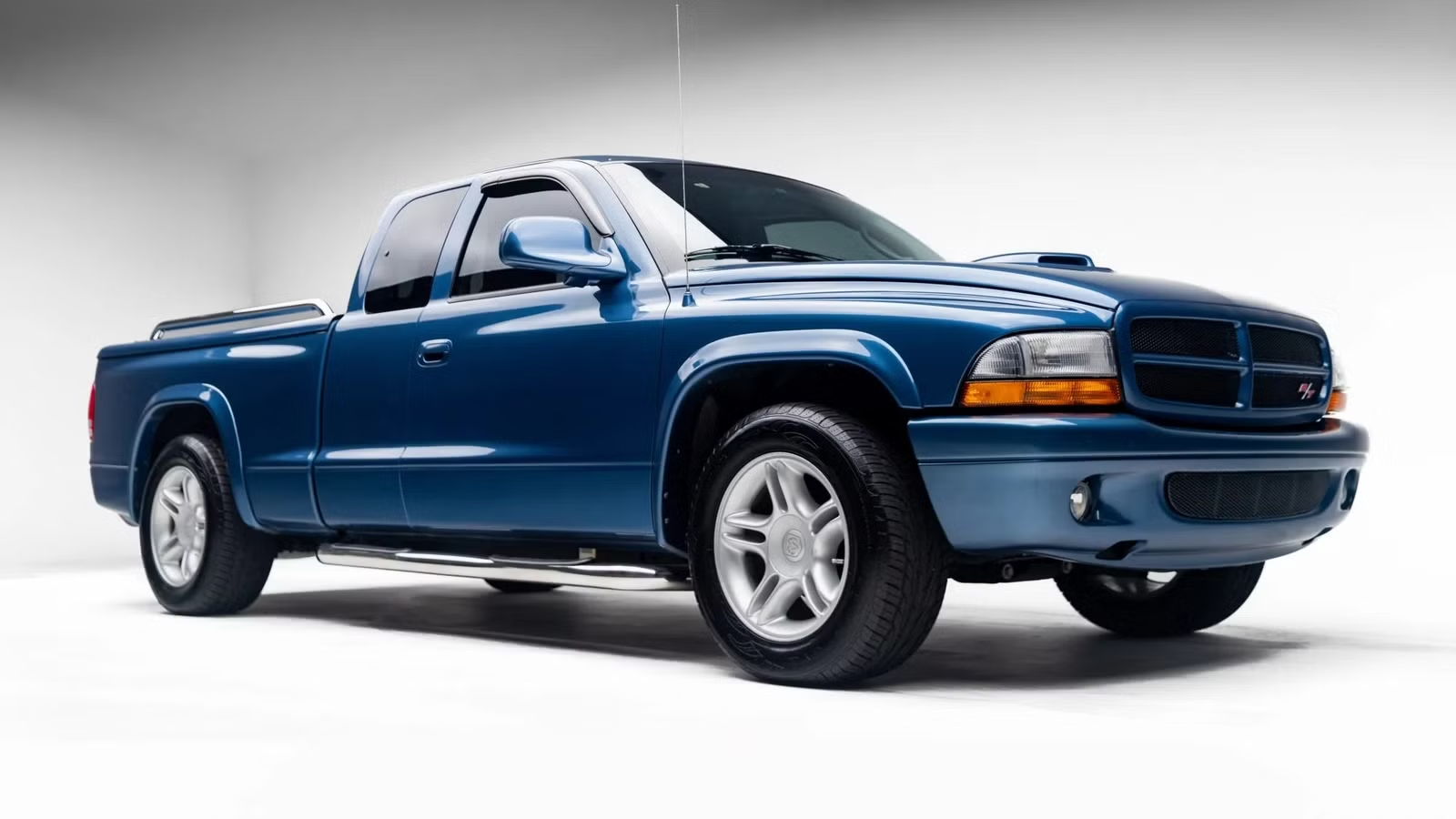
1998 Dodge Dakota R/TBring a Trailer
The Magnum engines were a vast improvement over the LA series of engines, combining a successful and time-tested engine architecture with the modern advancements and efficiency of fuel injection, advanced ignition and electronic engine control systems.
The early to mid-1990s saw a greater demand for pickup trucks and SUVs. The Magnum gave Dodge trucks and SUVs competitive power and reliability while maintaining daily use efficiency and meeting strict emissions requirements. These engines were used in the Dodge Dakota, Dodge Durango, and Dodge Ram 1500/2500 vans and pickup trucks. In addition, the first-generation Jeep Grand Cherokee utilized the powerful Magnum V8 engines as well.
The 5.9-liter Magnum was not only used in the full-size Ram trucks, but also special performance models such as the Jeep Grand Cherokee 5.9 Limited, Dodge Dakota R/T, and the Dodge Ram 1500 SS/T muscle trucks.
Return Of The Hemi
Exterior view of the Chrysler 300Chrysler
By the early 2000s, the Magnum engines were struggling to meet ever-tightening emissions regulations and remain competitive in a segment where the bar for horsepower and capability was on a steady rise. Chrysler needed a modern replacement for the Magnum that could deliver significantly more performance, while maintaining efficiency and meeting emissions requirements. This replacement did have big shoes to fill as the Magnum platform had earned a good reputation for itself. Recognizing the enormous marketing potential of the popular and familiar “Hemi,” Chrysler delivered the new 5.7-liter Hemi V8 for the 2003 model year, and the people rejoiced.
This was more powerful and efficient than the old Magnum engines that it replaced and worked well across several popular models. Later variants were larger and made even more power, like the 6.1-liter and the 6.4-liter used in higher performance models like the earlier SRT8 vehicles, and Scat Pack versions of the Dodge Charger and Challenger. In 2025, Ram halted availability of the Hemi V8 in the half-ton Ram trucks. However, amid a major backlash from Ram truck fans and perspective Ram customers, the powerful 5.7-liter Hemi V8 was once again made available for the 2026 model trucks.
Dodge
“One of the building blocks of the turnaround of this company.”
– Dieter Zetsche, Chrysler Group CEO (at the time)
Construction, Performance, And Capability
The 5.9-Liter Magnum
2000 Dodge Dakota 5.9Dodge
The Magnum had a block that was nearly identical to that of the LA engine family. It had five main bearings, used a cast steel crankshaft and the connecting rods were forged steel. Coolant passages were cast between the cylinders, while a gerotor-type oil pump was used to supply lubrication to vital engine components. Oil seals on the crankshaft were redesigned to provide better resistance to oil leaks and a thicker gauge steel was used for the oil pan, along with an improved silicone-rubber gasket that was to be more leak-resistant.
The fuel system was completely new and comprised of two fuel rails that provided fuel to the eight Bosch-type electronically actuated fuel injectors. Located on the return side of the fuel rail, a vacuum-controlled fuel pressure regulator modulated fuel pressure. This ensured that any unused fuel was sent back to the fuel tank.
Part of the trademark aesthetic of the new Magnum engines was the unique upper intake manifold. Often referred to as the “beer keg” manifold, the intake resembled half of a barrel lying on its side in the center of the engine. The head design was another major change from the LA engine. Designed to meet the strict requirements of emissions but still offer competitive power, the heads were cast iron units with wedge-shaped combustion chambers and “high-swirl” valve shrouding.
Dodge 5.9 liter Magnum V8 engine bayBring A Trailer
The standard 5.9L Magnum engine produced 230 horsepower and 325 lb-ft of torque, while the heavy-duty version would produce 330 lb-ft of torque. Additionally, for the 1998 model year, horsepower was increased to 245 horsepower and 335 lb-ft of torque as seen in limited production models like the Jeep Grand Cherokee 5.9 limited and the Dodge Dakota R/T.
The 5.7-Liter Hemi
Third Gen Dodge Ram 1500
Dodge
This new third generation Hemi was completely new and shared nothing with the Magnum series of engines. Still at 90 degrees, this 345 cubic V8 uses a cast nodular iron crankshaft with four bolts main bearing caps. The 5.7-liter retains a traditional push rod design and uses aluminum cylinder heads with only two valves per cylinder. Of course, to live up to its namesake, the Hemi had hemispherical combustion chambers and included two spark plugs for optimal performance and efficiency.
To further achieve improved fuel economy, the 2005 Hemi engines included a multi-displacement system (MDS). This system turns off fuel in four cylinders (two in each bank) and keeps both intake and exhaust valves closed via oil pressure modulation through the corresponding lifter of the cylinder being shut off. Initially utilized on only select models like the Chrysler 300C and the Dodge Magnum R/T, by 2006 the fuel-saving MDS was expanded to light trucks and SUVs as well. The MDS was engineered with the best of intentions, but would ultimately prove problematic for this otherwise much-loved power plant.
Stellantis
This potent new Hemi engine delivered 345 horsepower and 375 lb-ft of torque when in the Dodge Ram pickup truck, while some models like the Chrysler 300C and the Dodge Magnum received a different tune that put out 340 horsepower and 390 lb-ft of torque. The latest version of the 5.7-liter Hemi includes eTorque, a mild hybrid system. This ensures even greater fuel economy and capability, with horsepower now at 395 horsepower and 410 lb-ft of torque, including an additional 130 lb-ft from the eTorque system.
Reliability And Common Problems
Common Problems
GM LQ4 V8 camshaftI Do Cars, YouTube
The introduction and utilization of both of these engines marked significant time in engine advancement and technology for the brand. Additionally, these engines helped usher in some of Dodge and Chrysler’s most memorable and impressive vehicles in recent history. However, either engine was not without its usual problems.
The 5.9L Magnum is well known for its longevity and reliability, but it’s also known for upper plenum leaks. This causes rough running, illuminated check engine lights, and a loss of power and fuel economy. Heavy oil consumption is also experienced, as the failure of this gasket allows oil to be drawn into the intake manifold, ultimately ending up in the combustion chamber. Although the Magnum did use an improved head design from that of the older LA engines, the improved heads did develop a reputation for cracking at the valve seats, leading to even more oil consumption problems, decreased power, overheating, and white smoke.
Lifter failure (Source: gavi3000i/LS1Tech)
The third-generation Hemi is another story. Smaller, more powerful and far more technologically advanced than the older Magnum engines, it introduced some significant reliability concerns. Early versions (primarily 2005–2008) were known for dropped or cracked valve seats and broken valve springs. Starting in 2009, however, the Hemi became widely associated with the dreaded “Hemi tick.” While some pre-2009 engines experienced lifter failures, the problem was far more common on the 2009 and later engines.
The Hemi tick typically occurs when a roller lifter fails and destroys the corresponding camshaft lobe – most often (though not exclusively) on the cylinders deactivated by the MDS. This issue was especially concentrated on the engines equipped with the revised valve train and variable valve timing (VVT) introduced in the 2009 “Eagle” redesign.
“The MDS was part of the engine’s original design. This resulted in a cylinder deactivation system that is elegantly simple and completely integrated into the engine design.”
– Bob Lee, Director of Rear-Wheel Drive Engineering, Chrysler
The Verdict For Buyers And Builders
2010 Jeep Grand Cherokee’s 5.7-liter HEMI V8 Engine logo/badge.Jeep
The debate for supremacy between these two engines is similar to that of the ongoing big block versus small block discussion. The truth is that these are two different engines that offer great advantages over each other. Both engines are generally reliable, especially when properly maintained. The 5.7-liter is more technologically advanced with its MDS, even though that same system has proven to give it some issues. The 5.9-liter, however, is a much simpler design, lending to its reputation for outstanding reliability and longevity.
As far as power and capability are concerned, the 5.7-liter Hemi comes out victorious. The Hemi easily outperforms the Magnum in the horsepower department. Thanks to advancements in engine technology, the Hemi is capable of much higher horsepower and torque than that of the Magnum V8. So, if horsepower and efficiency are the priority, the 5.7-liter Hemi may be the best choice.
The 1979 Dodge Li’l Red Express engine… a 5.9-liter small-block V8 making 225 hp.Bring A Trailer
For those looking for the simplicity of the 5.9-liter Magnum but higher horsepower of the Hemi, a 5.9L Magnum crate engine is available through many suppliers. This ready-to-install solution delivers the classic Dodge 5.9L Magnum engine with modern reliability. Additionally, for those enthusiasts that really want to compete with the power of later model engines like the 6.2-liter Hellcat engine, a 5.9L Magnum supercharger kit can be had for the ultimate performance from this old-school platform.
Whether you prefer the modern strength of the Hemi or the rugged simplicity of the Magnum, both V8s represent important chapters in Chrysler/Dodge engine options, and both engines still have plenty to offer today’s drivers and enthusiasts.
Sources: Ram, AllPar, Car Complaints
