

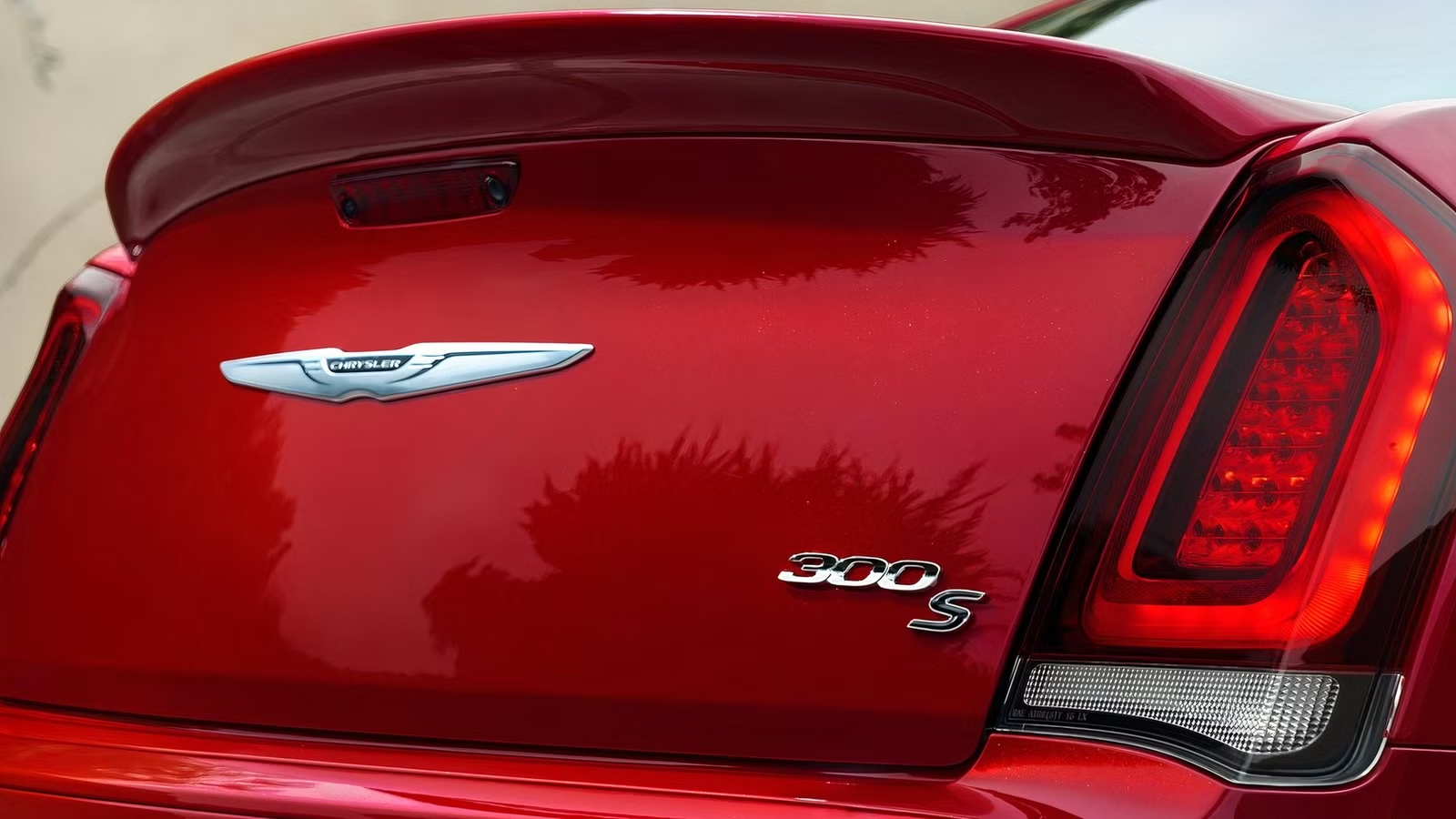
Once a popular segment subtype, the old-school rear-wheel-drive V8 muscle sedan is now a rarity in the mass market, especially naturally aspirated examples. Fifteen years ago, there were more options, including the Pontiac G8 GXP. These days, though, things have become quite different, with no domestically produced, naturally aspirated rear-drive V8 sedan on the market.
However, just a few years ago, one of the last holdouts of the subtype was taken from us. It was the Chrysler 300S, which packed an optional 5.7-liter Hemi V8 under the hood, rear-drive, and full-size comfort inside. It also wasn’t all that expensive when it was new, especially when compared to something like the Dodge Charger Hellcat or Scat Pack. Nowadays, you can pick up a clean, used Hemi-powered Chrysler 300 for much less than $20,000.
The 300S Accidentally Became The Final Traditional American Sedan
2023 Chrysler 300SStellantis
The 300 series was one of Chrysler’s most revered nameplates. It entered the fold in 1955 as a high-performance luxury model boasting 300 horsepower. The model series was carried through 1971, when Chrysler axed it entirely.
Come 2005, the nameplate was brought back into the fold as the marque’s flagship model, bred to compete with the likes of Lincoln and Cadillac, as well as a whole host of European and Japanese luxury sedans. The modern 300 entered its second generation in 2011, with a facelift in 2014.
Throughout the 300’s modern revival, Chrysler has offered a 5.7-liter V8-powered iteration. By 2019, the model had found itself in a unique spot in the domestic market as being the final, understated, naturally aspirated V8 sedan with a rear-drive drivetrain. Backing up the big engine is an eight-speed automatic transmission. Owners were spoiled when it came to interior space, too, which further enhanced the 300S’ American-sedan-throwback feel.
Chrysler 300 SRT-8Stellantis
Rear-drive sedans dominated American roads throughout the latter half of the 20th century. The segment was by far the most popular in the country, and virtually every driveway had a brand’s full-size, domestically produced V8-powered sedan sitting in it. However, by the 1990s and 2000s, things had changed drastically.
Despite the changing automotive landscape, Chrysler clung to the old ways with the 300S. Of course, Dodge had also been hard at work building the Charger sedan throughout much of the modern Chrysler 300’s life, but the latter had a much more sophisticated, understated appeal. If you saw a V8-toting Charger pull up to the lights, it was either a police officer or someone with a loud exhaust and something to prove. However, a 300S with a Hemi pulls up to the lights, and you’d barely notice.
The Chrysler 300S goes beyond being just another sleeper, though. Because of its naturally-aspirated V8 and rear-wheel drive, it ended up being the last of its kind.
Old-School Muscle… In A Suit
2011 Chrysler 300 – front 3/4 angle Stellantis
Sitting underneath the Chrysler 300S’ stately hood is a 5.7-liter Hemi V8, arguably the most popular iteration of the fabled engine over the last quarter-century or so. When it comes to power output, a 2019 Chrysler 300S can chuck out 363 horsepower without skipping a beat, alongside 396 pound-feet of torque. For the 2023 model year, Chrysler revamped the mill’s estimated output figure to 372 hp.
Using the 5.7-liter Hemi, the 2019 Chrysler 300S is capable of running a 0-60 mph sprint in just 5.3 seconds. Keep in mind that the 300S weighs 4,013 pounds. In a quarter-mile sprint, the 300S reaches the trap in 14.4 seconds at a speed of 94.1 mph. If you keep your right foot mashed into the carpet, you’d eventually reach a top speed of 130 mph.
Chrysler
The engine itself is surprisingly simple for a modern unit. It’s made up of a deep-skirt cast-iron engine block mated to a pair of aluminum cylinder heads. It’s a pushrod design, as well, meaning its camshaft is buried underneath the cylinder heads. However, the Hemi employs both variable valve timing and variable displacement tech, the latter of which allows two or four cylinders to shut down during cruising or light-load situations.
There’s something to be said about naturally aspirated power. Turbocharged engines can suffer from lag, with limited power until the turbine takes a moment to spool up and make boost. A naturally aspirated engine is also simpler to maintain and cheaper to repair overall should something happen. Not to mention, a V8 without any sort of forced induction provides a great soundtrack.
Because of its very discreet and, frankly, old-man-ish styling, many pure-blooded V8 enthusiasts overlooked the Chrysler 300S in favor of louder, more in-your-face models like the Dodge Charger. However, this is actually good news for bargain-hunting V8 lovers who are currently car shopping.
Depreciation Turned It Into One Of America’s Best Performance Bargains
Side profile view of a Chrysler 300Chrysler
Rear-drive, V8 power is all well and good, but the Chrysler 300S also has another ace up its sleeve because it’s an exceptional used value. When new, a 2019 model fetched approximately $36,395 before any destination fees, taxes, or other costs were factored in. However, with the optional 5.7-liter Hemi V8 selected, the base MSRP rose to $39,395. A final-year 2023 model cost roughly $47,000 with the Hemi factored in.
As of today, 2023 model-year examples still trade hands for prices around the low $30,000s. Of course, that’s because some of these models will still have small portions of their factory warranties left, along with a huge time window to take advantage of factory-certified warranties. That’s not bad, as it costs the same, and is way more interesting than a new Honda Accord.
The 2019 model-year examples are, in reality, the true bargains. As it stands now, a 2019 would fetch about $16,641 on the open market with average odometer mileage and in good condition. The best part? You’re not giving up much by going a bit older because, in reality, it’s the same car.
If you’re gung-ho about getting one for yourself, just keep in mind that the $16,641 price isn’t all you’ll have to dole out. You’re going to need a couple of thousand bucks to cover taxes, registration, and any other administrative fees that your specific state or local government requires.
The depreciation cliff is real, and the difference between 2019 and 2023 Chrysler 300S values proves this. By going for a 2019 model, you’re going to spend less than you would on a new or slightly-used economy sedan, all while enjoying a full-fat Hemi V8, leather seats, and a reasonably refined build quality.
There Probably Won’t Be Another Car Like It
2011 Chrysler 300 – rear 3/4 angle Stellantis
The traditional rear-drive V8 sedan lacking forced induction is, truly, a thing of the past in the domestic market. As it stands now, the only rear-drive V8 sedan left here is the Cadillac CT5-V Blackwing, but that uses a supercharger. Other choices consist of foreign marques, most of which rely on forced induction, hybridization, or high price tags. The Chrysler 300S relied on none of those things, and still doesn’t to this day.
Yes, after a few years, the Chrysler 300S’ value fell off a cliff, and it’s good news for used buyers. But it does seem that its market value has been stabilizing lately. Because production ended in 2023 and the pool of unmodified V8 examples shrinks, its value is likely to rise naturally as more and more folks discover it for themselves. A healthy dose of V8-bred nostalgia, spurred on by the disappearance of the V8 as a whole, helps those values stabilize, too.
Let’s not be mistaken, though: the 5.7-liter Hemi-equipped Chrysler 300S will likely never fetch the same sort of money as, say, a used Dodge Charger Hellcat. But, hey, that’s good news for the average buyer. Because it’s overlooked, you can buy one for the price of a used Toyota Corolla. However, this affordability window may not last long.
Sources: Stellantis, CleanFleetReport.com, MotorMatchup.com, Car and Driver.
