

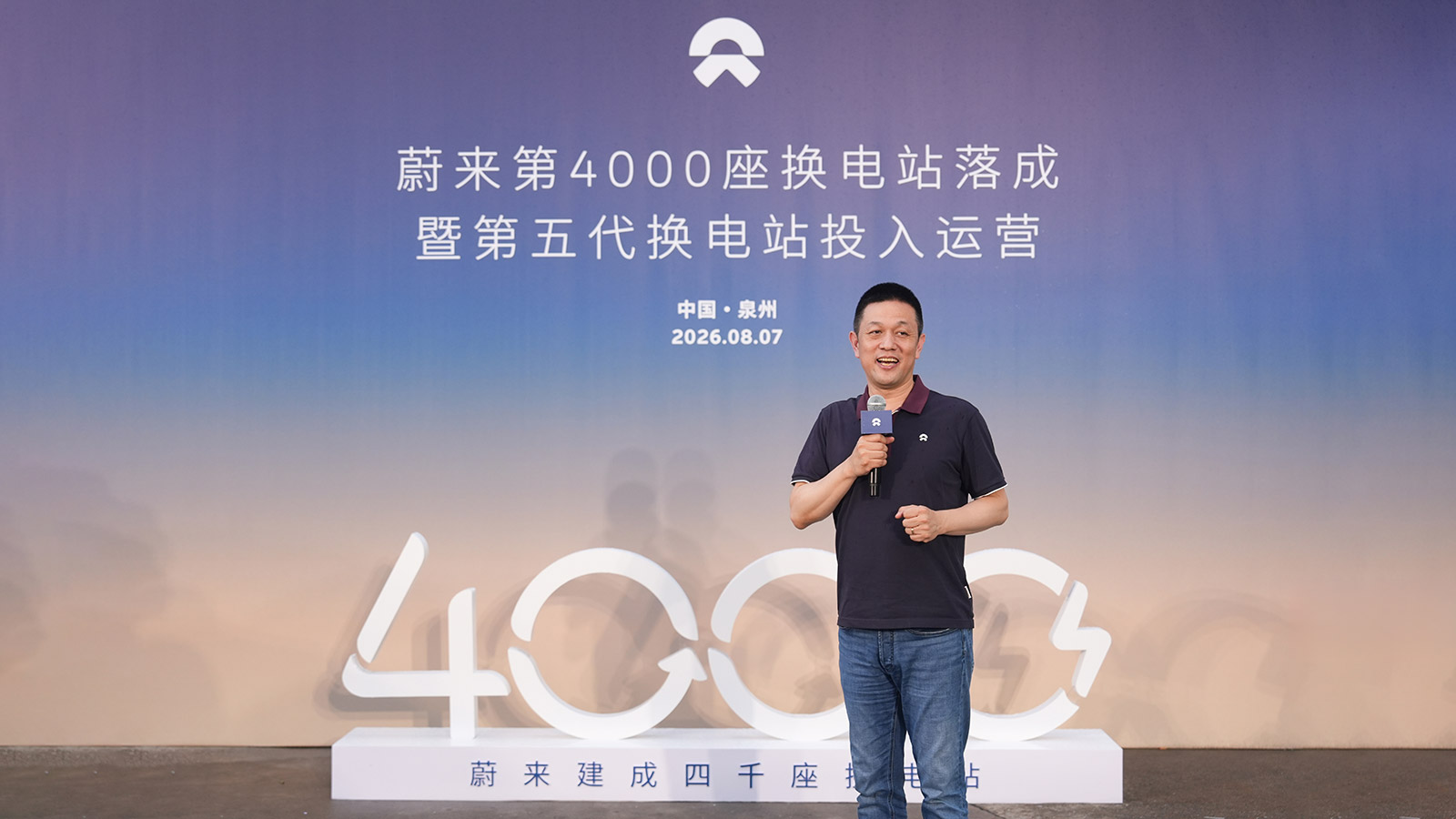
William Li, founder, chairman, and CEO of Nio, spoke at the launch ceremony for Nio’s first fifth-generation battery swap station. Credit: Nio
- William Li said Nio’s 120-kWh large battery pack is still being developed, without giving a timeline.
- Firefly will also get a bigger battery, arriving by the end of this year at the earliest and before the Chinese New Year holiday next year.
Nio Inc (NYSE: NIO) founder, chairman and CEO William Li said the company is still developing a 120-kWh battery pack, and that all Nio brand models will be able to use it.
At a face-to-face user event held on Friday in Quanzhou, Fujian province, Li was asked whether the ET9, the company’s flagship executive sedan, would get an exclusive, larger battery.
“We’re currently using a ternary battery system, and within the same standard pack, there will be a 120-kWh battery, which of course all vehicles can use,” he said, according to a Weibo post by auto blogger Dong Maimai.
Li did not disclose a specific launch time for the larger pack.
The remarks provide fresh clues about a product that has been in limbo for nearly three years. When Nio first unveiled the ET9 at Nio Day 2023 in December 2023, it said the vehicle would carry a 120-kWh battery pack with a cell energy density of 292 Wh/kg.
The pack was described at the time as supporting 5C fast charging, adding 255 kilometers of range in five minutes on Nio’s high-power chargers.
In a poster released in December 2023, Nio introduced its in-house-developed 46105 large cylindrical battery.
When the ET9 was formally launched in December 2024, however, it came with a 100-kWh pack and a CLTC range of 650 kilometers. Currently, all Nio models come standard with a 100-kWh battery pack.
Li’s comments suggest the 120-kWh pack will not be exclusive to the ET9, but will instead keep the dimensions of Nio’s standard pack, making it compatible with all Nio brand models in the battery swap network.
Nio currently offers 75-kWh and 100-kWh standard packs for its main brand in its battery swap network. A larger version, if launched, would lift the range ceiling without requiring changes to vehicle design.
Nio rolled out a 150-kWh semi-solid-state battery pack for main-brand vehicles several years ago, but never deployed it at scale because of its extremely high cost.
Nio today put its first batch of fifth-generation battery swap stations into operation in seven cities, with the site in Quanzhou becoming its 4,000th swap station in China.
The fifth-generation stations support wheelbases of up to 3.5 meters, making all models from the Nio, Onvo and Firefly brands fully compatible for the first time.
At the same user event, Firefly president Daniel Jin said the small-car brand will also get a bigger battery, targeting a launch before the Chinese New Year holiday next year, and possibly by the end of this year.
Firefly has just one model on sale, which comes standard with a 42.1-kWh lithium iron phosphate (LFP) battery pack and a CLTC range of 420 kilometers.
On LiDAR, Jin said Firefly was initially defined as a car that is fun to drive, though the company has taken note of demand for LiDAR-based smart driving assistance and is studying it. It won’t come in the short term, he said.
Nio’s main-brand models currently come standard with LiDAR, while the Onvo sub-brand fits it on higher-end trims.
The new stations support wheelbases of up to 3.5 meters, allowing the Nio, Onvo and Firefly brands to share the network.
