

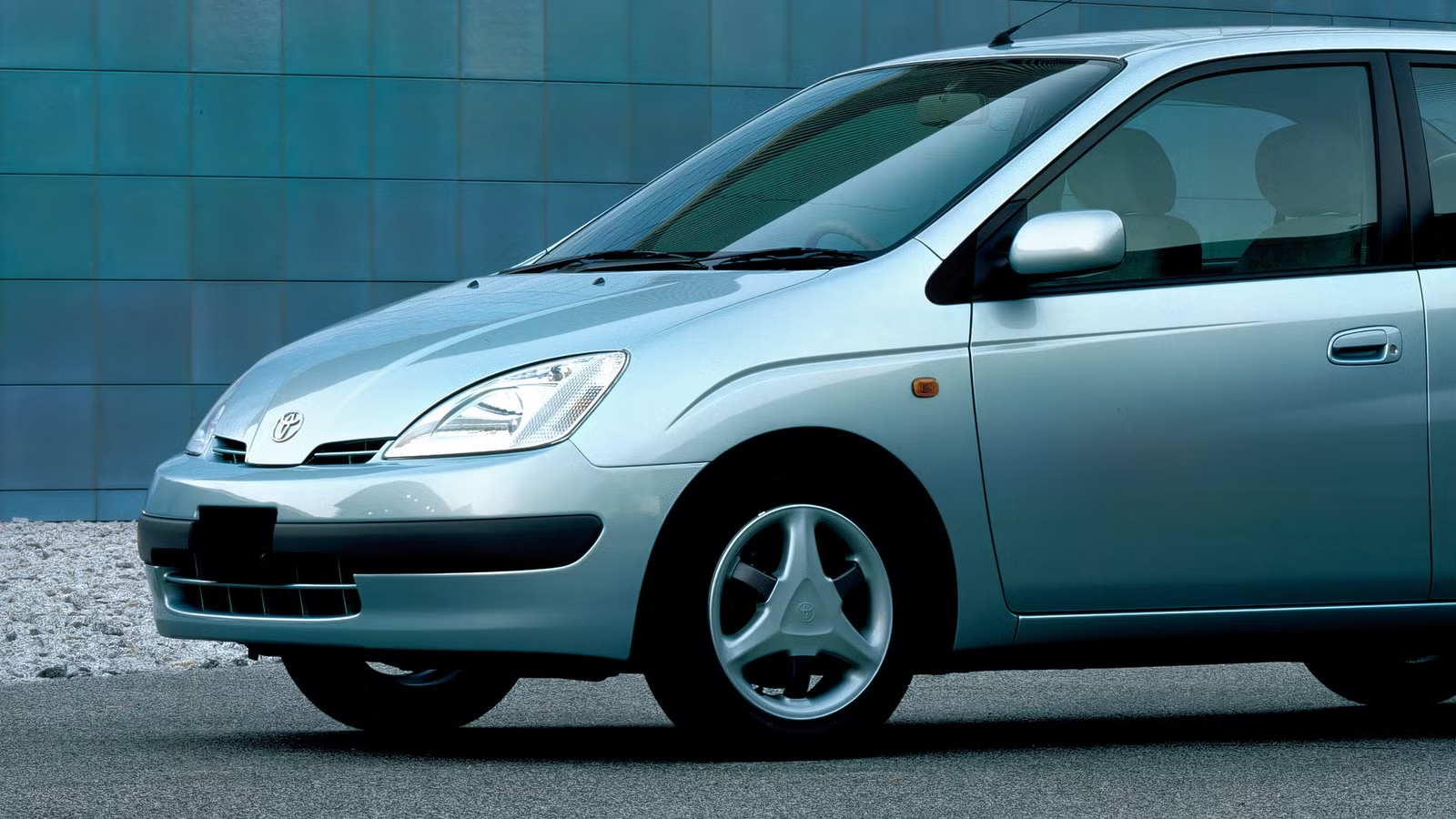
Toyota’s original Prius had a steep uphill slope ahead of it when it first took to the roads in 1997. It wasn’t a particularly impressive car to look at and had some unusual proportions, but its job was to show that motoring could be eminently sensible in an increasingly skeptical age. This original Prius became a bit of a punchline for auto enthusiasts, with one US example needing around 13 seconds to get to 60 mph. But Toyota was serious about its hybrid approach and the story of the Prius since then has been quite remarkable.
The 13-Second Prius Was Slow But It Wasn’t Simple
1997 Toyota Prius front nearside quarterToyota
Toyota introduced the Prius in Japan at the tail end of 1997, calling it the world’s first mass-produced gas-electric hybrid passenger car. It featured a 1.5-liter Atkinson-cycle inline-four rated at just 58 PS, or around 57 horsepower, which was less than the 70 hp commonly linked to the first-generation Prius outside Japan. Toyota then launched the updated car in the UK in 2000 and in the US for the 2001 model year. The gas engine itself now produced 70 hp, with the electric motor contributing 44 hp.
It wasn’t possible to combine those two outputs easily because the two power sources reached their peaks under different operating conditions, so Toyota called it a combined 97-hp system output.
The big story for the Prius was, of course, its fuel economy. Toyota now cites a combined EPA rating of 41 MPG for the original US version, which was exceptional for the era and introduced the market to what mainstream hybrid capability could deliver.
The car’s acceleration and road manners offered little in the way of excitement, but the Prius was still technically ambitious. It had a planetary power split device that allowed the gas engine, traction motor, and generator to work together without needing a conventional stepped transmission. The car was able to recover energy under braking as well, turn off its engine when not needed, and vary the contribution of each power source according to load.
But Toyota was just getting started — and what it accomplished in the next 25 years would turn that 13-second embarrassment into a genuine performance benchmark.
Toyota More Than Doubled The Prius Output Without Sacrificing The Spreadsheet
2026 Toyota Prius Plug-In NightshadeToyota
Fast-forward to 2026 and the new Prius Plug-In Hybrid SE generates 220 net combined horsepower, which is 123 hp more than the combined 97-hp system cited for the early US Prius. According to those figures, that’s an increase of approximately 127% or 2.27 times the original system output. And those tepid acceleration figures have also improved dramatically. Today the Prius can get to 60 mph in 6.6 seconds, which is no less than 6.4 seconds faster than the 2001 car.
Crucially, Toyota never turned its back on the car’s original purpose in achieving those performance landmarks. The 2026 SE is rated at 52 MPG combined versus 41 MPG combined for the first-generation US model. And this is despite the new car having stronger acceleration, additional equipment, greater output, and more plug-in hardware.
The SE can cover a manufacturer’s estimated 44 miles on electricity alone through its 13.6-kWh lithium-ion battery. However, as some higher trims sacrifice efficiency, the SE’s range and economy figures do not describe every Prius plug-in hybrid configuration.
The Real Breakthrough Is In How The Engine And Motors Divide The Work
Toyota Hybrid System Diagram with AnnotationsToyota
Much of the capability of the modern Prius is, of course, down to significant technological improvements over the years. And this means that today’s Prius is a far more capable version of the original car. For example, Toyota now has a different interpretation of the power-sharing philosophy introduced by the original car. Today’s 2.0-liter Atkinson-cycle inline-four now produces 150 hp and the primary electric drive motor is rated at 161 hp. Again, those figures can’t simply be added together, but Toyota does give the vehicle an official 220 hp net system rating.
The electric motor also delivers immediate torque, handling the region where an efficiency-focused, naturally aspirated engine would be least responsive. The gasoline engine then kicks in to contribute more of the sustained output. There’s a second motor generator to start the engine, produce electricity, and help manage the link between engine speed and road speed via Toyota’s electronically controlled CVT.
The Prius also features regenerative braking to reverse the traction motor’s role during deceleration. This pushes part of the car’s kinetic energy back into electrical energy. The vehicle’s overall packaging is better too, and Toyota now puts the battery under the rear seat rather than beneath the cargo floor. This helps to lower the center of gravity but preserve a more useful luggage area.
The Prius Is Now Quicker Than Some Of The Hot Hatches That Mocked It
2025 Toyota RAV4 Plug-in Hybrid Front 3/4 angle in redToyota
When the original Prius was finding its footing, some of the best hot hatches of the era were making headlines. A 2000 Volkswagen GTI GLS 1.8T could get to 60 mph in 7.3 seconds, while a 1999 Honda Civic Si could get to the same target in 7.1 seconds. Against such heady competition, the original Prius was nowhere to be seen, emphasizing a very stark difference in performance. Yet the 2026 Prius Plug-in Hybrid can now get to 60 mph roughly half a second sooner than those turn-of-the-century hot hatches.
Of course, the Prius is not a substitute for cars like that in any way, and acceleration is still only one element of performance. The modern Prius plug-in may be entertaining and relatively quick, but it’s certainly not a dedicated sport compact. But that comparison does reveal what was happening around the turn of the century. Manufacturers were treating early hybrids as though efficiency was inevitably linked to weak performance. But now, the current Prius shows that electric assistance can do away with some of that compromise in everyday road driving.
That same principle has spread far beyond the Prius. For example, Toyota’s 2026 RAV4 Plug-in Hybrid produces 324 combined hp, and it can get to 60 mph in 5.4 seconds. It also has an estimated 54 miles of electric range in its SE form. And at the extreme end of the market, the Chevrolet Corvette E-Ray has a gas-electric system that turns out 655 hp and rockets to 60 mph in as little as 2.5 seconds.
The Prius SE Is The Value Sweet Spot, But With A Caveat
2026 Toyota Prius PHEV rearToyota
Those looking to find out what a new Prius Plug-in Hybrid can deliver will find that the SE opens the conversation at $33,775 before destination, processing, and handling. And for many, the SE will arguably be the best entry point all round. After all, it costs less than the upper trims and can travel a little further on electricity alone. It also returns better gas fuel economy, and has smaller 17-inch wheels, which means that replacement tires should be less costly than the 19-inch tires further up the range.
Overall, ownership economics will depend heavily on charging habits. Someone who plugs in regularly and whose daily commute is relatively local may find that they can frequently operate within the 44-mile electric envelope and significantly reduce their gas usage. On the other hand, someone who rarely charges would carry the cost and weight penalties of a plug-in battery while the vehicle operates primarily in its 52-MPG charge-sustaining hybrid mode.
Buyers will also find that Toyota provides three years or 36,000 miles of basic warranty coverage, five years or 60,000 miles of powertrain coverage, and eight years or 100,000 miles for specified hybrid components. It then adds 10 years or 150,000 miles for the hybrid battery, and original owners can transfer the battery warranty to a subsequent owner, which is a consideration for future resale value.
No Car Is Bulletbroof, But The Prius Comes Close
Overall, the Prius nameplate has a strong longevity record, with one iSeeCars study suggesting that the Prius had a 12.2% chance of reaching 250,000 miles. But there are still some trouble spots to be aware of for the current generation. For example, Toyota had to recall approximately 141,000 examples of the Prius in the US earlier in 2026. This recall covered vehicles from the 2023 through 2026 model years and related to water intrusion that could cause an unlocked rear door to open while the vehicle was moving.
But while today’s Prius Plug-in Hybrid may not be completely bulletproof, it still represents a very strong value argument. It’s got useful electric range, can record a sub-seven-second sprint, has 50+ MPG gas operation, features a good battery warranty, and comes with a sensible price proposition. And it’s a very different animal compared to the first Prius, which asked drivers to tolerate weak acceleration so that they could get exceptional efficiency.
Now, the modern interpretation of the Prius has more than twice the system horsepower, cuts the tested 0–60 time by approximately 49%, and adds 44 miles of electric driving. It also improves the comparable US combined gas rating from 41 MPG up to 52 MPG. And all of this means that the 2026 Prius is not only rational, but it can also be quick. It also shows that the early idea of sacrificing performance for efficiency in the world of the hybrid was never going to be a permanent engineering requirement.
Sources: Toyota, iSeeCars.
