

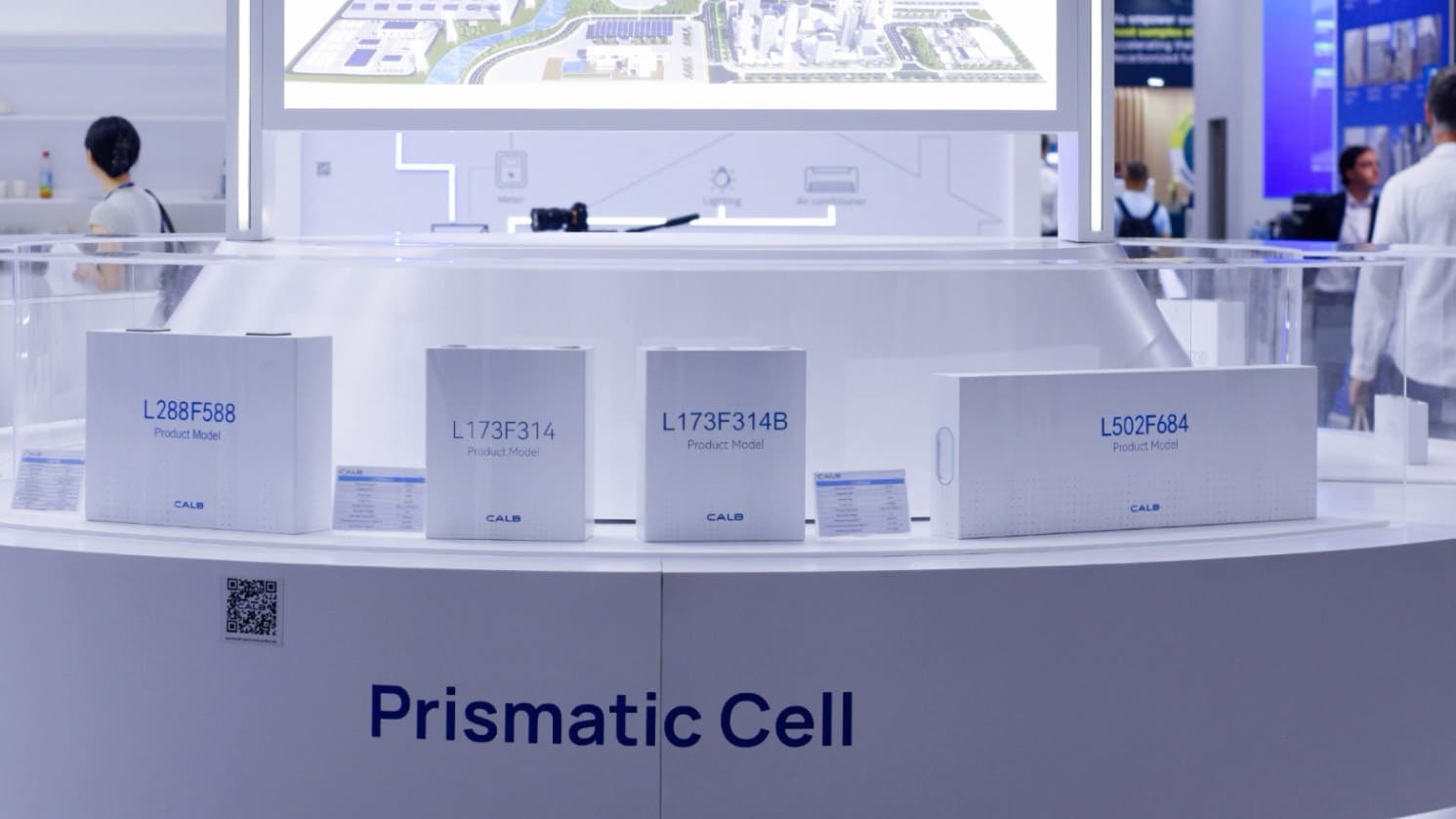
CALB’s battery cell products showcased at an energy storage event in June 2026. Credit: CALB
- China’s third-largest battery maker has tightened manufacturing tolerances and given its quality team veto power over batch releases.
- Battery problems affecting Aion S vehicles equipped with CALB cells have put it in the spotlight.
CALB (HKEX: 3931) is carrying out an internal technology overhaul centered on quality and safety after its battery cells experienced widespread swelling in GAC Aion vehicles.
China’s third-largest power battery maker has made substantive changes to process traceability, validation systems, its organizational structure and customer relations mechanisms, according to a report Thursday by local media outlet Auto Time.
On the manufacturing side, CALB has tightened its tolerance standards. Thickness measurement and areal-density controls in the electrode coating process are being brought “in line with CATL’s (HKEX: 3750) specifications,” the report cited people familiar with the matter as saying.
Previously, the areal-density deviation for lithium iron phosphate (LFP) cathodes at CALB was within the industry-standard range of 2.3 to 2.5 g/cm³. Following the overhaul, the deviation is required to be kept within ±1.5%.
Online monitoring of dew points and moisture levels during electrolyte filling has also been upgraded. Traceability of retained batch samples has been refined from a daily basis to individual rolls.
CALB is also conducting a retrospective audit of incoming materials, auxiliary materials and additive formulations used on its production lines in 2022 and 2023, while discontinuing some formulations with low safety margins.
The company has rewritten design standards covering cell casings, explosion-proof valves and welding margins for terminal posts to improve durability and safety redundancy.
CALB has also established a rapid-response customer quality team under its passenger vehicle division and is jointly monitoring battery management system (BMS) data with major customers.
More importantly, the quality department has been given veto power over batch releases, according to the report. Previously, second-tier battery manufacturers commonly used workarounds to approve batches in order to meet automakers’ urgent capacity requirements.
“As long as a batch fails to meet the quality department’s review standards, even research and development teams rushing to meet project deadlines cannot bypass the approval process,” a person familiar with the matter was quoted as saying.
The controversy began in July. A large number of Aion S vehicles equipped with CALB’s 177-Ah LFP cells experienced problems after traveling between 150,000 and 300,000 kilometers, including cell swelling, electrolyte leakage and sudden power loss while driving.
The incident became known as the “banana battery” controversy because the swollen cells bent into a shape resembling a banana.
Models equipped with the cells recorded sales of 220,900 units in 2023, with 72% going to the ride-hailing and taxi markets, the Auto Time report noted.
On July 18, GAC Aion announced that it would extend the battery warranty for affected models to 8 years or 300,000 kilometers and provide free inspections and replacements. CALB opened a direct maintenance channel and pledged to assume ultimate responsibility for cell quality.
In the near term, after-sales compensation, upgrades to production standards and process restructuring will all increase costs and put pressure on profits.
CALB’s first-quarter revenue rose 71.2% year-on-year to 11.8 billion yuan ($1.74 billion). Its domestic battery installations totaled 7.31 GWh during the period, giving it a market share of 5.86%.
The company installed 5.2 GWh of batteries in China in June, accounting for a 6.82% market share and ranking behind only CATL and BYD (HKEX: 1211), according to data from the China Automotive Battery Innovation Alliance (CABIA).
Share of top EV battery makers in China (June 2026)
Share of Top EV Battery Makers in China (June 2026)
Company
Installations (GWh)
Market share (%)
Share vs prev month
CATL
32.59
42.70%
-3.43
BYD
14.11
18.49%
+1.92
CALB
5.20
6.82%
+0.82
Gotion High-tech
4.96
6.49%
+0.30
Eve Energy
4.45
5.84%
+1.33
Rept Battero Energy
2.71
3.55%
-0.12
Sunwoda
2.12
2.78%
-0.30
Zenergy
2.07
2.72%
-0.49
Energee
1.85
2.42%
-0.11
Svolt Energy
1.54
2.02%
+0.21
LG Energy Solution
1.46
1.91%
-0.23
Yinpai Battery
0.93
1.22%
+0.08
Cornex
0.82
1.08%
+0.24
Sany Hongxiang
0.32
0.42%
-0.18
CNET
0.25
0.32%
+0.01
Aion S vehicles equipped with CALB’s 177-Ah LFP battery cells have seen a surge of complaints over swelling, leakage, and other faults.
($1 = 6.7895 yuan)
