

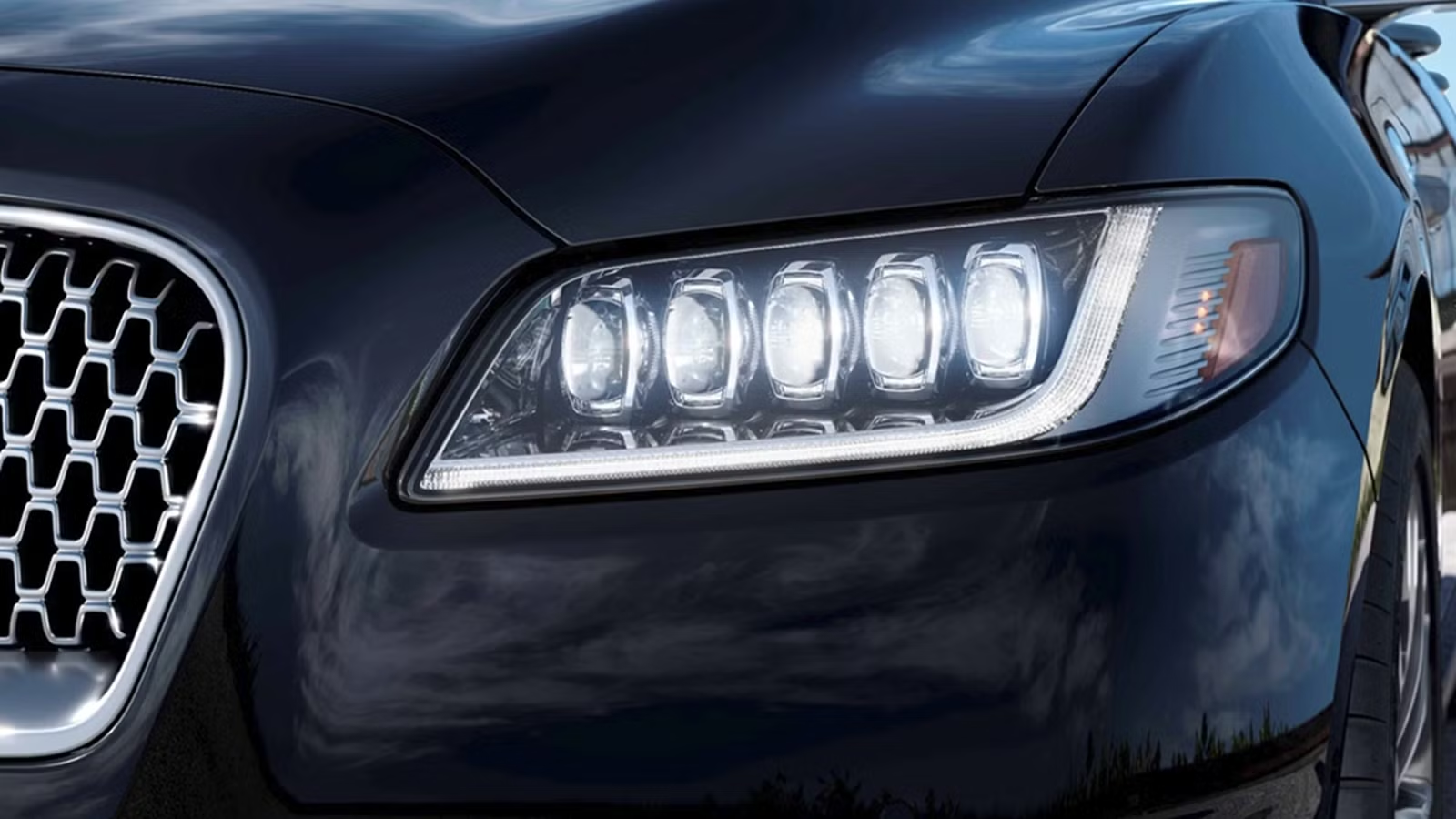
The subtle shift to alphanumeric naming structures among the automakers closed the door on one of the most romantic elements of new cars. When the sheet comes off a new car, and the badge reads more like your Gmail password than the soul-stirring name, the one factory that conjures emotion around a car fails to do its job.
Lincoln began to backpedal on its tri-letter naming scheme in the late 2010s, starting with one of its most iconic names. By now, you’ve forgotten all about the last Continental, and so did everyone else, which means it can now be picked up for less than a used Toyota Highlander.
Continental Prices Have Hit Rock-Bottom
Black 2020 Lincoln Continental top angleLincoln
Faring only slightly better than the smaller MKZ it shared the showroom with, the Continental has not been treated nicely by time. Depreciation and public opinion might cast dark clouds over perceptions of Lincoln’s last large sedan, but the situation didn’t change the facts. For 2017, Lincoln gave its latest incarnation of the Continental nameplate equal parts luxury and power, making it one of the few cars of its era to follow the blueprints of the old guard. It was modern enough without being overkill, classically styled without missing the mark of Lincoln’s design language.
The average used price, which currently floats around $19,000-23,000, is far lower than the near-$70,000 sticker price some of them had when new in 2017. For the same price as a used Toyota Highlander from the same year, the last luxury sedan produced by Lincoln is a tempting option if you have a long list of priorities severely out of order. The Continental cost twice as much as Toyota’s family SUV when it was new, and now they’re both a steal at around $20,000.
Of the Continentals available for the money, the one that gets us most excited has a big secret under the hood. Top-of-the-line models came packing a 3.0-liter twin-turbo V6, making it the only sedan to receive this engine. In fact, every engine on offer for the Continental couldn’t be had in any other four-door from the brand. The car paid some homage to Lincoln’s behemoth vehicles from the 1930s and ’40s, which used V12 engines, or even the long, sleek Continentals from the ’60s, which spring to mind with V8s displacing 7.0 liters or more.
The Continental’s Days Were Numbered From The Start
Even with its multi-way massaging seats and 5.0-second sprint to 60 miles per hour, not to mention Lincoln’s failure to curb its aging ownership base like Cadillac started to do in the mid-2000s, the Continental’s reincarnation was destined to fail from the start. By late 2016, when the Continental arrived at dealerships, the brand’s sedan sales were already sliding. The MKZ achieved its second-best sales year in 2014, with 34,009 units, then slipped to 30,901 in 2015 and 30,534 in 2016. By 2017, sales were down by 3,000 units, and by 2018, they were down by 8,000 units.
The Continental’s first full year of sales returned what would become its best: 12,012 units in 2017. That’s 2,000 units better than Cadillac fared with the CT6, and three times better than Lexus with the LS. All three of these sedans no longer exist, further proof of consumer preference for crossovers and SUVs, and brands’ unwillingness to continue supplying sedans to a shrinking customer base.
Sales of both the Cadillac Escalade and Lincoln Navigator were increasing even as their large sedans were dwindling in popularity, driving the decision to kill both sedans after the 2020 model year.
Contributing to the Continental’s quick decline was its price, which by 2020, crested $70,000. Lincoln was in the presence of giants. At 201.4 inches long, it was bigger than a 2020 Mercedes-Benz E-Class at 193.8 inches but smaller than a contemporary standard-wheelbase S-Class at 206.9 inches. There was criticism of the Continental’s FWD-based AWD system and its 400-horsepower V6 compared with these German stalwarts in the premium segment.
Despite Lincoln keeping luxury first on the list of requirements, ignoring any sporty pretensions others try to bake into their luxury sedans, the crowd it was trying to appease was either aging or already looking to switch to a crossover that better suited their needs.
A Model With High-Class Doors
2020 Lincoln Continental Coach DoorsBring A Trailer
To further differentiate the Continental against its competitors, Lincoln built 230 Coach Door Edition models from 2019-2020. They carried a price around $115,000 before any options. To build them, fully assembled Black Label Continentals went to Cabot Coach Builders in Haverhill, Massachusetts, where they received body modifications to incorporate the classic coach doors that defined the older Continentals from the 1960s.
Inside, the rear seat was retrimmed with fancier leather and an extended center console that hid folding tables and the controls to Ford’s Sync 3 infotainment system. A Mercedes S-Class might’ve been cheaper, but it didn’t let occupants make a grand entrance by opening a rear-hinged door.
Solving A Riddle: Which Continental To Buy
2018 to 2020 Lincoln Continental Coach Door Edition front closeupLincoln
If you’re looking at a 2017-2020 Continental, the 400-horsepower twin-turbo V6 isn’t your only option. A 3.7-liter naturally aspirated V6 came standard on the Premiere and Select trims, with the optional 2.7-liter twin-turbo V6 available on the Select trim and standard on the Reserve. The 3.0-liter twin-turbo engine was optional for the Reserve. If some of these turbocharged engines sound like they belong in something a little bigger, you’d be correct.
The 2.7-liter is still used in the Ford Bronco, Ranger, and F-150, with the 3.0-liter used in the Ford Explorer for the ST and Platinum grades, Bronco and Ranger Raptor, and Lincoln Aviator. Even the deceased Lincoln MKZ could be optioned with the 400-hp V6, which really shines a light on what Ford was letting its engineers do before its sedans were officially discontinued.
Continentals with the 3.0-liter engine are what we recommend most, given that 400 horsepower in a FWD-based AWD vehicle reads like the brochure of a homologated rally car rather than a luxury sedan built to inject verve back into an American luxury brand and compete with the best of Germany. Plus, at Highlander pricing, what’s not to enjoy about the prospect of owning what’s probably the last sedan to wear the Continental nameplate?
If that extended-wheelbase Continental speaks to you, just know that they hold their values exceptionally well compared with the Continentals we’re talking about today. Regular models with high miles and equally-long rap sheets of repairs can be picked up for under $10,000. Well-loved ones fetch $22,000-26,000 at the highest. A few Coach Door Editions popped up for sale, fetching prices that prove not all Continentals are destined for exorbitant depreciation. The last two up for auction went for $82,500 and $104,777 online.
A Badge With History
2019 Lincoln Continental Coach Door EditionLincoln
The Continental ushered in the brand’s new intent to get people back into Lincoln’s products by putting some personality back into the automaker. Before any preconceptions could be made about a new car, its name could speak volumes. The Continental badge carries enough history that you could assume without question what kind of car it would be, even if you mistook it for a Bentley of the same namesake. It would be a long, sleek, comfortable sedan, true to its purpose, to be the envy of the block. That’s what Lincoln’s intentions were, but its rediscovered intentions of building nothing but the best wouldn’t last forever. Sedans were on their way out, and there wasn’t anything Lincoln could do to stop it. But for a short while, it tried its hardest to delay its demise for a little while longer.
There’s nothing wrong with a car’s name sounding like a password. But it ought to sound like the password whispered between cracks in the wall to enter a speakeasy. That’s what makes a car cool, intriguing, and mysterious before you know what it looks like. Ford’s decision to rebrand the entire Lincoln model lineup began with the idea of returning the Continental to showrooms. Maybe it was to give engineers and designers one last go at building the best sedan before exiting the segment, or maybe it was to remind itself of the majesty its cars once floated down the road with. Either way, you can have one for $20,000 today, which is probably the best part.
Sources: Ford, Good Car Bad Car, GM Authority
